Full article about Envendos: Where the Ocreza Smells of Schist & Strawberries
Envendos (Mação, Santarém) hides scented rivers, 34 °C thermal baths and a sky-starred church paid for with poultry.
Hide article Read full article
The scent before the river
The Ocreza announces itself by smell long before it comes into view: wet schist and bruised strawberry-tree leaves. First sound-track is the dogs of Zimbreira arguing across garden gates; only afterwards does the church bell toll for the seven-o’clock mass, once the sacristan has finally surfaced. Envendos was never “perched” on the hillside – its houses were set down by people who noticed the valley floor is mercifully level and that a door facing east lets the rain slide past.
Contours the road forgets to mention
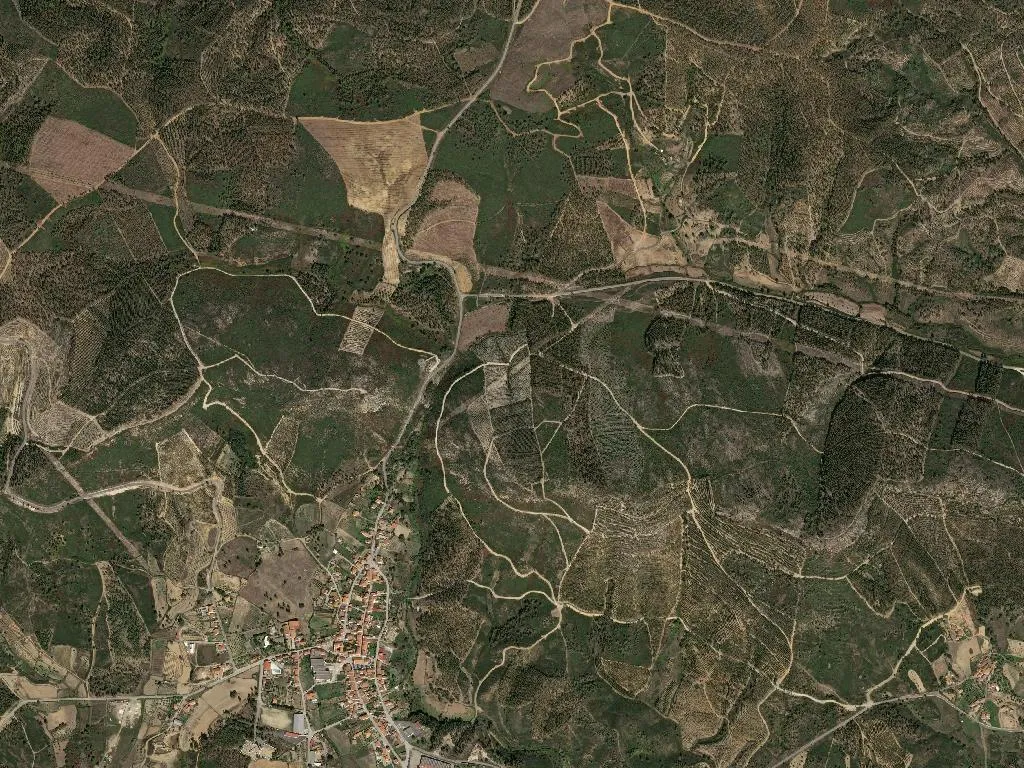
Officially the parish spreads across ninety square kilometres, but locals measure in contour lines: three uphill from the Ocreza to Alpalhão, then two down to Ladeira where the spring water runs warm and smells faintly of boiled egg. The so-called Roman bridge is actually thirteenth-century, built of local sandstone whose core still holds the cork-soled footprints of almond pickers. The M1103 slices the area in half; drive it and you see the same landscape twice – the glance downhill is always quicker than the climb back up.
A church whose painter was paid in poultry
Inside the mother church a sky-blue ceiling freckled with gold stars flakes gently onto the pews. Legend says the Sardoal painter accepted a hen and two alqueires of wheat – and died before the parish could find the cash. Outside, the Knights of Malta cross doubles as a truckers’ warning: gear down, the next bend hides a pothole that loves the right-rear tyre. The oak confession still smells of beeswax and mothballs; the priest only appears Tuesday to Sunday, so candles are lit by the faithful and snuffed by the slamming door.
Water that heals, water that hauls
The Ladeira thermal baths open Monday-Friday, 8-6. Entry €3, towel another €1. At 34 °C the water soothes Dona Alda’s rheumatism; she has kept her Monday appointment since 1987. The immersion tank is cement painted kingfisher-blue; the sulphide whiff is masked with a weekly slug of bleach. Those who resent the fee dunk a foot in the factory stand-pipe – same source, colder, perfect for rinsing a Land Rover. Downstream the Tejo slides over fine sand and flat slabs; gulls mug the rod-and-line fishermen from Carvoeiro for their swordfish. Two kilometres up, the Ocreza hides a swimming hole where teenagers still bomb from the rocks; the bottom is mud and someone’s handlebars glint beneath.
What the tongue knows before the brain
The olive oil is mostly Galega, with a splash of Cobrançosa in dry autumns. The co-operative mill stands next to the cemetery; when the grindstones start up, the grave candles flicker. Sunday lunch kid is roasted over vine prunings; anyone short of fuel helps themselves from Sr Aníbal’s stack, provided they later bring back a sack of chestnut husks for his stove. Blood sausage is scented with home-grown pennyroyal; the morcela is sweetened with Alpalhão onions, famous throughout Ribatejo. Flatbread is baked on the iron griddle great-grandmother stores inside the oven; when it rises, a cross is forked on top to stop the “little saint” from stealing it.
Eight hundred and four, minus a few
804 on the books, but the maths changes monthly: three left for France in January, two went to university in Lisbon and never reappeared, one funeral last Friday. Zé Manel’s tavern legally holds fifteen; overflow sits in the kitchen among the water heaters. When EDP cuts the power everyone migrates to the square – someone always has a generator that will charge a phone for a glass of aguardente. The school bus passes at 07.42 sharp; miss it and Beatriz’s mother shuttles the infants in a Renault 4L. Night is country-dark: the Milky Way throws shadows, dogs bark at constellations out of habit.
The sun slips behind the Ameixoeira ridge and the mercury drops five degrees in ten minutes. One by one the mercury street-lights blink awake, as if someone were walking the lanes with a dimmer switch. What lingers is the scent of cork-oak smoke, the clatter of the Ocreza shifting pebbles, and the taste of new oil on bread – bitter, then sweet, like the land that made it.