Full article about Alburitel: Dawn bread, dinosaur prints, olive silence
Where 1,060 villagers hand-pick olives before the Tejo bus leaves and 175-million-year-old footprint
Hide article Read full article
Dawn on Rua da Igreja
The granite setts still hold the night’s chill when the first footfall ricochets off the single-storey houses. At 07:30 sharp, Joaquim lifts the aluminium shutter of O Pão Quente and Alice pulls the lever on the espresso machine that has hissed since 1983. By 08:15 the Tejo interurban is already idling: seven passengers climb aboard—three carers bound for the Ourém care home, two teenagers who study in Escoural, a painter in white overalls, and the district nurse carrying her monthly blood-pressure kit.
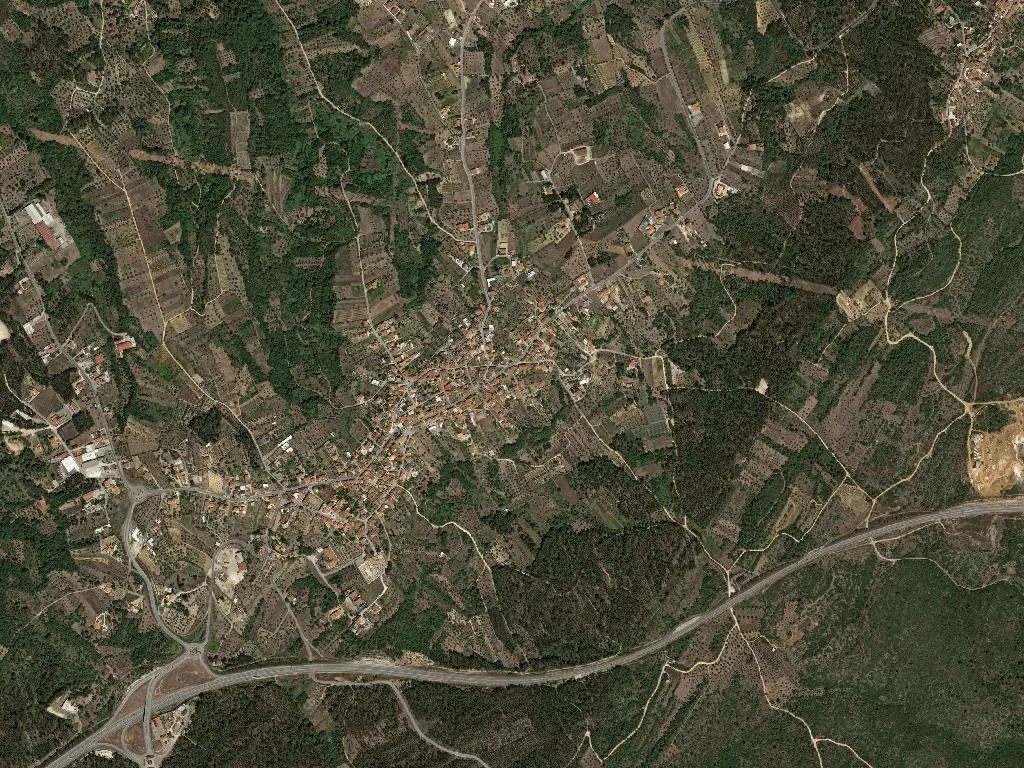
Alburitel spreads across 11.42 km² of schist and limestone where 1,060 souls refuse to surrender to the slow-motion exodus that hollowed out neighbouring Alqueidão and Caxarias. The 2021 census logged 343 residents over 65 and only 127 children under 14. Olive groves carpet 42 % of the farmland; centenarian trees still yield 180 tonnes of fruit a year, trucked to the co-operative press in Torres Novas. The oil is legitimately DOP Ribatejo, yet the €2.80 a kilo paid to growers in 2023 barely covers the cost of hand-harvesting the 800 ancient trunks that survive on the Serra’s fractured terraces.
When the Jurassic tide reached Ribatejo
Three kilometres south of the church, a rusting council sign points up a clay track to Cabeço da Pedra. After heavy rain the path is impassable—boot-sucking marl that can wrench an ankle. At the crest, 42 fossilised sauropod footprints lie trapped in a limestone slab the size of a city bus. Impressed 175 million years ago when this 246-metre ridge was a coastal mudflat, the depressions measure 1.10 m across and are now fenced off rather than interpreted; there is no visitor centre, no audio guide, only the wind and the creak of the gate installed after geologist Carlos Silva publicised the find in 1994.
In the pilgrims’ corridor
Since 2012 Alburitel has formed part of the Variante Nascente of the Caminho de Fátima, a detour marked by yellow arrows that steers walkers away from the N113. Around 800 pilgrims register each year—Spaniards in early spring, Poles in September. Beds are scarce: three legal places to sleep exist—Maria do Céu’s spare room (cable telly, bidet, €25), a former stable at Quinta do Pinheiro converted in 2019, and the parish hostel open only when Father António can rustle up volunteers. None serves supper; instead, guests are directed 6 km north to O Lagar in Casal dos Bernardos, where the cozido à portuguesa must be ordered a day ahead.
Monday evening frequencies
The municipal postbag arrives at 18:00: 60 copies of Público for commuters who work in Ourém, 13 Região de Leiria weeklies for farmers who still prefer print over phones. When the returning bus drops its passengers, Bar do Zé fills with the crackle of the football pools coupon. Wi-Fi is free but card machines are absent—“cash only, like the old days,” says Zé, a former cork-factory worker from Minde who bought the bar in 1997. Outside, the last generator of the picture-frame workshop shuts down at 20:00; Mr Albano’s dog rehearses its nightly argument with his son’s tractor; the breeze carries the ammoniac whiff of 450 sheep bedding down in the Vale. These are the sounds Alburitel keeps—not for visitors, but for the 1,060 who still call it home when the mobile signal collapses on the Serra bend.