Full article about Matas, Ourém: Dawn Footprints in Jurassic Stone
Walk limestone trails where sauropod prints, olive groves and pilgrim bells share Ribatejo silence.
Hide article Read full article
The path lifts just enough to let you feel the Ribatejo plateau tilt beneath your boots. One moment you’re walking on packed ochre earth, the next the ground flakes away to reveal its skeleton – pale grey limestone that glows against the winter grass. A low wind combs through the evergreen oaks; every so often a ewe’s bell tolls, the note travelling farther than seems reasonable. Dawn light slants across the track, printing long shadows that point the same direction as the pilgrims ahead of me: south-east, toward Fátima.
When the land remembers the Jurassic
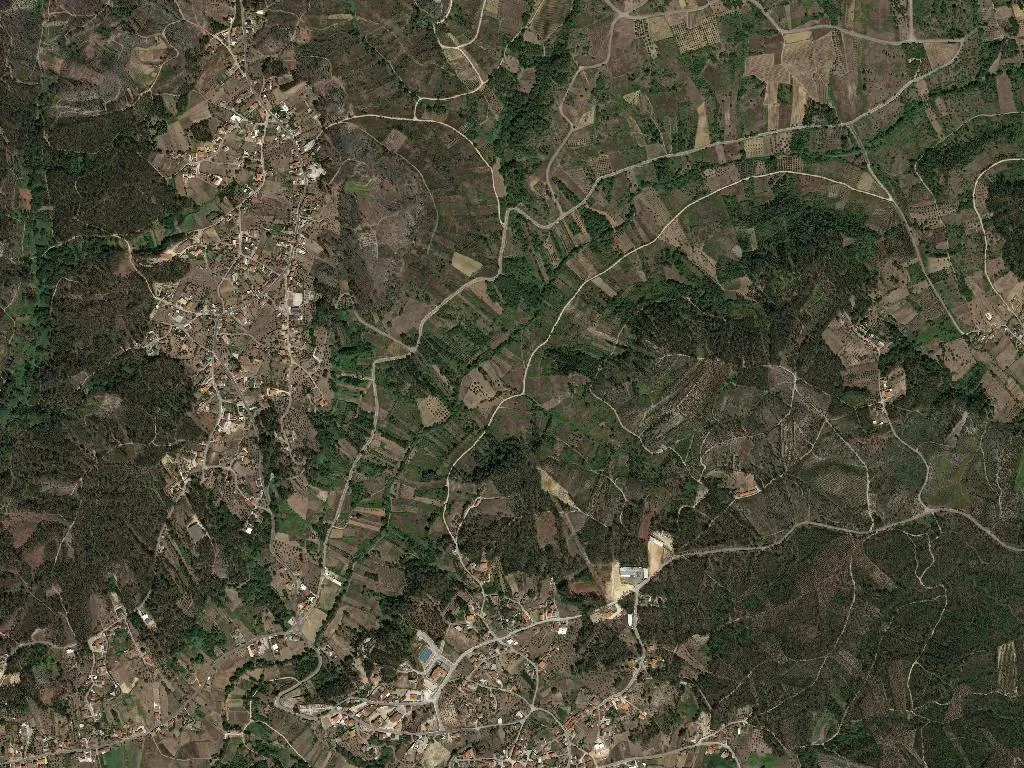
Matas covers barely five square miles of gentle swells at 150 m above sea level, its name a relic of Latin matta – thick scrub. Yet the parish’s real signature lies underfoot. At the far edge of the council limits, the Natural Monument of Ourém–Torres Novas preserves a bedding plane of 175-million-year-old coastal limestone. Sauropod feet punched into the tidal mud here, leaving three-toed prints the diameter of a dinner plate. The sun warms the grey rock all afternoon; by dusk the craters fill with violet shadow and look freshly made, as if the animals had just lumbered on towards the vanished Atlantic.
Footsteps of a different age
This is one of the quietest stretches of the Portuguese Camino. Way-markers stencilled with the yellow scallop guide walkers through stone-pine and holm-oak; the only other traffic is a tractor hauling olives to the cooperative press in Ourém. Two private guesthouses – Casa do Rio and Casal do Colégio – offer beds and set dinners, but no bars, no souvenir stalls, no downhill mountain-bike outfits. Just 809 souls live here, spread thinly enough that you can hear a cork-cutter’s adze half a mile off.
Oil and ember
The olive groves are not the postcard silver of Alentejo but scattered, wind-pruned thickets whose fruit earns the protected designation Azeites do Ribatejo. Between October and December the lagar exhales a sharp, almost peppery perfume that clings to hair and coat. In the parish hall kitchen, the communal oven is fired with pruned oak every Friday; by eleven the loaves are lifted out, crusts blistered, crumb breathing wood-smoke. Lamb stew follows the local rule: one hour in the pot for every kilo, a glass of red for the cook, another for the pot.
Walking through two timelines
Two short loops leave from the church square. PR2 “Pegadas de Dinossáurios” drops to the fossil slab, then climbs through cork-oak whose trunks glow chestnut where the bark was recently stripped. PR3 “Caminho do Colégio” skirts wheat terraces and a line of stone terraces built to coax water into a drying stream. There are no selfie-decks, no audio guides – only the slow give of limestone underfoot and, in February, the smell of damp moss rising like a held breath. The village ages quietly – 232 residents over 65, fewer than ninety children – yet the primary school, closed since 2012, still opens as a day centre, and on 16 July the church of Nossa Senhora do Carmo fills for the festa, candles flickering against the same Jurassic stone that once felt the weight of dinosaurs.
Evening comes quickly. The fossil prints pool with darkness; somewhere a hearth spits pine into the night air. Two time-lines converge in that moment – the Mesozoic pressed into rock, and the thin curl of smoke from a kitchen where tomorrow’s bread is already proving.