Full article about Alcobertas: Church-Built Neolithic Tomb & Silent Springs
Inside Rio Maior’s whitewashed village a 6,000-year-old grave sleeps beneath gilded altars
Hide article Read full article
Stone, Water and Silence
Morning light slips through the nave of Igreja de Santa Maria Madalena and lands on the oldest stone in the building – not the 17th-century masonry but granite hauled here six millennia ago. A Neolithic passage grave rises inside the Christian church, its capstone still intact, its corridor now a side chapel. The hush inside carries more than echoes: prehistoric burial rites, medieval plainsong, the tentative footfall of a visitor who has just realised that two incompatible calendars have been stitched together in a single room. Outside, the white limestone of the Serra dos Candeeiros bounces the unfiltered Ribatejo sun back into your eyes; the air smells of baked earth and hot rock.
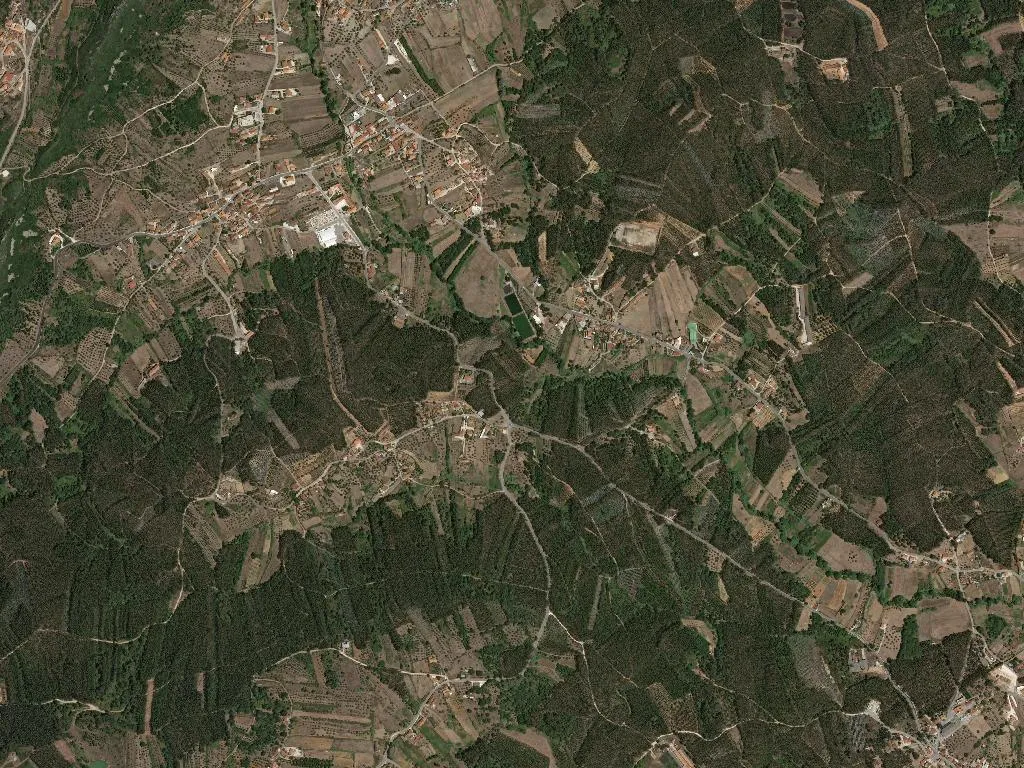
Alcobertas, a parish of Rio Maior municipality, sits where geology wrote the script. The Natural Park of Aire and Candeeiros massif is a karst plateau – invisible caves beneath your boots, springs that gush from fissures, a landscape that drinks every drop of rain then releases it in sudden, unexpected pulses. The Ribeira de Alcobertas begins at Olho d’Água, one of only five perennial springs in the Estremenho limestone massif, and the sound of water on stone follows you along the footpaths that weave between outcrops and low, thyme-scented scrub. With 1,735 people spread across 32 km², population density is barely 54 per km²; you feel it in the gaps between houses, in the way a distant tractor engine is the only rival to the wind.
Memory Carved in Stone
The Dolmen of Alcobertas is the largest megalithic monument in Iberia incorporated into a functioning church. Christian reuse of a prehistoric tomb is vanishingly rare; here it is brazenly visible – granite orthostats from the fourth millennium BC stand beside gilded baroque altarpieces. Walk in and you witness vertiginous time-lapse architecture.
A kilometre away, hand-hewn steps descend to the Potes Mouros, medieval grain silos cut into the bedrock – a survivalist’s larder from the years when scarcity was the regional default. The same limestone hosts basalt prisms, the cooled geometry of ancient volcanic fissures, and a 14th-century lime kiln whose brick crown still refuses to collapse.
Quarry, Spring, Trail
Alcobertas has long lived off its stone. Working quarries scar the ridge; firms such as RUIPEDRA turn raw blocks into building aggregate and kitchen worktops. Yet water is the subtler export. The Estremenho massif is Portugal’s largest freshwater aquifer; Olho d’Água is a year-round source that once slaked ox trains on the move from the interior to Lisbon. Beside it, the 18th-century Azenha de Alcobertas, a water-driven mill, still holds its wooden paddles – a monument to the marriage of liquid and labour.
From the spring, a signed 9 km loop climbs through dwarf palms and kermes oaks to Montanelas ridge. At the swing-bench lookout you can trace the curve of the Candeeiros escarpment, patchwork wheat plots and the chalky scar of inactive quarries. Griffon vultures ride the thermals; in April the air is laced with almond blossom and the resinous snap of Mediterranean pine.
Alcobertas is a way-station on the Caminho de Torres, a lesser-trodden variant of the pilgrimage to Santiago. Waymarks are scarce but the geography itself steers the walker: limestone pavement glowing at dusk, the sound of your own boots amplified in the silence, the knowledge that water, somewhere below, is still cutting new passages through the dark.