Full article about Marmeleira & Assentiz: Quince, Salt & Stone
Rio Maior’s quiet union of Templar stones, fruit orchards and pilgrim paths
Hide article Read full article
Stone walls and quince perfume
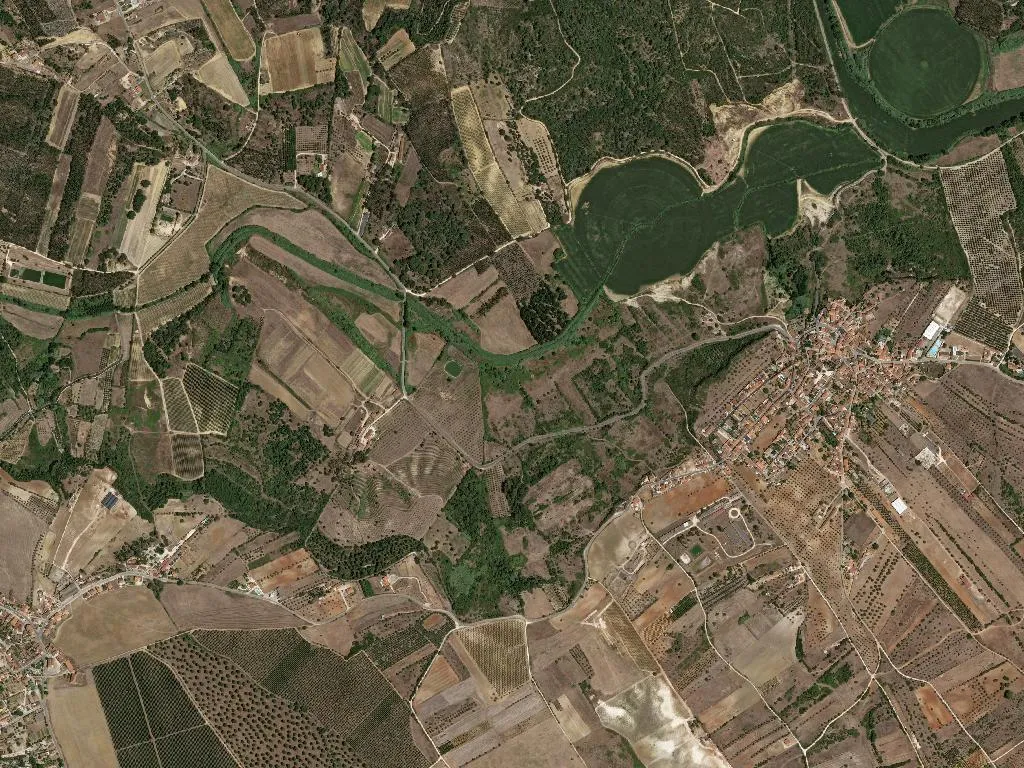
Morning light catches on granite walls that parcel out orchards of Rocha pear and Alcobaça apple. The air is thick with ripening fruit and the faint iodine tang drifting up from Rio Maior’s salt pans eight kilometres south. Beyond the olive terraces, the limestone ramparts of the Serra de Aire e Candeeiros rise like a fortress. All 1,415 hectares of this parish union are home to just 792 souls.
Marmalades and Templar marks
Marmeleira first appears in a 1338 charter as “Marmellar”, a nod to the quince trees still grown here. Assentiz keeps its Templar boundary stones, carved with the cross pattée. Step inside the Igreja de Assentiz for a late-afternoon dose of gilded baroque: the retable is a listed monument and the door is never locked. Marmeleira’s church is younger—rebuilt in 1926 after a lightning fire—yet the scorched slab of the original altar lies deliberately left in the nave floor, a quiet memorial.
Yellow arrows and ridge-top light
The Santiago pilgrim path (Via Torres variant) cuts straight through: 1,500 walkers a year, three hours from Assentiz to Rio Maior. Yellow arrows lead past farm gates where homeowners leave out jugs of water and windfall fruit. For solitude, take the 5 km Salgueiros trail that starts by Marmeleira’s cemetery and drops to the salt works; carry water—there is no shade. Drive to Vale do Peso, then walk 200 m for the ridge viewpoint at 222 m: orchards tessellate below, the serras shimmer beyond.
Salt-wine suppers
Tasquinha “O Cantinho” opens only at weekends in Assentiz; €8 buys whatever’s bubbling on the stove—often hare stew or salt-cod fritters—washed down with a bowl of Tejo red for a single euro. On the first Saturday of each month Marmeleira’s market hall fills with DOP pêra Rocha, Alcobaça apples and wheels of sheep’s cheese crusted with Rio Maior’s own flor de sal.
Picking days and winter fires
September and October bring apple and pear harvest. The Rio Maior farming co-op welcomes short-stay volunteers—turn up at 08:00 for a ladder and a crate. On the third Sunday of January Marmeleira stages the Festa de São Sebastião: mass at 10:30, then the medieval “stone soup” is served in the square—chorizo, beans and a fist-sized river rock for seasoning. Wear something woollen. Follow the stream path 500 m east of Assentiz to find the 1783 water-mill ruins; the date is still readable on the lintel.