Full article about São Sebastião: where pears blush and salt remembers Rome
Rio Maior’s tiny hill-village keeps orchards, vineyards and pilgrim springs in first-name rhythm
Hide article Read full article
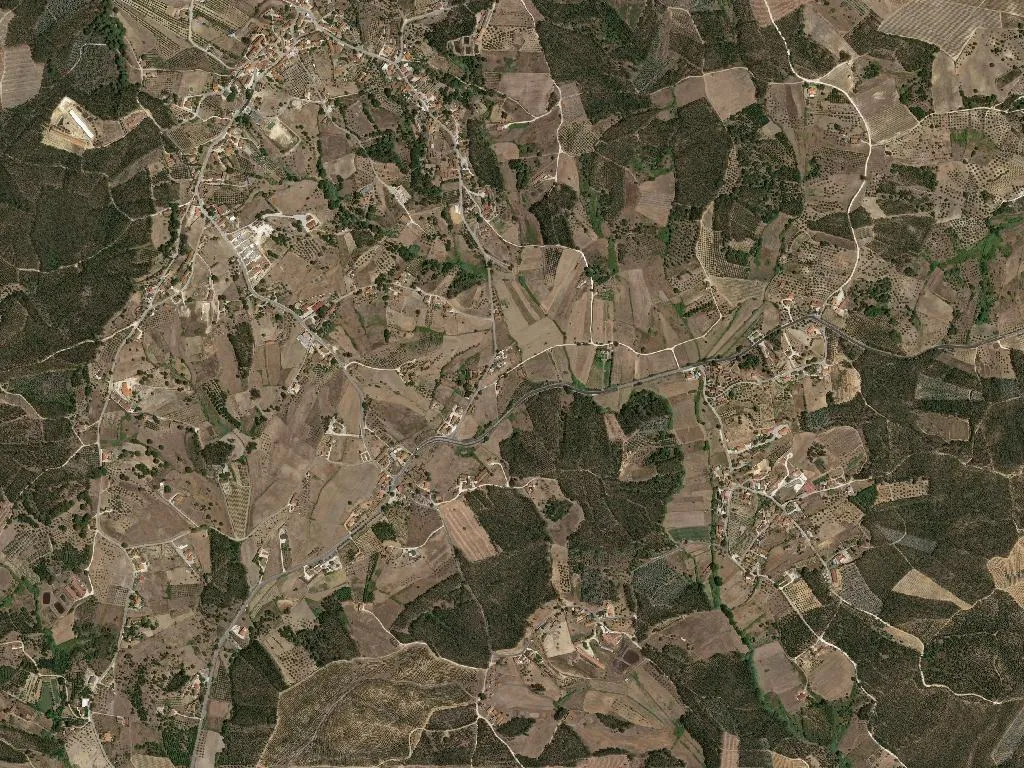
Morning light slips through the slats of wooden shutters, painting precise bars of gold across lime-washed plaster. In São Sebastião’s single thoroughfare the only soundtrack is the drag of a chair on café terrazzo and, far off, a tractor turning earth on the Ribatejo plain. Four hundred and sixty-two people live here, 86 m above sea level, and they still greet one another by first name; they can also tell you which olive tree marks whose boundary, where the road kinks after the third vine row, and when the first Rocha pear will be ready to pick.
The calendar is agricultural. Alcobaça apples blush in eastern orchards while Pêra Rocha DOP, protected by origin law, hangs late-summer fruit the colour of young straw. Both crops drink in the microclimate created by the limestone rampart of the Serras de Aire e Candeeiros Natural Park rising 12 km north.
Salt in the stone
Ten minutes away, the Roman-era saltpans of Rio Maior notch the hillside like a giant staircase. A subterranean spring, seven times saltier than seawater, floods the tanks; the resulting DOP sea salt – and its fragile surface bloom, flor de sal – is still raked by hand on windless days, tasting faintly of the dissolved stone through which it has percolated for millennia.
Between village and pans, clay soils and baking summers build reds that travel writers compare to mini-Alentejos: supple Castelão and peppery Touriga Nacional bottled in family cellars where the scent of new must drifts through rooms just beginning to need a log fire.
Stone, prayer and onward to Santiago
The Torres variant of the Portuguese Camino cuts through the parish on its way to Coimbra and, eventually, Santiago. Pilgrims find no souvenir stalls, only a tap by the 16th-century church that has never run dry, a bench beneath a mulberry, and perhaps a nod from a gardener tying up tomatoes. Bring an empty bottle; the water is cold even in August.
The quiet arithmetic
Of the 462 residents, 145 are over 65; fewer than 40 are under 14. Houses shutter, vegetable plots return to scrub, yet the café opens at seven regardless, the bell still tolls the hour, and Zé the barber wields his scissors twice a week for whoever arrives – usually the parish priest and the council chair.
As the sun tilts, façades ignite briefly, then cool. Wood-smoke drifts across irrigated fields, carrying the mineral breath of distant salt pans. Nothing dramatic happens – only the certainty that tomorrow the same light will strike the same walls, the pears will ripen another degree, and the village will continue its measured conversation with the seasons.