Full article about Bronze bells echo over Além da Ribeira’s pear orchards
Between Tomar’s Templar skyline and Pedreira’s quarried cliffs, irrigation ditches glint like silver
Hide article Read full article
The bells that measure the morning
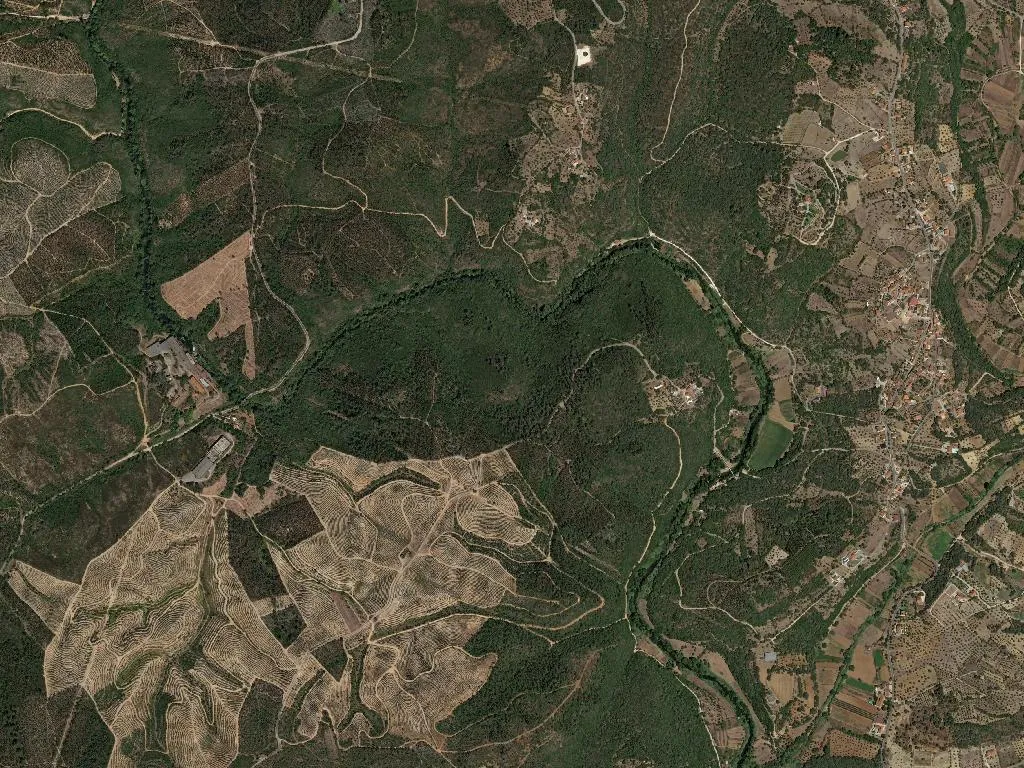
The single bronze bell of Além da Ribeira’s parish church strikes eight, and the note rolls downhill through olive terraces until it meets the Ribeira de Além. In August the stream is only a silver ribbon fingering between pale stones, yet its name still defines this side of the valley—literally “beyond the river” from Tomar, the Templar city that glimmers on the opposite ridge. Dawn smells of wet earth from the overnight irrigation, laced with the musky sweetness of Pêra Rocha do Oeste, the DOP pear whose fruit hangs in tight orchards and is left to ripen slowly under mosquito-netting sleeves.
Scars of stone, memories of water
Pedreira keeps its history in the open. The old quarries that gave the village its name are now sheer cliffs of limestone, their faces cleanly sliced by nineteenth-century hand saws. No din of iron on rock remains—only the occasional clink of a climber’s karabiner, since the shaded walls have become an unlikely sport-cragging spot listed on the UKC database. Between these two settlements—formally fused in the 2013 local-government reorganisation—narrow tarmac lanes corkscrew through smallholdings where every field is edged with loose-stacked stone. Population density is 44 people per km², and the spacing tells: a whitewashed house, 400 m of maize, another house, a cork oak, then nothing but horizon.
The commandery influence of the Knights of Christ seeps this far out. In Pedreira’s tiny church a Manueline window frame, carved with nautical ropes, has been re-set into an otherwise plain façade; inside, the rood screen is painted the exact ox-blood red used in the Convent of Christ’s famous chapterhouse window. Stand at the altar and you can just glimpse, through the open door, the matching scarlet of a telecom mast on the hill—six centuries of signalling condensed into one sightline.
Way-marked for walkers, made for lingering
Three separate pilgrimage routes cross the parish: the Central Portuguese Camino, the Interior Portuguese Way (sometimes marketed to Brits as the “Via Lusitana”), and the Fatima link path. Yellow arrows appear on lampposts, stone walls, even the occasional pear trunk. Most hikers march through without overnighting, pausing only to refill bottles at the granite font beside the 1570s Capela de São Sebastião. The gradient is forgiving—144 m above sea level—so the horizon keeps unfolding like a pop-up book: first Tomar’s castle, then the Serra de Aire, then nothing until Spain.
What the land tastes like
Order lamb stew at the only tasca open on Thursdays and you are eating hyper-local: animals that grazed the same meadows you walked that morning, potatoes from the floodplain, thyme from the verge, red Tejo wine pressed in an 1880 stone lagar still driven by a 1953 Lister engine. The soup—sopa da panela—arrives thick enough to hold a spoon upright, the traditional test of a farmwife’s seriousness. Dessert is a pastel de feijão, the Azorean pastry adopted by local nuns and flavoured now with almond must from the neighbouring grove. Olive oil is DOP Ribatejo, grassy and peppery; drizzle it over slices of rough bread and you understand why Tomar’s Saturday farmers’ market keeps a stall exclusively for parish produce.
Where to stay
Eleven legal lodgings are scattered across the 24 km², ranging from a three-room pilgrim hostel (donation box, compost loo) to a pair of architect-renovated schist cottages with plunge pools and star-gazing decks. None is more than 15 minutes from Tomar’s UNESCO convent, yet light pollution is low enough to catch the Perseids in August. Wake at first light and you will hear, before the bell rings again, the softer metallic click of secateurs: another morning’s pruning of the pear trees that keep this side of the river both rooted and alive.