Full article about Paialvo: Ribatejo’s Templar-Plotted Horizon
Wheat, olive drills and scallop-shell way-markers 86 m above sea, curated by 2,234 souls.
Hide article Read full article
The Road Through Paialvo
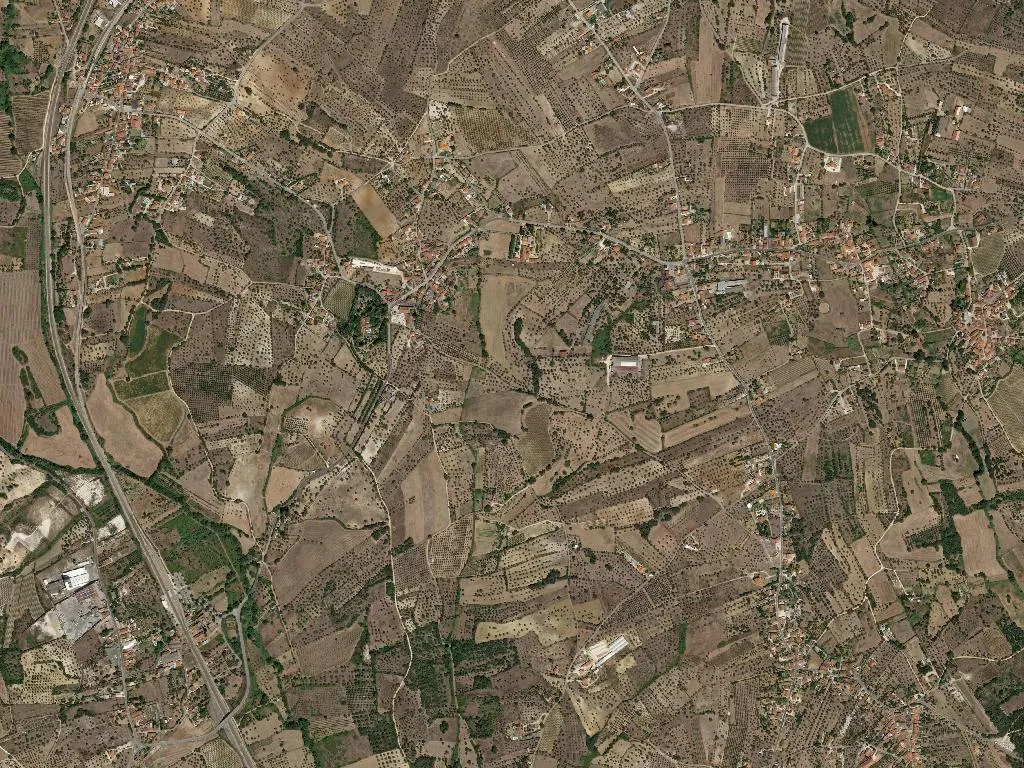
The EN3 runs ruler-straight, then dips and lifts like a loose tape measure across the Ribatejo. At kilometre-marker 86, just before the road climbs toward Tomar, a discreet white sign reads “Paialvo – 2 km”. Take the turn and the horizon widens into an optical illusion: wheat stubble, olive drills and the occasional whitewashed farmhouse appear to breathe in slow motion. You are only 86 m above sea level, yet the land feels aerial, the sky owning more of the view than the earth.
Written in Soil
Paper records begin in the thirteenth century, when the Order of Christ – successor to the Knights Templar – was tightening its grip from the castle keep at Tomar seven kilometres away. Paialvo never warranted a monastery or a fortress; instead the monks simply parcelled out the flood-plain, granting strips of alluvial loam to tenant farmers whose descendants still plough the same lines. Look closely and the cadastral DNA is visible: every smallholding aligns with a compass-straight “linha” first surveyed in 1294, and the parish boundary still follows the old Templar grazing limits marked by chestnut trees.
Population Ledger
2,234 residents occupy 22 km², giving a density of barely one hundred souls per square kilometre – half that of the Lake District. The age pyramid is lopsided: 227 children under fourteen, 773 over sixty-five. In the single café, the morning chorus of spoons against porcelain is interrupted only by the tractor timetable: first pass at 7.45 a.m., lunch-time return at 12.30 p.m., final rumble home before the 8 o’clock news. The village has not so much been abandoned as curated by those who stayed.
Crossroads for Pilgrims
Paialvo sits at the convergence of three Santiago routes: the Central Portuguese, the Interior (nicknamed the Via Lusitana) and the Fatima detour. Way-markers with the yellow scallop shell appear on telegraph poles just as the tar gives way to dirt. Five private houses along Rua da Igreja have been quietly converted into albergue-style accommodation – no signage, just a brass key safe and a handwritten note: “Ring for bed, bathroom second door on the left”. Most walkers push on to Tomar for the UNESCO-listed Convent of Christ, but the smart ones stop, because the municipal hostel here charges €5 and the baker still makes bread with leaven from 1953.
Tastes with Postcodes
The surrounding olive groves are inscribed within the Ribatejo DOP, a denomination created long before the phrase “extra virgin” became a supermarket cliché. The oil is loud – cut grass, green banana, a throat-catching pepper on the finish – and locals pour it over everything including breakfast toast. West-facing orchards supply the Pêra Rocha do Oste DOP; pears are picked hard in August, then wrapped in tissue and forgotten until Christmas, by which time the flesh has turned candied-butter. The Tejo wine region begins at the bridge over the Nabão; look for the co-op at neighbouring Almemé where a tank sample of Castelão will stain your teeth violet and taste of warm damson.
Where to Eat
O Pátio, halfway between the church and the cemetery, is the only full-service restaurant. Sunday lunch is kid goat (order by Thursday, €14 half portion). Mid-week there is whatever came off the land that morning – migas with wild asparagus, or a bowl of bean and chouriço stew thick enough to support a spoon upright. If the dining room is full, locals divert to Café do Santinho on the main square where €2 buys milky coffee and a toasted ham-and-cheese sandwich pressed until the edges caramelise.
Where to Sleep
Booking.com lists two self-catering houses: Quinta do Paialvo (pool, €80, dogs welcome) and Casa do Forno (€45, three kilometres out, no Wi-Fi, total silence). Pilgrues queue for the eight-bed municipal hostel open April–October; the key hangs on a nail inside the parish council office, opposite the war memorial. Bring your own sheet; the caretaker will lend you a towel that smells of sunflower ironing water.
Plains Time
Walk the grid of farm tracks at dusk and you will understand why the old poets equated the Ribatejo with solitude. There is no ridgeline to catch the sunset, so the light simply drains sideways, gilding stubble and olive trunk alike until everything becomes a uniform, molten hour. A single combine harvester blinks orange and disappears. Somewhere a dog rehearses the same three-note bark. The air smells of turned earth and cold metal, the scent carried intact for miles because nothing taller than a fig tree interrupts it. In that widening quiet you realise why the medieval name stuck: Pai Alvo – the Visible Father – is not a person but the horizon itself, keeping frank watch over anyone who crosses it.