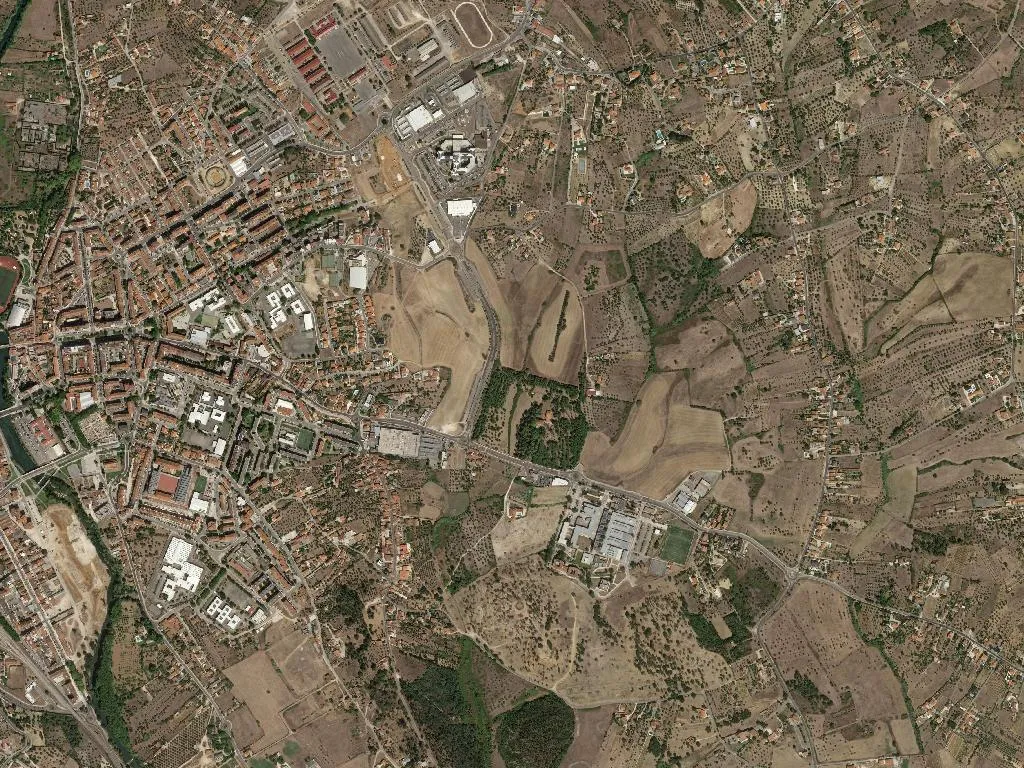
Full article about União das freguesias de Tomar (São João Baptista) e Santa Maria dos Olivais
Walk Tomar’s lantern-lit Charola, Europe’s only round Templar church, then trace Manueline ropes and river-wheels in the Nabão-shadowed old town.
Hide article Read full article
The Nabão slides beneath the Ponte Velha like liquid pewter, its current nudging the waterwheels of Mouchão into a drowsy creak. Dawn smells of wet slate and river-mud, cut by the candied breath of a bakery on Rua Direita that has been folding puff pastry since before first light. Plane trees on the island catch the low sun and flare the colour of burnished brass while, high on the hill, the Charola still waits in shadow. Tomar wakes from the water up: river, bridge, square, castle – an upward tide of stone set in motion by the flow below.
The city the Templars sketched
Romans were here first – a township called Sellium on the left bank – but the place was renamed, re-spelled and re-imagined in 1159 when the newly conquered territory was handed to the Knights Templar. Master Gualdim Pais drew a charter in 1162, drove a keep into the escarpment and wrapped it in the Convent of Christ, a fortress meant to overawe Muslims, Visigoths and any neighbouring count who doubted the Order’s reach. At its heart he built the Charola, a twelfth-century rotunda modelled on Jerusalem’s Holy Sepulchre and still the only intact circular Templar church in Europe. Step inside and you walk an octagon of stone where light arrives in blades, sketching trigonometries on the slab floor – geometry as theology.
Two centuries later, Manuel I stamped the complex with his own exuberant signature: the Chapter Window erupts in a petrified tangle of ropes, armillary spheres and seaweed-carved limestone, a piece of Manueline swagger designed for sailors who would soon be sailing to Brazil and beyond. Henry the Navigator ran the re-christened Order of Christ from Tomar; Magellan is thought to have ridden up the hill to settle dues before the voyage that would girdle the globe.
Twenty-six monuments in one parish
Thirty square kilometres contain twenty-six listed buildings, eleven of them National Monuments – a density that turns a weekend into an architectural sprint. The Convent dominates, yet the smaller stops anchor the story. In the parish church of Santa Maria dos Olivais, the first Templar masters lie under a plain Gothic vault; the silence inside feels weighted, as though the air itself has acquired mass. Round the corner, Portugal’s only intact medieval synagogue – four columns, pointed ribbing, the size of a London living-room – now houses the Luso-Hebrew Museum where every whisper ricochets.
Renaissance chapels line up like dominoes – Misericórdia (1567), Conceição (1571), São Lourenço, São Gregório – their portals scored with pilasters and spheres, their interiors smelling of beeswax and 200-year-old cedar. Between them run cobbled lanes just wider than a donkey cart, originally plotted to slow attackers and now slowing tourists who keep stopping to photograph doorways.
365 steps to sundown
Someone, somewhere, decided the staircase to the Capela da Senhora da Piedade should number one tread for every day of the year. Climb at dusk and the city shrinks beneath you: clay roofs buckle like a terracotta sea, the Nabão becomes a silver filament, and the castle keep glows pink in the last horizontal light. Halfway up, legs begin to protest; by the top, the wind off the Ribatejo plateau slaps the climb into perspective. Descend into Praça da República as the lamps flick on and the Manueline façade of São João Baptista blushes briefly – a stone changing colour the way a glass of Tempranillo shifts in candlelight.
From river to table
The Mouchão island, first engineered in the twelfth century to regulate mill-races, still spins two timber water-wheels. Walk the causeway at duck-level and you hear wooden cogs groan, poplars rustle like dry paper, mallards land with an undignified splash. A riverside footpath – the Pequena Rota – slips past vegetable plots where the city dissolves into allotments of kale and tomato, proving Tomar has never quite abandoned its kitchen garden.
That garden returns at dinner. Sopa da panela, a sturdy bread-and-cabbage broth, opens the meal; ensopado de borrego, lamb stew scented with mint and cumin, follows; bacalhau assado à lagareiro finishes the savoury set, olive-oil-slick and punched with garlic. Convent sweets steal the show: fatias de Tomar – no local ever calls them “fatos” – are mille-feuille sandwiches of yolk-rich egg jam; pastéis de Santa Iria echo the custard tarts of Lisbon but are baked in taller, crisper cylinders; pão de rala marries almond and squash in a slice that looks like mortadella and tastes like marzipan. Tejo whites (Fernão Pires, Arinto) and juicy reds (Castelão, Trincadeira) wash it down, while Ribatejo DOP olive oil and Rocha pear arrive with the bill as edible souvenirs.
Three long-distance footpaths converge here – the Central Portuguese Way, the Lusitanian Interior Route and the Fátima feeder – so every café on the square learns to interpret blistered feet. Order a meia de leite and a pastel de nata and you will share the counter with French pilgrims swapping Compeed tips.
Processions and pyromania
Holy Week turns the lanes into a slow-moving censer. The Senhor dos Passos procession inches past balconies hung with crimson damask; incense coils around wrought-iron lamps, mixing with the hot-wax smell of candles that have burned since dawn. On 24 June, São João Baptista’s eve, the town stages a secular after-party: grilled snails by the kilo, served from the Club 13 tavern in a sauce of oregano, garlic and enough piri-piri to make you grateful for the plastic cup of beer. October belongs to the medieval Feira de Santa Iria – 12 days of bookstalls, copper pans, shepherd’s whistles and second-hand tractors that occupy every square. Emigrants fly back from Paris or Zürich; by 11 p.m. the esplanadas are trilingual and someone is always trying to explain to a bewildered child why the bumper cars are called “autodromo”.
Night settles, the Nabão keeps turning its wheels, and across the current the floodlit Convent floats like a golden mirage – stone briefly turned back into liquid, flowing downhill to the river that first gave it reason.