Full article about União das freguesias de Olaia e Paço
In União das freguesias de Olaia e Paço, dawn fog lifts over sauropod prints, 1958 pear orchards and 27 °C olive oil
Hide article Read full article
The Sound Comes First
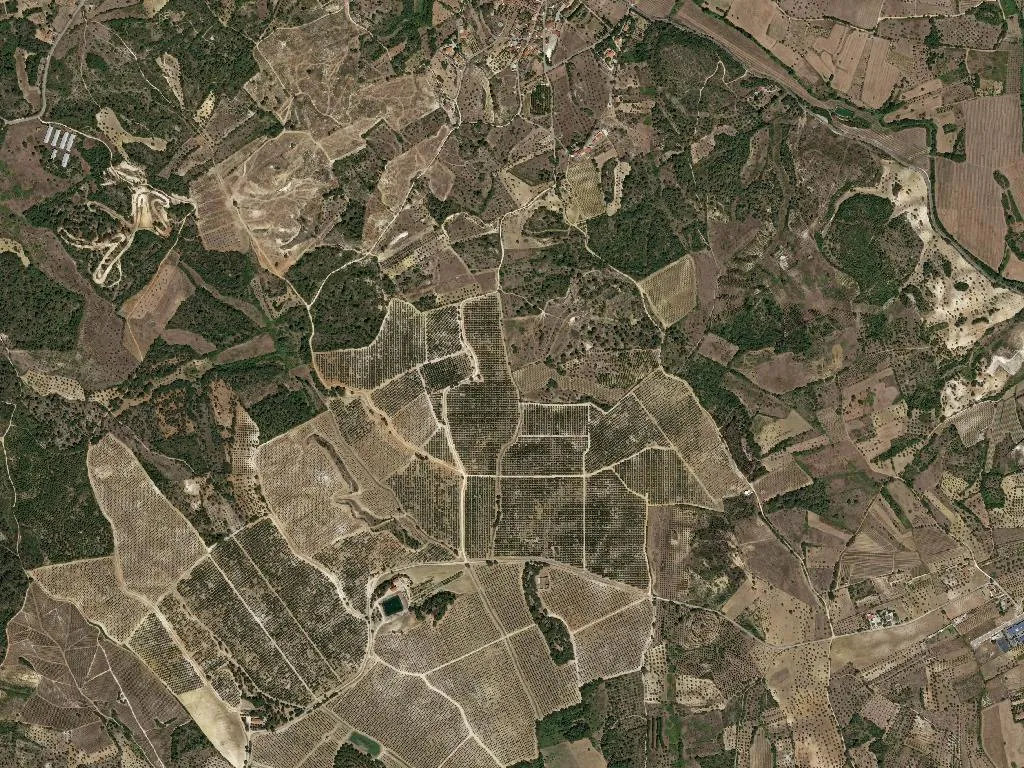
The day begins with a noise you cannot photograph: the iron yawn of Paço’s Quinta gate, still locked at 19:30 as it has been every evening since the Carnation Revolution. Rubber boots scuff the stone lip of the communal wash-tank; an irrigation channel—Poço do Bispo to the Netos orchard—mutters beneath pear leaves. Only then does the eye catch up. Between Olaia (92 m) and Paço (87 m) the Ribatejan landscape peels itself open in slow, grey-green layers: olive groves planted before Salazar was born alternate with blocks of ‘Rocha’ pear, the cultivar the National Agronomic Station introduced here in 1958 after importing the first certified grafts. At 07:15 the November fog splits along the Ribeiro de Alcoentre valley and the 1887 military survey by artillery captain Joaquim Filipe de Sousa suddenly makes sense—every contour line still pencilled on the land.
A Hundred-and-Fifty-Million-Year Memory
Forget the shuttered Avelino quarry; the real archive lies underfoot. The Serra de Aire’s Miocene limestone preserves sauropod footprints 108 cm long and 95 cm wide, found in 1994 by quarryman Carlos Silva while splitting blocks for Cimpor cement. The trackway sits 1.2 km north of the parish boundary—cross the yellow-blazed trail where the CM537 meets Cabeço do Peão road and you stand on Jurassic seafloor that once lapped against future Torres Novas. Barbed wire now rings the quarry face, but the timber viewing platform is open and free; vertigo comes standard.
Oil that Moves Like Mercury
Drive three kilometres to the Torres Novas farmers’ co-op and you can watch extra-virgin olive oil being born at 27 °C—António Bacalhau’s deliberate chill to satisfy the Ribatejo DOP rule for first extraction. Forty-five per cent of the parish’s growers deliver here: 20 kg crates of galega (60 %), cobrançosa (30 %), madural (10 %) are milled within four hours of harvest. During November the line runs 22 hours a day; the air tastes of crushed stone and wet grass. Pears arrive later. José Dias Simões planted the first ‘Rocha’ orchard at Ribeiro de Alcoentre in 1962; today 42 ha are registered with the agriculture board, yielding 35 t a year. Taste the oil in Olaia’s bakery (founded 1924) floating on tomato soup, or in Maria do Céu’s Saturday lamb at O Tarro in Paço: whole leg, three-and-a-half hours at 180 °C, half a litre of local oil and Quinta do Alqueve white wine.
Slow-Motion Pilgrims
Since 2017 the Via Lusitana—a sanctioned detour of the Camino de Santiago—crosses the parish in 5.8 km. Enter at Paço’s 1892 wayside cross (39°31'45"N 8°37'12"W), leave at Olaia where a yellow arrow points down a farm lane to the stream. The Torres Novas pilgrims’ hostel logs an average of fourteen walkers a day in May, none in January. Beds are scarce: Casa do Lavrador offers a double for €35 with breakfast; Casa da Avó Rosa has bunks from €15 and a communal kitchen, both in Olaia. The only architectural pause is the chapel of São Sebastião, rebuilt in 1932 after sparks from Sr. Albino’s hayloft rode a north wind on 20 January 1926 and razed the building.
Rural Life, Unfiltered
Census 2021: 2,071 souls spread over 28.3 km², down 214 since 2011. Density: 73 people per square kilometre. The last passenger train left Olaia halt at 06:42 on 4 October 1984; the rails are now a whispering grass runway. Six places to stay survive: three Airbnb villas, two rooms at Quinta do Pinheiro Manso, one hostel. The primary school closed in 2009 with twelve pupils and reopened as a day centre, Monday to Friday, 08:30-17:30. Central café (Sr. Carlos, 1958) pulls an espresso for €0.65 and still makes egg-butter on the premises. Reserve ahead for O Tarlo’s wood-oven kid goat (Saturdays) or take an empty bottle to O Cacito on Sunday for chanfana sauce. The Torres Novas–Alcanena ecotrail passes two kilometres south; average traffic on the approach road is forty-two vehicles a day. Birders head for the Conde cork-oak grove, three hectares planted in 1936 where a lesser kestrel has nested since 1998, monitored by SPEA.
Dusk arrives behind Cabeço do Visconde at 17:43 in December. The scent of wet clay and cork-wood smoke braids itself into the evening air. The gate at Quinta do Pinheiro Manso groans—same iron, same 1962 Serra da Estrela forge—and the sound stays with you long after any photograph has faded.