Full article about Pedrógão: Limestone, Fossils & Dawn Tractors
Walk Roman roads, baroque glow and olive terraces above Jurassic bedrock
Hide article Read full article
Morning sun warms the limestone walls while the scent of damp earth rises from newly irrigated fields. Pedrógão wakes reluctantly, in time with the olive groves that march in disciplined formation towards the creased horizon of the Ribatejo. At only 116 m above sea-level, the plain inhales and exhales to an agricultural rhythm first set centuries ago—tractors have ousted oxen, yet the hand that guides the plough still carries the same resolve.
Stone & Memory
The name is its own footnote: Pedrógão derives from the Latin petra, and the surrounding limestone confirms the etymology. But the archives run deeper than dry-stone walls. Fifteen kilometres away, on the edge of neighbouring Ourém, the Monumento Natural das Pegadas de Dinossáurios preserves the heel-and-toe impressions of Iguanodonts and Theropods that sauntered across a Jurassic shoreline 175 million years ago. The very rock propping up today’s olive terraces was once a shallow seabed; every shower washes another shard of fossilised shell onto the footpaths.
Pedrógão’s own time capsule stands in the centre: the parish church of São João Baptista, rebuilt after the 1755 earthquake with an unshowy 18th-century façade and a gilded baroque altarpiece that catches the late-afternoon sun like a sheet of fire. Opposite, the Manueline chapel of São Sebastião, dated 1536, marks the southern edge of the village. Between the two, farmhouses the colour of burnt cream and doors painted the same indigo as the morning sky map out a settlement that prefers endurance to display.
An Interior Way
Pilgrims on the Portuguese inland route to Santiago—the Via Lusitana—enter Pedrógão along the EN 3-7, once the royal road between Torres Novas and Ourém. Their boots clip the same cuboid granite setts that rattle under the 7 a.m. convoy of lime-green John Deeres heading for the fields. A still older artery, the Roman road that linked Sellium (Tomar) to Eburobrittium (Óbidos), has left a more persistent legacy: an understanding that this is territory to be crossed, not possessed. Farm tracks such as the Caminho da Fonte do Vale or the Quinta do Freixo invite walkers into galleries of pear and centenarian olive, the silence broken only by the wind turning the leaves silver side up.
Olive Oil, Pears & Limestone Soup
The local table is as direct as the landscape. Sopa da pedra—literally “stone soup”—is no fable: chorizo from Zé Manel’s counter, winter cabbage from Dona Amélia’s vegetable plot and butter beans simmer until the broth turns tawny. On Sundays, wood-fired ovens breathe lamb stew for three slow hours, scenting entire lanes. At breakfast, DOP Ribatejo olive oil, pressed at the Torres Novas cooperative, pools in the crumb of homemade bread from the village bakery; at dessert, Pêra Rocha pears from the Chibroso and Freixo orchards arrive with the calibrated sweetness that only the Atlantic breeze and limestone soils can engineer. Tejo IG reds—Trincadeira and Touriga Nacional—are poured without ceremony. Nothing is designed to impress; everything tastes precisely of what it is.
A Mosaic of Fields
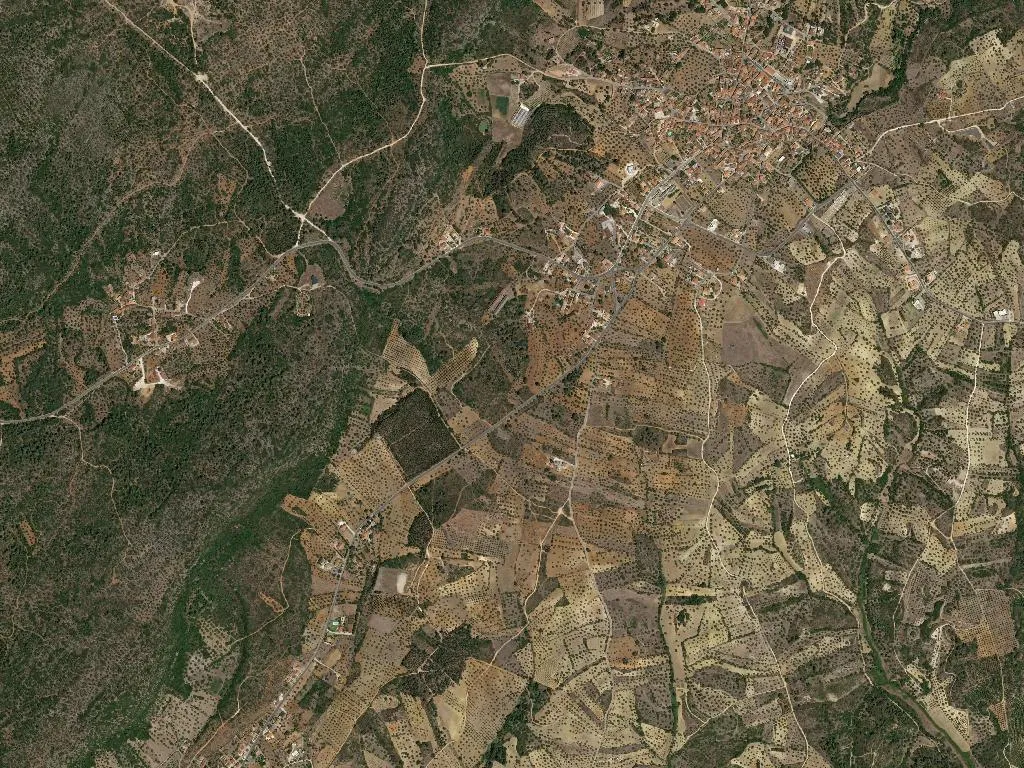
Pedrógão’s countryside is an exercise in rural geometry: 1.5-hectare plots on average, olive rows six metres apart, pear terraces stitched into schist ledges. The land tilts gently—100 m in the valley bottoms, 180 m on the ridges—creating shallow amphitheatres drained by ephemeral streams such as the Vale de Maceira and the Fonte do Vale. Cycle the Municipal Road 517 at dusk and you’ll catch the sun flattening across the corrugated earth, green crops throwing long ochre shadows. Biodiversity survives in the details: strawberry-tree hedges, dry-stone walls first laid after the 1758 Sequestro land reforms, pockets of rosemary and broom that the tractors politely skirt.
By 7.30 p.m. in high summer the air begins to smell of cork-oak firewood. It is not so much a retreat as a contractual pause—Pedrógão honouring the same stone-weighted rhythm that gave the place its name and, still, its form.