Full article about Dawn espresso in Torres Novas’ triple-parish plain
Walk floodplain, castle keep & 175-million-year dino prints in one morning
Hide article Read full article
Flat light on the Almonda floodplain
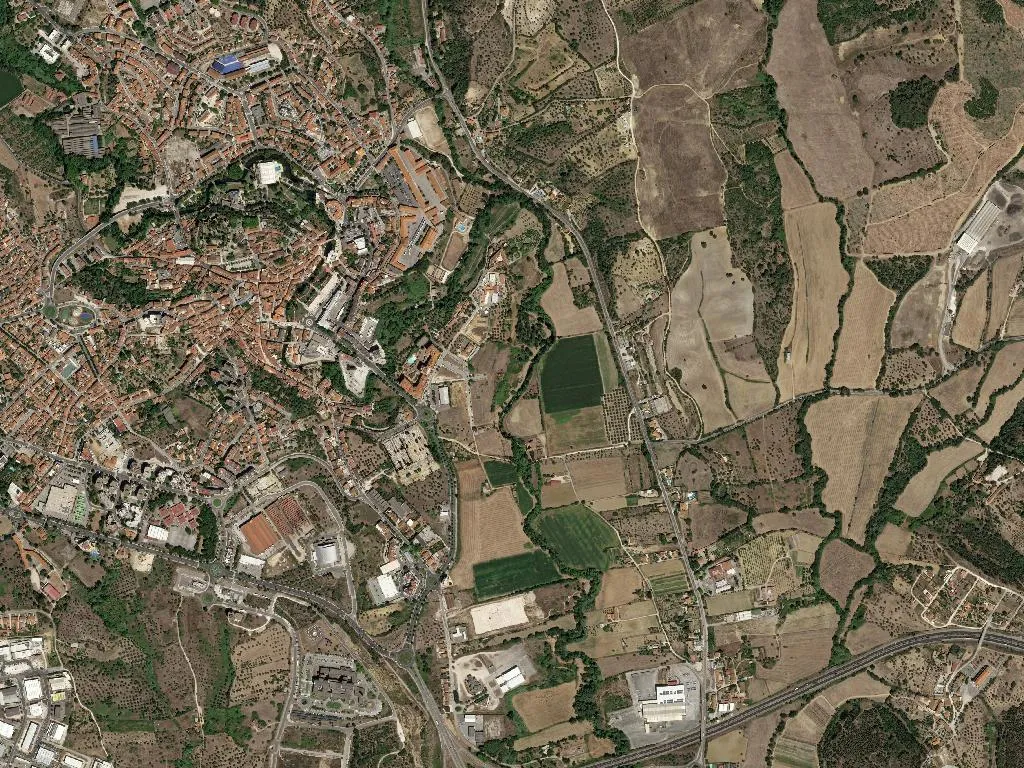
The first thing you register is the horizon. At barely 30 m above sea level, the Ribatejo opens like a parchment—no hills, no sudden cambers, just the river’s old floodplain stretching east until it dissolves into heat haze. Dawn arrives with a vegetal dampness that settles on cotton and skin; the air tastes of tomato leaf and distant irrigation. By 07:30 the metal shutters of the pastry shops ratchet upwards, releasing plumes of espresso into the street. You are standing in the civic heart of Torres Novas, a municipality that in 2013 welded three medieval parishes—Santa Maria, Salvador, Santiago—into a single administrative slab. The merger shows on paper; in conversation it barely registers. Locals still say “I’m going down to Santiago side” with the certainty of compass points.
Three names, one pavement
Eight thousand people share 38 km²—low-density by European standards, yet high enough that you’ll meet the same neighbour twice in one afternoon. Two thousand are over sixty-five, and they set the cadence: garden benches fill before nine, conversations stretch like wool, and the mid-afternoon hush has real mass, broken only by pigeons shifting under the eaves of Santiago church. The toponym “Torres Novas” is a memory of vanished watchtowers—eleven of them, if the castle’s shield-shaped curtain wall is taken literally. Four monuments carry protected status, including the keep itself, classified National Monument in 1910. At golden hour the stone glows the colour of burnt honey against the dark lettuce of backyard allotments that still survive inside the old perimeter.
Footprints older than stone
History here is measured in geological time. Three kilometres north, the protected Pegadas de Dinossáurios site unfurls across a limestone slab the size of a cricket pitch. The three-toed depressions—175 million years old—are so sharp you expect the animal to still be breathing round the corner. The same wind that dried the tracks in the Middle Jurassic lifts laundry from the line in the neighbouring hamlet; only chronology has changed.
Low vines, thick oil
Below the floodplain, the Tejo wine region runs its low-trained vines in parallel ranks. Harvest scent drifts over the lezíria: crushed berry, dust, diesel from the cooperative where smallholders still deliver grapes as their grandfathers did. Medieval tithe records already list vineyards here; identity and alcohol have grown together ever since. In winter the script switches to olive. Ribatejo DOP oil—green-gold, throat-catching—comes from groves that quilt the surrounding slopes, while the granulated sweetness of Pêra Rocha do Oste DOP appears in October market stalls, proof that the Atlantic’s influence reaches this far inland.
A pilgrim’s pause on the Interior Way
The Portuguese inland route to Santiago de Compostela cuts through town on its way to Tomar. Torres Novas supplies what the guidebooks call “infrastructure” and walkers call mercy: eight modest guesthouses, hot water, supermarkets that open on Sunday. You recognise pilgrims by their deliberate limp, scallop shell swinging, the way they study phone maps over espresso as though maths could shrink the remaining 540 km. For them the parish is an interlude—somewhere to feel pulse return to swollen feet.
The measured weight of a small city
Torres Novas has no metropolitan ambition. Its scale is deliberate: urban enough for a cinema and a covered market, compact enough to cross on foot in 45 minutes. The 1,100 children enrolled in local schools guarantee life after 3 p.m.—the thud of footballs, the squeak of trainers on municipal astroturf. Yet the elderly remain the town’s metronome. They decide when bread is deemed fresh (12:15, when the bakery bell rings), how fast one should cross Praça 5 de Outubro (measured shuffle), and whether a stranger deserves directions (spoiler: always, delivered with unhurried precision).
Evening arrives without ceremony. Low-rise apartment blocks switch on their kitchen lights one rectangle at a time; the Almonda keeps talking to itself among reeds and willow scrub. What lingers is not a postcard vista but something subtler: the damped echo of your own footsteps on calcada, the smell of watered earth rising like memory, and the sense that life here is counted not in events but in the quiet interval between them.