Full article about Dawn coffee & Jurassic prints in Torres Novas
Watch sauropod tracks glow at sunrise, then sip espresso under 1950s vitrolite in São Pedro square
Hide article Read full article
Torres Novas: dinosaur footprints at dawn, Tejo light on the vines
The first thing you register is the flatness. At barely 77 m above sea-level the Ribatejo plateau unrolls like a pale-green tablecloth all the way to the Tagus, the morning sun skimming across it so low that shadows of the village washing lines stretch halfway across São Pedro’s main square. By eight o’clock the coffee counters have already folded up their shutters, the espresso machine exhales, and the 8 020 residents get on with the day without bothering to advertise the fact. Density here is 365 people per km² – enough to keep the streets animated, the chemist busy, and the parish council’s noticeboard in permanent rotation.
Older than stone
Scale shifts violently when you drive five kilometres south-east to the Ourém–Torres Novas Natural Monument. In 1994 geologists José Carlos Carvalho and João Pedro Cunha noticed ripple marks in a disused quarry floor; what looked like dried-mud curls turned out to be 175-million-year-old coastal silt, baked into limestone and now carrying the clearest dinosaurTracks in Iberia. Twenty parallel trails – sauropod and theropod – run across 6 000 m² of rock like a busy pavement frozen mid-stride. Stand with your running shoe in one depression and you cover barely half the heel print of a 30-tonne sauropod. The stone is warm, granular, almost tacky under the palm, and the silence is not museum-silence but something deeper: time compressed into calcium carbonate.
Human memory is far shorter. The only building awarded protected status is the Manueline pillory on Largo 5 de Outubro, erected in 1507 when King Manuel I upgraded Torres Novas to town. A single classified monument might sound meagre, yet the place trades in cumulative texture: ochre-rendered houses, 1950s shopfronts with original vitrolite signage, and the thin white mortar lines that local masons call cal fino – details that survive because no earthquake, no war, and no property boom ever found them worth erasing.
What the river grows
Since 1996 the parish has sat inside the Tejo PDO wine region, and the logic is visible from the road. Vines are trained low on wire cordons, the leaves a dark, almost black-green that soaks up the plain’s reflected heat. Estates such as Quinta do Casal Branco and Falua ferment reds that taste like sun-baked pomegranate and whites with the heft of southern Rhône blends – wines built for the local table, not for London lists.
Two protected ingredients dominate that table. Ribatejo PDO olive oil arrives in squat green bottles, pressed from centenarian groves that punctuate the valley between allotments and the first limestone ridges. It is poured over morning toast, whisked into sopa de beldroegas (a herb-and-bread soup), and drizzled in a slow golden thread over steamed grelos (turnip tops). West-coast Rocha pear has also leap-frogged the hills; the micro-climate here gives the fruit its signature snap – thin skin fracturing into granular, sweet-acid flesh. Eat one at the exact moment of ripeness and the sound is audible across a kitchen.
Foot pilgrims, slow residents
Since 2017 the Interior Route – the so-called Via Lusitana of the Camino de Santiago – has cut a straight west-east line through the parish. Pilgrims expecting northern mountains instead get merciful flat asphalt and three private lodgements: a first-floor apartment opposite the health centre, a shuttered townhouse on Rua Direita, and a farmhouse on the edge of Ribeira Branca where the hostess sets out homemade quince cheese at dusk. Beds are €15, conversation included.
Demographics read like much of provincial Portugal – 1 000 children under 14, 2 000 residents over 65 – but the place has not surrendered its soundtrack. At midday the EB1 schools discharge rucksacks larger than their owners; late afternoon brings the click of tac-tac-tac from petanque players under the lime trees; Friday night is chorus rehearsal in the municipal hall, soprano voices drifting through open louvres.
The texture of an ordinary afternoon
Spectacle-seekers will leave disappointed. There are no cliffs, no waterfalls, no Instagram viewpoints. Instead you get small recurrences: the hiss of a moped climbing São Pedro’s main street, the smell of hot olive oil escaping a kitchen at 13:00, the dense shade of a chapa-lima plane tree where an old man in pressed trousers reads Record from a plastic chair. Winter cold is damp but civil; summer heat settles like a heavy cloth, shirt sticking to shoulder blades by 11:00. Elevation – that unremarkable 77 m – means wind rarely disturbs the dust, and the Tagus, though ten kilometres away, feels present in every alluvial breath.
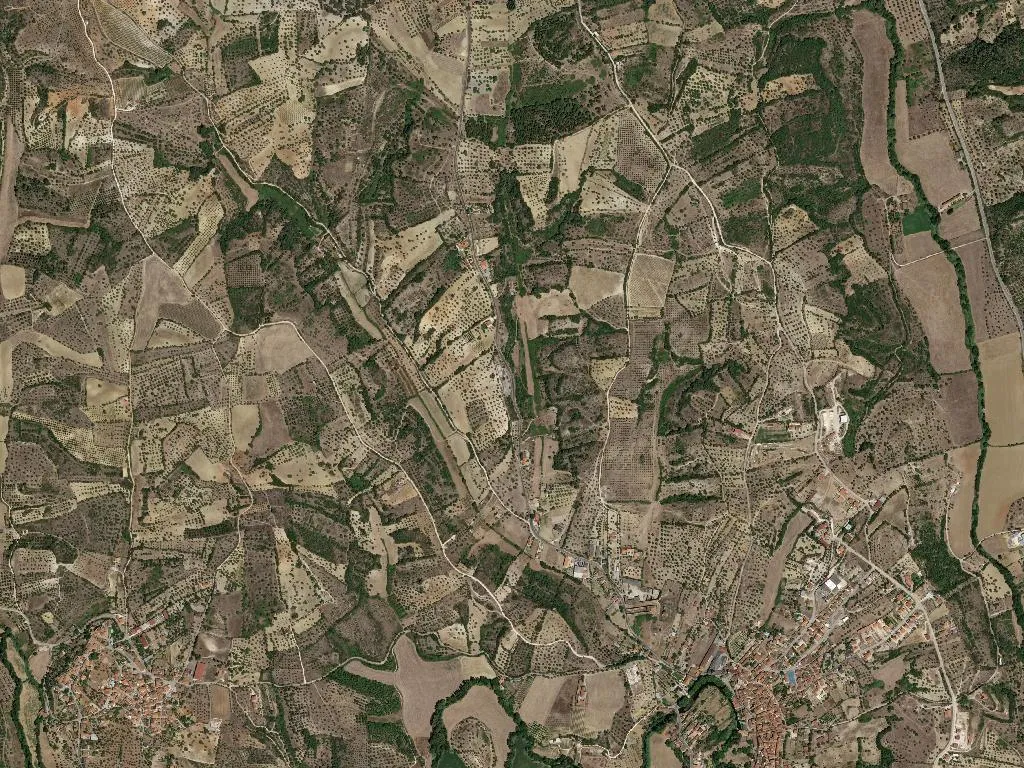
Lapas and Ribeira Branca extend the parish beyond the built core, scattering low white walls that separate vegetable plots and sheep paddocks. Dirt tracks still function as neighbourly short-cuts; a farmer waves you through a gate with the same gesture his father used in 1973.
Then dusk arrives. The sun drops into the plain, roofs, walls and airborne dust ignite the same amber tone, and for a moment the limestone that once recorded dinosaur steps and the whitewash that shelters today’s sleepers appear to be made of the self-same substance: heated stone, slow stone, stockpiling every footprint that ever pressed it.