Full article about Tancos: Where the Tagus Writes the Village
Waterwheels creak, gilded saints glow and lamb stew simmers in this Ribatejo hamlet.
Hide article Read full article
The waterwheel of the old mill groans, timber grating on stone, its rasp braided with the hush of the Barquinha stream. Even in mid-July the water is knife-cold as it slips over slate slabs; the scent of moss rises off the masonry where the date 1850 is still legible, chiselled deep. Tancos wakes without an alarm. Silence holds until the parish bell strikes nine—three blunt strokes that roll across the drying fields and dissolve into the Tagus vastness.
Carved memory, gilt and shale
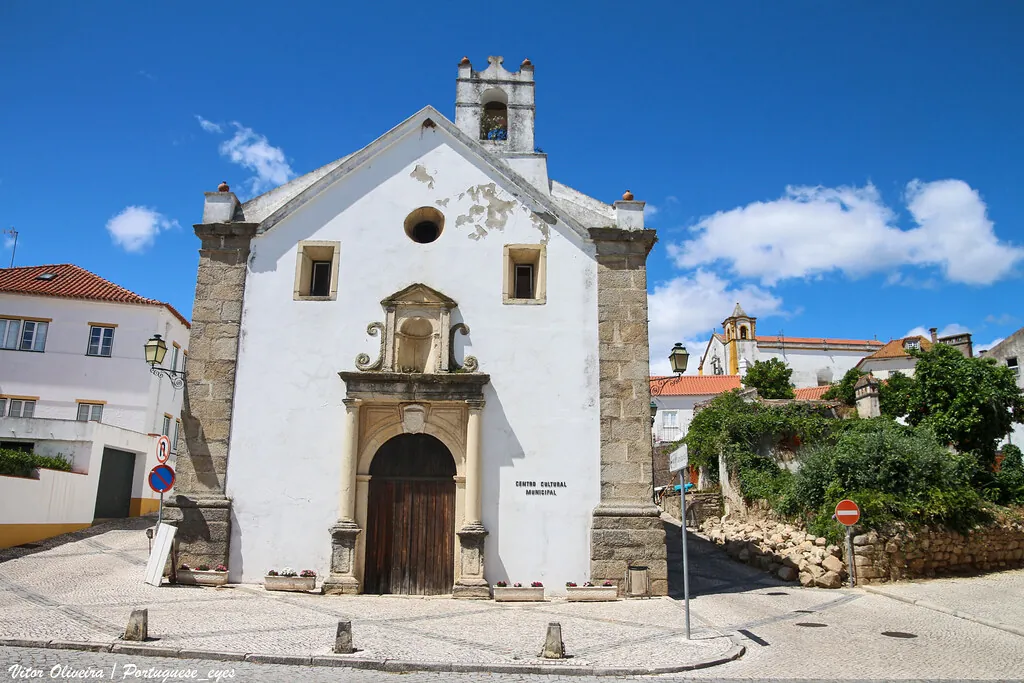
The mother church anchors the village: a single-nave, lime-washed rectangle finished in 1753 with a stone portal framed by scallop-shell volutes. Inside, high windows sieve the light that ignites the gilded retable of St John the Baptist—ribbons of gold-leaf woodwork flaring against bare white walls. In the churchyard a 1743 granite crucifix marks the spot where, during drought years, processions once circled chanting litanies for rain. A few paces on, the chapel of Nossa Senhora da Conceição—rebuilt after the river clawed its way uphill in 1979—keeps painted ex-votos in the sacristy: a sailor’s escape from a December squall, a farmer’s pledge after the olive harvest.
The river that writes the rules
The Tagus slides past two kilometres south, a sheet of mercury under the low afternoon sun. Tancos sits on a river-terrace at 69 m, caught between marshy lezírias and scattered olive groves. The Barquinha stream cuts east–west, feeding galleries of alder and ash where night herons stand motionless, waiting. A wooden bridge thrown across in 1892 still carries threshers to their smallholdings; its planks are replaced each spring by Sr Joaquim, who hammers in new nails before the winter floods. The five-kilometre Caminho do Tejo footpath shadows the greater river, skirting ruined water-mills and lizard-warmed schist walls.
Lamb stew, river eel and Ribatejo olive oil
At table, Tancos keeps to the seasons. Ensopado de borrego—lamb shoulder slow-simmered with mint and soaked Alentejo bread—appears on Sundays. Caldeirada de enguia, an eel stew thickened with tomato and sweet pepper, depends on the river’s temperature drop in October; the oil is local DOP Ribatejo, decanted from five-litre flaggons hauled home from the Atalaia co-op. Spring brings migas de espargos, breadcrumbs tossed with wild asparagus and shards of smoked pancetta. For São João every household fries bolinhos de favas, honey-sweet fritters eaten scalding, and Dona Lurdes’ gila-filled pastéis accompany late coffee under the crucifix shade.
Fireworks and folk farce
The Feast of St John, on the nearest Sunday to 24 June, turns the square into an open-air refectory. After dusk a procession of banners leaves the church, brass bands strike up, and fireworks rake the river surface. Carnival brings the “burial of the cod”, a mock funeral with cross-dressing widows and satirical epitaphs recited from a hay-cart—a script unchanged since the 1930s. At Christmas the “sawing of the bilro” still happens: improvised verses teasing every neighbour until the whole room is weak with laughter.
At twilight, when the sun drops behind the Tagus and light skims the water like a thrown stone, the mill begins its slow groan again. The sound crosses the fields, climbs the shale slope, and meets anyone on the old bridge—an ancient pulse that needs no translation.