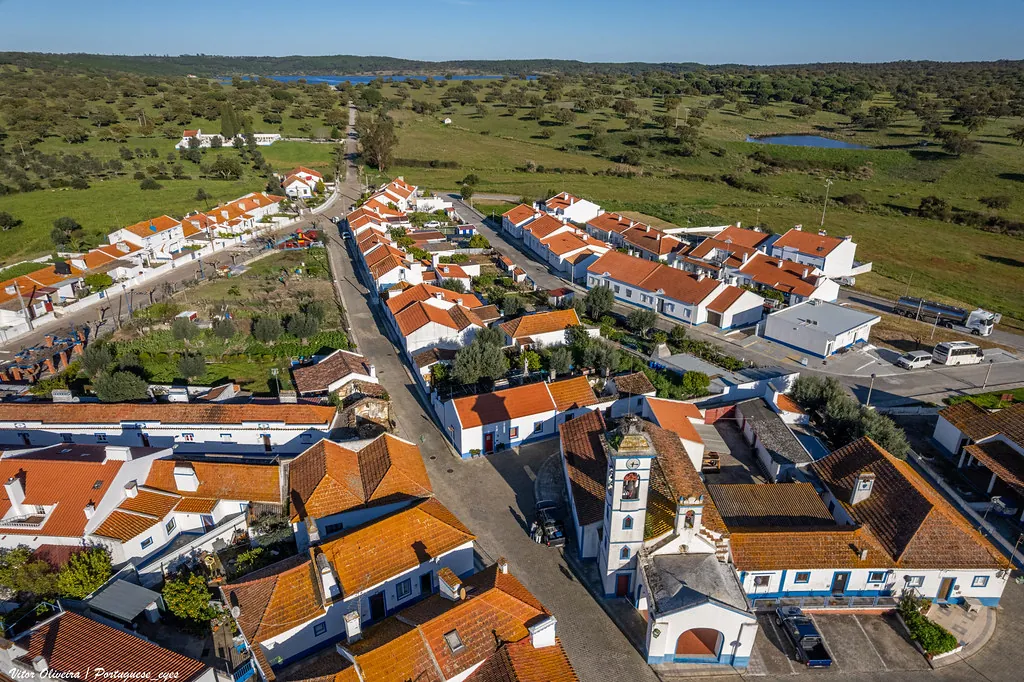
Full article about Santa Susana: where cork oaks outnumber people 900 km²
In Alcácer do Sal’s quiet parish, silence is broken only by wild boar and tractor gates.
Hide article Read full article
The Silence of the Montado
A dry branch snaps beneath the trotters of a wild boar. Seconds later the iron gate of the Seixal estate answers with its own metallic cough as Joaquim’s tractor rolls home. Between these two sounds lies the entire acoustic world of Santa Susana, a parish of 3,866 souls scattered across 900 square kilometres of cork oak and umbrella pine. The nearest neighbour lives two kilometres away; solitude is measured in the interval between mobile-phone rings. At five o’clock the pale sky already holds a ghost of moonlight, the oak canopies glow ember-orange, and every bird in the parish appears to be commuting to the same low whitewashed cottage.
Chapels, Cork and Memory
The original chapel of Santa Susana survives only as a stone wall nibbled by lichen and three concrete feed silos. Parishioners transferred their loyalties long ago to the mother church in the hamlet of São Bartolomeu, where candles still flare at dawn on Sundays. Cork, not faith, shaped this landscape. Until the 1990s men like my grandfather stripped the oaks from the age of fourteen, coming home with hands the colour of Malbec that no amount of petrol would bleach. Today the crews are Brazilian and Romanian, but the same raw trunks stand in the winter fields like open wounds, flayed by the north wind that rides up the Sado estuary.
What the Land Gives
Zé’s café doubles as the petrol station; if you bring a bottle he’ll fill it with cloudy new olive oil straight from the lagar—€2 a litre. Toninho’s kid is spoken of in Évora’s restaurants: six hours in a clay-brick oven his father built during the 1974 revolution. No one mentions DOP labels; they talk about the neighbour who still milks her own goats for queijo de cabra, or Seu António’s red that arrives unlabelled in five-litre jerrycans and tastes like chilled communion on a blistering day. Spring brings rosemary honey, winter the bitter oranges that colonise abandoned quintas, and every August the peach trees seem to hold a sun that refuses to set.
From Oak Savannah to Salt Marsh
Take the municipal road 521 east until the cork gives way to stone pines and the air smells suddenly of iodine—fifteen minutes and you’re on the edge of the Sado estuary. No one stops for the flamingos; they’re as unremarkable here as the white stilts nesting on ruined chimneys or the ospreys that patrol the rice fields. The dirt track between Póvoa and Carrascal is scored deep by tractor tyres—follow it in October after the first rain and you’ll fill a basket with saffron milk-caps; come in January and the soaked earth steams like a just-snuffed candle, exhaling resin and burnt wood.
Stillness Without Adjectives
There is no village centre, only places. Carrascal, where the primary school closed in 2003 and the wind rehearses speeches in the eucalyptus. Póvoa, where the combined café-grocery counter still sells cornbread warm at seven in the morning. Barroil, whose bandstand sags in the square but manages, every August, to host a tourada with young bulls ferried in from Alcácer. What astonishes outsiders is the scale of emptiness—how the quiet is stitched together by tiny noises: a bee working a thistle, the plink of an air bubble in a plastic water bottle, a chainsaw two kilometres away carving its own echo.
Dusk drops behind the oaks of São Lourenço estate; the first stars look like nail heads in softwood. Wood-smoke drifts across the cooling fields, and farm dogs trade gossip across kilometres of darkness. In that hinge-moment between daylight and night Santa Susana declares itself: a parish where time is measured in cork harvests, distance in silence, and where the loudest sound is sometimes your own pulse.