Full article about Torrão: Where Alentejo Water Mirrors Timeless Stone
Limestone, herons and a dam’s golden blades frame Torrão’s 7,000-year whisper.
Hide article Read full article
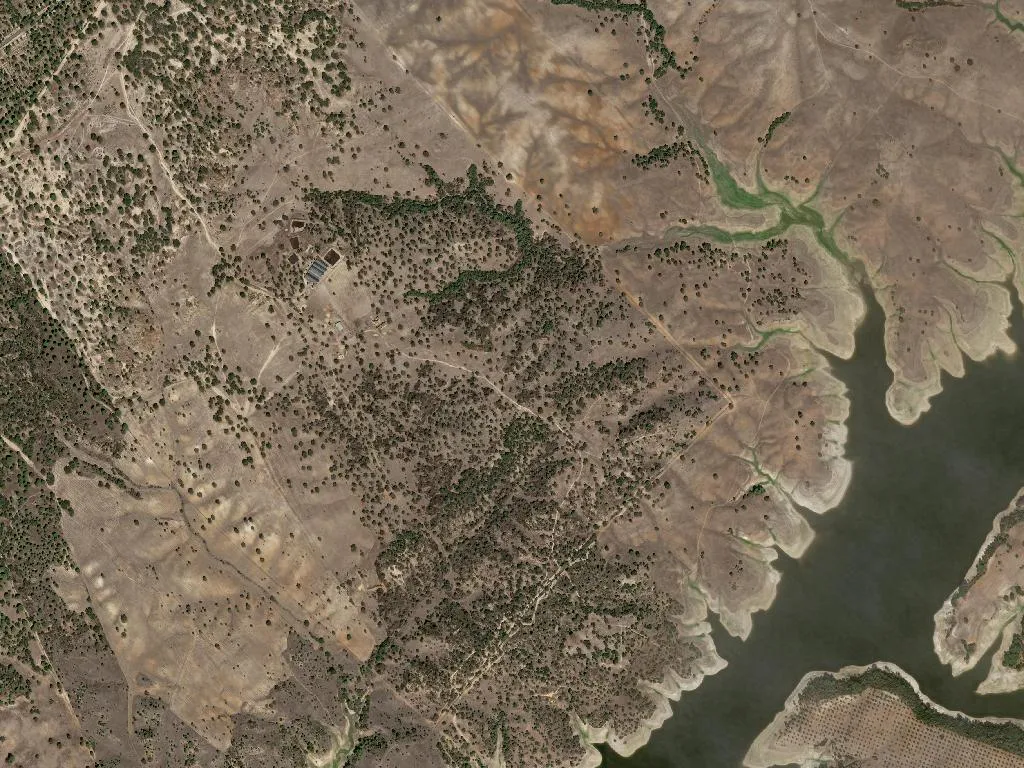
The sun glints on the surface of the Engenheiro Trigo de Morais Dam — opened in 1951, 48 metres high, five kilometres long — and the light fractures into golden blades that slice across the water’s mirror. A grey heron pins a black silhouette against the rinsed-blue sky. Silence here has mass: not absence but a dense, almost tactile presence, broken only by the discreet slap of a fishing boat or the cry of an osprey. Torrão spreads across 372 square kilometres of Alentejo plain, latticed by the rivers Xarrama and Sado, where water draws borders and the land breathes slowly.
Stone that remembers
The village is built in layers of time: Neolithic scatters on Monte da Tumba (flint flakes, cardial pottery), Roman slabs from the road that once linked Salatia — today’s Alcácer do Sal — to Pax Julia (modern Beja), limestone blocks of the parish church of Nossa Senhora da Assunção rebuilt after the 1755 earthquake. The name itself is a contraction of the Arabic hisn Turrus, “great tower”, a memory of a fortification that once surveyed the plain. In 1512 a Manueline charter gave Torrão full town status; in 1836 liberal reforms reduced it to a parish. It later belonged to the municipalities of Alvito and Viana do Alentejo until, in 1871, its 1,200 inhabitants petitioned to be annexed to Alcácer do Sal, 32 kilometres away — the place where they went to market and to confession.
The eighteenth-century palace of the Viscounts of Torrão stands at the centre, whitewashed façades reflecting noon light so sharply that shutters stay closed until sunset. Locals still recount how the last viscount, Joaquim Inácio de Brito, left before dawn in 1892 and never returned. A few streets away the former Convent of Nossa Senhora da Graça (founded 1570, dissolved 1834) keeps its cloistered hush even in private hands — grilles on the windows, interior courtyard invisible but imaginable. On the outskirts the sixteenth-century chapel of São João da Ponte marks the old crossing over the Xarrama where tolls were collected until 1860; the seventeenth-century hermitage of Nossa Senhora do Bom Sucesso keeps solitary vigil over the wheat fields, once a place where women came to pray for children. Every stone here is functional: shelter, landmark, anchor.
Water that shapes the land
The Vale do Gaio Dam — built 1946-1951 by engineers Trigo de Morais and Abecassis, 45 metres high, 450-hectare reservoir — dominates the horizon. The lake stretches eleven kilometres, good for canoeing and for bass or barbel fishing, but its real purpose is irrigation: 3,500 hectares of the Torrão irrigation block depend on it. At dusk the temperature drops seven degrees in twenty minutes and the water turns the colour of lead. From the south shore the Sado estuary nature reserve leaks in, bringing white storks and black-tailed godwits that pause between Africa and northern Europe. The Xarrama meanders more discreetly, edged by reeds and ash, offering footpaths where boots sink five centimetres into clay.
Bread, oil and lamb
Padarias Reunidas do Torrão has fired its wood oven since 1953: 300 loaves a day, dense 600-gram dough, crust that cracks like thin ice. The local olive-oil cooperative (founded 1956) produces Azeite do Alentejo Interior DOP — 200,000 litres annually, cobrançosa and madural cultivars, bitterness 3.5, pungency 4.0. In the restaurants — Belo Horizonte (1987), O Chaparro (1994), Excelentíssimo (2002) — lamb stew arrives heavy with coriander, three hours on a low flame, served with parsnip and bread soaked in the gravy. Cabrito do Alentejo IGP (45-day-old kids, 8–10 kg) comes with glass-crack skin and spoon-soft meat. Meals finish with queijadas de requeijão (a recipe borrowed from the Convento do Lorvão) and bolo real, a cake that uses a dozen egg yolks.
Calendar of encounters
On Palm Sunday the Procession of the Lord of the Steps leaves the parish church at 09:30 and threads through narrow lanes until 11:00. On 15 August Nossa Senhora da Assunção is carried through the streets at 18:00, followed by 400–500 people walking barefoot over uneven cobbles — a tradition recorded since 1778. Mid-summer is stitched together by dances: São João (23–24 June), the Baile da Pinha (last Saturday in August), the Baile do Malmequer (first Sunday in October), all driven by José Manuel Carreira’s accordion and António Pernadinho’s cavaquinho. Every second year the Medieval Fair re-creates the world of Bernardim Ribeiro — Renaissance poet, born here in 1482 — filling the square with canvas tents, open fires and the smell of roast pork. On the third Saturday of each month the market takes over: 45 stalls, fresh cheese at €8/kg, vegetables lifted from the soil that morning, live chickens in wicker cages.
The Ethnographic Museum, installed in the 1887 olive-oil mill, keeps 1,200 objects: wooden mallets from 1850, a 1908 photograph of the local folklore group, a 1945 threshing machine. When you leave the late light is already stretching shadows across the forecourt. Beyond, the reservoir returns the entire sky, doubling the size of the territory. Here space is measured in empty square kilometres, and the rhythm is that of the seasons: sowing in November–December, harvest in July–August, rest. What lingers is the echo of bells, the persistent taste of olive oil, the sense of amplitude that only a plain can give.