Full article about Samouco’s Salt Pans Gleam Beneath Tidal Clock
Walk Mondrian-perfect salinas, scrape moon-warm flor de sal, hear fado fade into the Tagus
Hide article Read full article
Salt rectangles and tide time
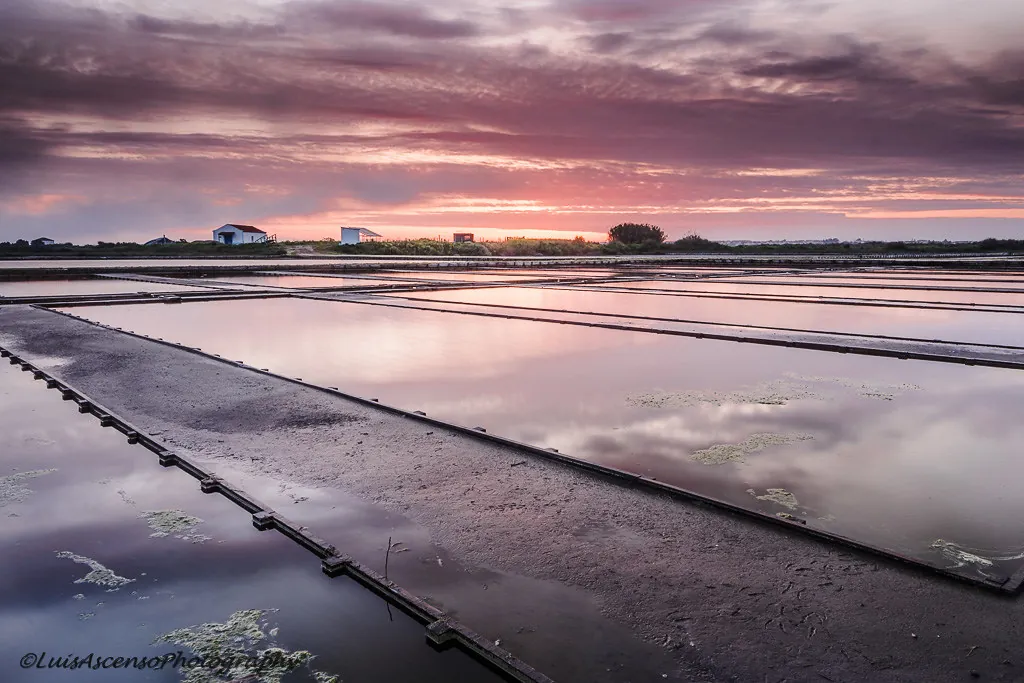
The first salt-worker is already barefoot on the gleaming screed when the morning sun lifts the haze. His wooden rake rasps against the crystalline crust, a dry metallic scrape answered by the yelping gulls that wheel above the pans. At barely five metres above sea level, Samouco keeps tidal time: the pumps open, the water rises, evaporation leaves its white invoice. Light here misbehaves—ricocheting off mirrored brine, leaping off whitewashed walls, multiplying down the estuary channels until you half-shut your eyes against the glare and see more, not less.
Geometry drawn by gravity
The Salinas do Samouco spread out like a Mondrian painted with brine: rectangles of identical proportion, ruled four centuries ago to obey sun and gradient. Classified as a Site of Public Interest since 1984, the pans still yield 120 tonnes of sea salt a year, plus a coveted tonne of flor de sal that forms only when the wind drops and the thermometre edges past 35°C. One Saturday a month, on the nearest full moon, the cooperative unlocks the gates and visitors can scrape their own glittering harvest by moonlight, crystals warm from the afternoon’s evaporation. Between March and September the water follows a lunar calendar no human watch can override.
The parish name comes from the Latin sal and mucro—salt and point—yet the place feels more edge than tip. Royal protection arrived in 1516 when Manuel I, born upriver in Alcochete, decreed the “white gold” should fatten the crown. Salt left on the 1952 timber pier that stilt-walks 200 m into the Tagus; the last load departed in 1978. Now the pier is a dolphin look-out and, on August Sundays, an impromptu stage where fado drifts across the flats until the tide drowns the final chord.
Where the estuary feeds you
The Tagus estuary wraps Samouco in a collar of saltmarsh and oozing mud. Three way-marked trails—Redshank, Flamingo and a wheelchair loop—thread the reserve, delivering 170 recorded bird species to anyone patient enough to stand still. Juvenile greater flamingos sieve the water for brine shrimp; purple herons freeze among glasswort; and if the birding gods smile a spoonbill lifts off in a flash of rose. Beyond the dykes, a small herd of Miranda donkeys—transplanted from remote Trás-os-Montes in 2014—graze the invasive reeds, their hooves squelching in counterpoint to rustling reeds.
What grows in the marsh turns up on the plate. In Café Central, Tia Amélia has ladled Arroz de Enguias na Cana do Sal since 1983: eels trapped in the tide gates, sun-dried tomato and a final snow of local flor de sal that sharpens without shouting. On feast days she serves kingfish soup thick enough to warrant toasted Alentejo bread for swabbing. Finish with the village toucinho-do-céu, an almond tart whose sweetness is clipped by a whisper of sea salt—Pastelaria Marques’ stroke of brilliance. Fernão Pires from the Palmela cooperative, crisp and lime-scented, keeps the maritime richness in check.
A calendar ruled by water
October belongs to Nossa Senhora da Saúde: procession at 15:30, fireworks at 22:00, fairground on the Campo da Feira. Easter brings the Enterro do Bacalhau—a three-metre papier-mâché cod paraded by fishermen then flung into the Tagus while improvised verses lampoon parish councillors, last year the chairman who dared suggest parking meters beside the salt pans. July’s Salt Festival turns the pans into an open-air classroom: dawn rake at 06:00, tastings of lemon-thyme crystals, cookery demos where chef Rodrigo Castelo rebrands glasswort as “green salt”. The parish church, rebuilt after 1755 in sober Mannerist baroque, hosts gilded altarpieces that bounce candlelight around the nave; the Rosary retable, commissioned in 1762, still smells faintly of beeswax and incense.
Samouco’s river beach is no secret—Lisbon families colonise the sand at weekends—yet it keeps a low profile. Two lifeguards, a playground and a 2-km boardwalk suffice. Children splash in current-free shallows while parents eye the distant span of the Vasco da Gama Bridge, its cables geometric against the haze. Rent a bike and the riverside lane unfurls through umbrella pines and allotment plots; Dona Lurdes sells lettuces at 50 cents a bunch from her front gate. Pause at the Amália Rodrigues viewpoint and the entire estuary tilts below you—salt pans flashing like signal mirrors, rice fields green as billiard baize.
Evening softens everything. The pans turn tangerine, then bruise-coloured, and silence arrives footstep by footstep. What remains is the hush of wings returning to roost, the iodine sting of dried salt on skin, the knowledge that you are standing on the westernmost lip of Europe’s largest estuary, five metres above the sea, where land hesitates before surrendering to water.