Full article about Almada-Cacilhas: salt, schist & sardine smoke
Cross the Tagus to Almada, Cova da Piedade, Pragal & Cacilhas for azulejo-clad chapels, 19th-century quayside cafés and Cristo-Rei’s 110-metre embrace
Hide article Read full article
The Shore That Looks Back
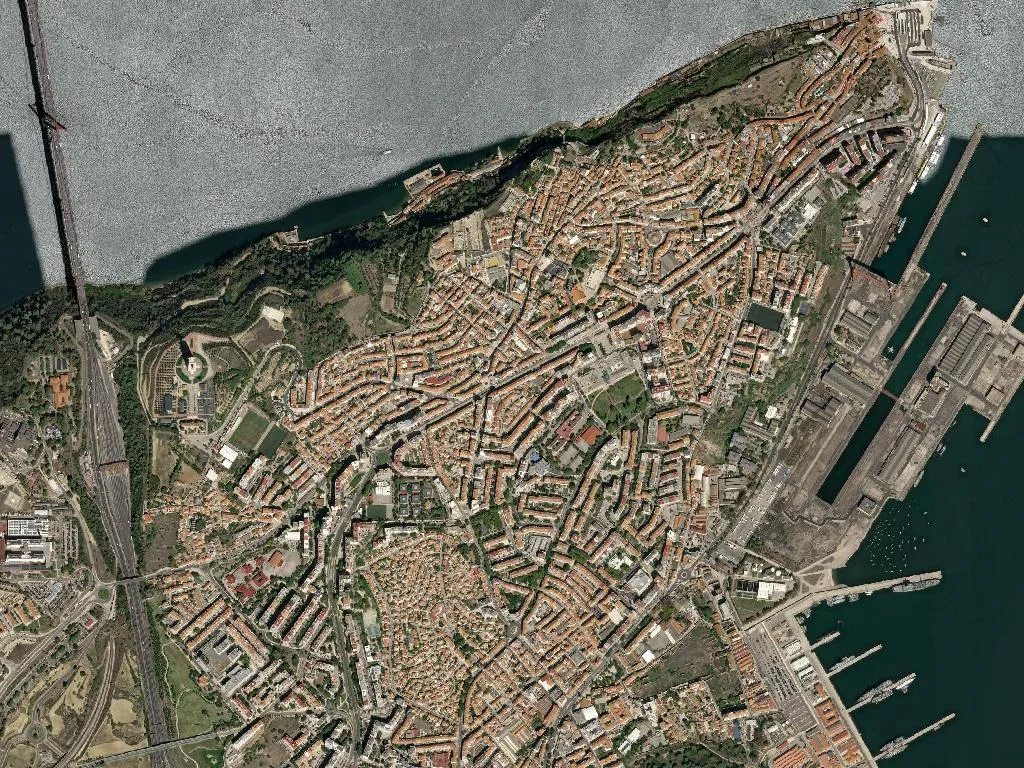
The ferry engine gives one last throat-clear before it nudges the pontoon at Cacilhas. Steel jaws drop, the Tagus rushes in – salt, diesel, silt – and Lisbon suddenly becomes a postcard you no longer belong to. Step off and the ground feels different: heavier, steeper, louder. This is the civil parish of Almada, Cova da Piedade, Pragal and Cacilhas, 48 600 people compressed into six square kilometres of riverfront schist and limestone. Density announces itself in the echo of heels on the quay, in gulls heckling pigeons above 19th-century warehouses, in the way conversations ricochet between cafés whose tables spill across Rua Cândido dos Reis.
A name carried across the river
Almada is whispered Arabic: al-madina, “the town”. The syllables survived Visigoths, Portuguese reconquest and 19th-century industrialists who built the quay you just crossed. Administrative tinkering in 2013 welded four settlements together, yet the layering predates any statute. Walk uphill to the Igreja de São João Baptista and you’ll see it: a granite fortress-parish that has watched June processions since the 14th century, when sardines first hit charcoal in its square. Drop to Cova da Piedade and a 16th-century chapel keeps vigil over alleyways that grew between dockyards and ship-repair slips. In Pragal the land tilts; pine breezes replace river damp, and the Igreja de Nossa Senhora do Pragal anchors a neighbourhood that smells of wet earth after rain. Down at Cacilhas again, the Igreja da Conceição supervises the descent to the water, its azulejo panels glinting each 8 December when the parish stages one of the last great riverfront romarias around Lisbon.
Seventy metres of concrete and gratitude
You cannot miss Cristo-Rei. From almost every corridor of the four-in-one parish the 110-metre monument raises its arms above the estuary, a 1959 thank-you note for Portugal’s WWII neutrality. Approach from the adjacent miradouro and scale becomes vertiginous: the Tagus narrows to a silver ribbon, the 25 de Abril Bridge feels close enough to sign, and the city you left behind is reduced to a painted backdrop. Pilgrims on the Portuguese Central Way to Santiago cross that bridge here, turning north towards Santarém while commuters vanish into Almada’s shopping malls below.
Where the Tagus tastes of caldeirada
Cacilhas spent four centuries as Lisbon’s auxiliary port, and the river infiltrates every plate. Caldeirada – layered potatoes, onion and whatever the boats landed – is still simmered at Ponto Final until the broth turns opaque with saffron and bay. Grilled sardines arrive between May and September; arroz de marisco appears year-round, and bacalhau à Brás is never off the menu. Finish with a pastel de nata or a rice-cake, then a glass of Moscatel de Setúbal, the fortified muscat from vineyards 20 kilometres south. The wine’s orange-peel sweetness tastes like sunlight; against the briny air it becomes a balancing act you didn’t know you needed.
Cliffs that archive millennia
The parish overlaps the Protected Landscape of the Costa da Caparica Fossil Cliffs. Follow the trilho dos lagosteiros westwards and the path becomes a seminar in stratigraphy: ochre Miocene sands lie above grey Pliocene clays, each metre compressing two million years. Atlantic wind forces you into your jacket; surf booms like tympani against the base of the cliffs. Cyclists can swap geology for hydrology on the riverfront bike lane that shadows the Tagus, container ships sliding past like floating apartment blocks.
The ferry as daily liturgy
There are 274 registered beds – Airbnbs in Almada’s high-rise slabs, a hostel in a converted fish warehouse, a 1960s guesthouse where the wallpaper still dreams of Expo ’58. Reaching them is absurdly simple: board at Cais do Sodré, ten minutes later you dock. Yet the crossing is never merely transport. Lisbon recedes, the water widens, the wind flips from urban to maritime. This shore has more pensioners than children – 14 000 over-65s versus 5 000 under-15 – and the rhythm adjusts: coffee at 10 a.m. is a parliament of retirees, benches in Jardim 1º de Maio host conversations measured in decades, shop shutters rise without the hurry of the north bank.
Late afternoon, the ferry leaves again, engines thrumming against the ebb. For three full seconds after it departs Cacilhas falls silent – only water slapping concrete piles and a gull’s proprietary shriek. In that hush Almada stops being Lisbon’s mirror and becomes its own place: stone, salt, sardine smoke and a river that refuses to choose between them.