Full article about Costa da Caparica: Lisbon’s sun-tossed backyard beach
13 km of fossil cliffs, sardine smoke and Atlantic rollers 20 minutes from the capital
Hide article Read full article
The first thing you hear is the sea
Before you see it, you hear it: a low, continuous hum that climbs the lattice of alleyways behind the fish cafés, threading through the clink of coffee cups and the shuffle of Havaianas on salt-crusted pavement. Then the iodine-and-butter smell of grilled sardine drifts in, followed by light so bright it feels almost pharmaceutical, ricocheting off whitewashed blocks and the Sahara-blonde beach. Across the estuary the 25 de Abril Bridge hovers like a single brush-stroke of scarlet ink; from here it looks close enough to swim to. We are standing a shade under six metres above sea-level on a slim littoral that is home to 13,968 people (2021 census) – many of whom still shake sand out of their shoes every evening.
The hill that slipped into the Atlantic
“Caparica” is a linguistic fossil, from the Arabic al-qāpara – “the hill” – a nod to the 120-metre fossil cliff that walls off the hinterland. The parish was carved out of Trafaria in 1923, but its identity as a seaside strip arrived only in the early 20th century when republican Lisbon rebranded it the “Portuguese Riviera”. Wide-brimmed straw hats and ankle-length bathing costumes paraded along a wooden boardwalk; steamers ferried the gentry across the Tagus from Cais do Sodré. Then, on 6 August 1966, the Salazar Bridge (today’s 25 de Abril) opened, the bus route became a 25-minute hop, and the Costa swapped exclusivity for democracy. Apartment blocks sprouted like salt-tolerant weeds, and the strand that once served a handful of Lisboeta aristocrats turned into the city’s most egalitarian sun-lounger.
Thirteen kilometres written in seashells
Protected cliffs run unbroken from the yacht club at São João to the lagoon mouth at Albufeira – 13 km of Miocene strata sliced open like a layer cake. Shark teeth, rib fragments of Miocene whales and the stumps of a 5,000-year-old drowned pine forest are cemented between ochre sandstone and grey clay. A way-marked trail threads Fonte da Telha to São João: at the base you can still make out Bronze-Age rock-carvings – concentric circles older than Rome – while on the crest the chalk-white 16th-century chapel of Nossa Senhora da Guia keeps watch. On the first Sunday of May villagers haul a statue of the Virgin up wooden steps that creak under the weight of processional devotion; picnics follow, spread on blankets above the infinite blue.
Cuttlefish, eels and almond “sand”
The cooking smells of clean frying oil and fresh coriander drift from beach shacks where cuttlefish reigns: choco frito arrives as bronze-crusted strips, iodine-sweet against a brick-red tomato rice. Inland, cooks simmer eels from Lagoa de Albufeira into a brick-coloured stew thickened with red pepper and onion, demanding thick Alentejo bread to mop the bowl. Between March and May razor-clams are grilled in their own shells – a tactile sport of burnt fingers and scalding juices – and every café ends the meal with Areias da Caparica, sandy-textured almond biscuits that dissolve like dune dust. The obligatory glass is Moscatel de Palmela, amber and viscous, served cold while the sun slips behind the Atlantic.
The beach tram with nineteen stops
From July to September the Transpraia rattles eight kilometres along the dunes, stopping nineteen times at beaches whose names read like footnotes to local history. Get off at CDS for the football fields first laid out by Setúbal’s sports club in the 1930s; at Nova where actor-playwright Mário Viegas once read Sophocles in the shade; at Fonte da Telha where storks and migrating flamingos feed in the freshwater lagoon just a sand-bank away from surf breaks. A parallel cycle path continues to Forte de São João, a 17th-century star-shaped fortress that still smells of Atlantic damp at dawn. Walkers share the route with wetsuited surfers: this stretch forms part of the Portuguese Central Way to Santiago, so you may find a pilgrim with scallop shell exchanging a nod with a teenager carrying a 6'2" short-board.
Salt, ink and revolution
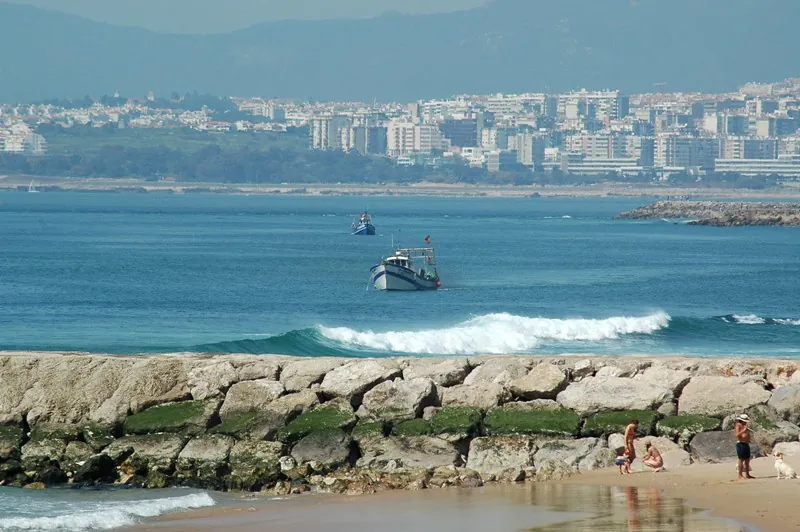
José “Zeca” Afonso rented a small house on Rua dos Pescadores in the early 1970s and wrote “Venham Mais Cinco”, the protest song that would ring out on the night of the 1974 Revolution. Poet Sophia de Mello Breyner Andresen and fire-brand writer Natália Correia spent summers debating politics over aguardiente; novelist Manuel da Fonseca set Cerromaior amid these cliffs. Proximity to Lisbon – yet far enough to feel fringe – made the Costa a natural refuge for dissenters. Today the dissent is aquatic: surfers drop into the notorious “Caparica wedge”, kitesurfers launch across the lagoon when the north-westerly blows, and small boats still put out from Praia da Saúde at sunrise in search of sea bass and gilt-head bream.
Between those same boats, a freshwater spring bubbles up through the wet sand – absurd, potable water rising a stride away from the briny Atlantic. It is the perfect metaphor for a shoreline that insists on surprising you, exactly where you expected nothing more than another grain of sand.