Full article about Barreiro’s tri-parish core: river, fog & fried cuttlefish
Explore Alto do Seixalinho, Santo André e Verderena in Barreiro—dense riverfront streets, industrial echoes and seafood taverns under Atlantic fog.
Hide article Read full article
Alto do Seixalinho, Santo André e Verderena: where the Tague becomes a city
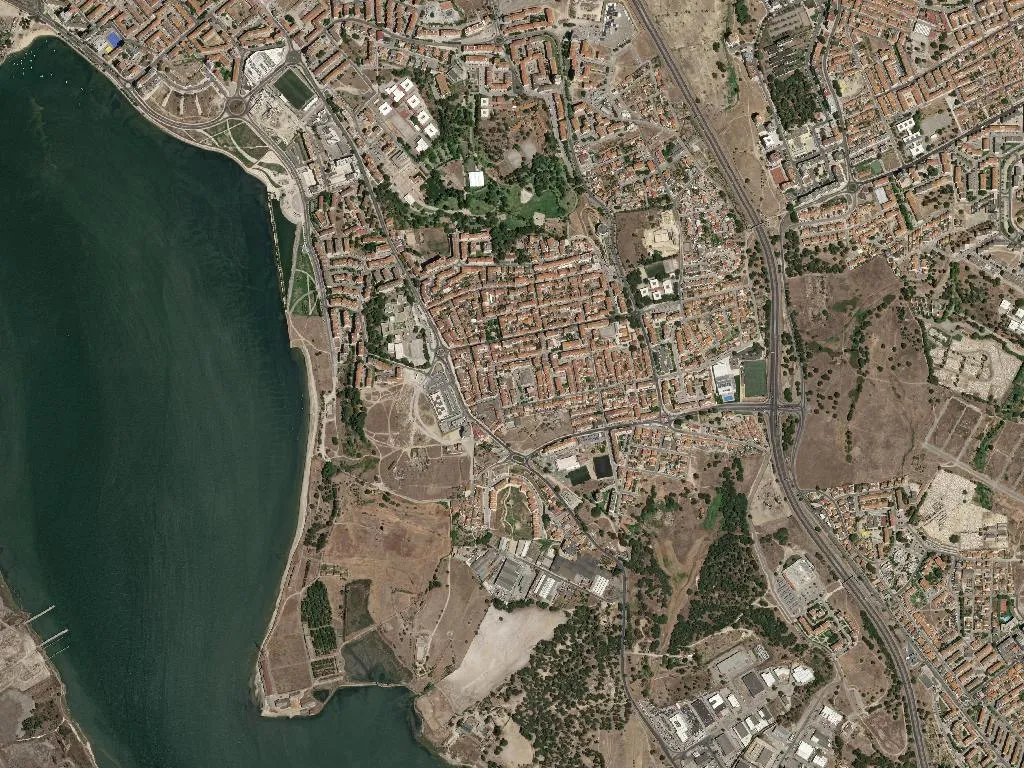
The wind riding up the Tagus smells of brine and something sharper — hot steel, diesel, the ghost of unloaded cargo. I walk Rua Vasco da Gama, past Café Aviz and the local Santander, and the scent follows like a second skin. At Barreiro ferry terminal the catamarans dock with Swiss-clock precision; the same breeze pushes uphill along Rua Almirante Reis, scuffing the facades of Alves Redol school and the Garrett grammar school, until it reaches the plateau where the Hospital Nossa Senhora do Rosário surveys the rooftops. Only 43 m above sea level — negligible by Lisbon standards — yet enough for winter fog to pool between the apartment blocks and the date palms of Jardim do Sapal. When the sun breaks, it illuminates everything at once: the Intermarché, the Pingo Doce, gulls perched on the Celeiro health-food shop, the Tagus glittering beyond the Alto do Seixalinho viewpoint.
This is the civil parish of Alto do Seixalinho, Santo André and Verderena, stitched together in 2013, the heart of Barrerio’s 32 km². Forget picture-postcards: 41 300 people are squeezed into 7 km², a density higher than Porto’s. Where the Quimigal fertiliser plant, the Petrogal refinery, the National Steelworks and Lisnave shipyards once stood, five-storey slabs went up, primary schools, pocket parks and cafés whose televisions never leave the sports channel. The street names — Alfredo César Torres, Camilo Castelo Branco, Antero de Quental — preserve the industrial memory; the river survives in scent and on plates: choco frito at O Pescador, caldeirada at Taska d’Avó, peixe-espada with tomato rice that Zé da Tasca serves on Fridays without bothering to write it on the blackboard.
Caravels once left from Telha
Before concrete, before CP Rail, before the A33, there was Quinta da Telha — now a container yard for Sadoport. Torre do Tombo archives record an “esteiro da Telha” in 1535. Pine from Pinhal do Rato was felled here, hulls were caulked for India-bound naus carrying holds tiled with salt cod. Walk Rua João de Deus today, between the health centre and Minipreço, and the irony is audible: the quarter that once launched caravels now commutes to Cais do Sodré in 20 minutes — assuming the ferry Swell isn’t out of order.
Alto do Seixalinho grew around Caminho do Meio, where cyclists brought produce from Verderena’s market gardens to sell in Barreiro. The real catalyst was the railway: 1 May 1861, Dom Pedro V opened the station, linking the capital to the Alentejo; steam whistles howled. Quimigal arrived in 1908, Lisnave in 1937, recruiting workers from Beja, Évora, Cuba and Aljustrel. Streets were laid out like crossword clues: Gilberto 4, Rosa 18, Manuel 42 — four-door houses, a well in the yard, the lavatory at the end of the corridor. Residents of Bairro 1º de Maio still say “I’m going to the block” and everyone knows they mean G-H.
Verderena keeps the name of the old quinta and the chapel of São Marcos, now a picnic spot on St Martin’s Day. In 1913 architect Raul Lino designed a summer house there for Dr Sousa Martins; today it is the Centro Escolar de Verderena, where children eat vegetable soup and perform theatre with teacher Sofia.
Two monuments, six centuries of silt
The Manueline pillory of Santo André (16th c.) leans against a Galp petrol station on Rotunda do Feijó. Few drivers realise that slaves were judged here and wheat plots redistributed. You slow for the roundabout, glimpse the chipped stone, read “…DD…1637”, and rejoin the traffic. Beside it, the parish church ordered by Dom Manuel I in 1514 has a Manueline belfry and 18th-century tiles from Tapada da Ajuda. The high altar is English oak that once came by barge up Ribeira do Barreiro. Restoration scaffolding finally came down in December 2023; the 11 a.m. Sunday mass still fills 120 wooden chairs.
A city breathing between generations
Census 2021: 5 013 children under 14, 11 457 pensioners. The parish is greying, yet the schools hold: three primaries (Santo André, Verderena, Dona Berta) and two secondaries (Alves Redol, Verderena JI). Saturday 9 a.m., Pingo Doce car park is a choreography of toddlers in trolley seats, grandfathers saving parking spaces, espressos at Balla or O Girassol. On Café Avenida’s terrace, António, retired from Lisnave, remembers: “Sapal was real marsh, full of frogs; now it’s a garden with Wi-Fi.” The council planted palms, installed wooden benches; old men play sueca cards, teenagers log 5 km on Strava.
Accommodation? 44 registered lets, zero resorts. A one-bed in Alto do Seixalinho rents for €550 a month, a two-bed on Rua Almirante Reis for €750, a student room in Verderena €200 with breakfast. The cheapest Airbnb is on Rua Dona Berta, overlooking an interior courtyard and the church bell tower. Owner Vítor’s warning: “Parking’s fine, but leave space—otherwise the dustcart can’t get through.”
Salt on the breeze, wine on the shore
Moscatel de Setúbal, single varietal, 10 000 ha between Palmela, Azeitão and Barreiro. Order it by the eighth-litre at Tasquinha do Manel, alongside clams Bulhão Pato from the municipal market. A bottle from José Maria da Fonseca is €6 in the supermarket; the Hetemann version from Quinta do Anjo is €9 at Casa do Concelho shop. When the north wind blows, the estuary’s brackish breath mingles with cellar fermentation — the blend that says you’re home.
The sound that lingers
At 18:45 the ferry Cidade do Barreiro gives two blasts, eases away from pier 2, exhales a diesel growl and sets a course for Lisbon. The sound ricochets off the town-hall façade, climbs Rua Hintze Ribeiro and dies somewhere on Campo da Bola. Locals stopped hearing it years ago; visitors carry it home in their pocket, like the €2.50 ticket that still smells of ozone.