Full article about Salt-Lunged Santo António da Charneca
Plateau village where Tagus brine seasons allotments & pine-lined streets
Hide article Read full article
The South-Bank Air That Tastes of Salt
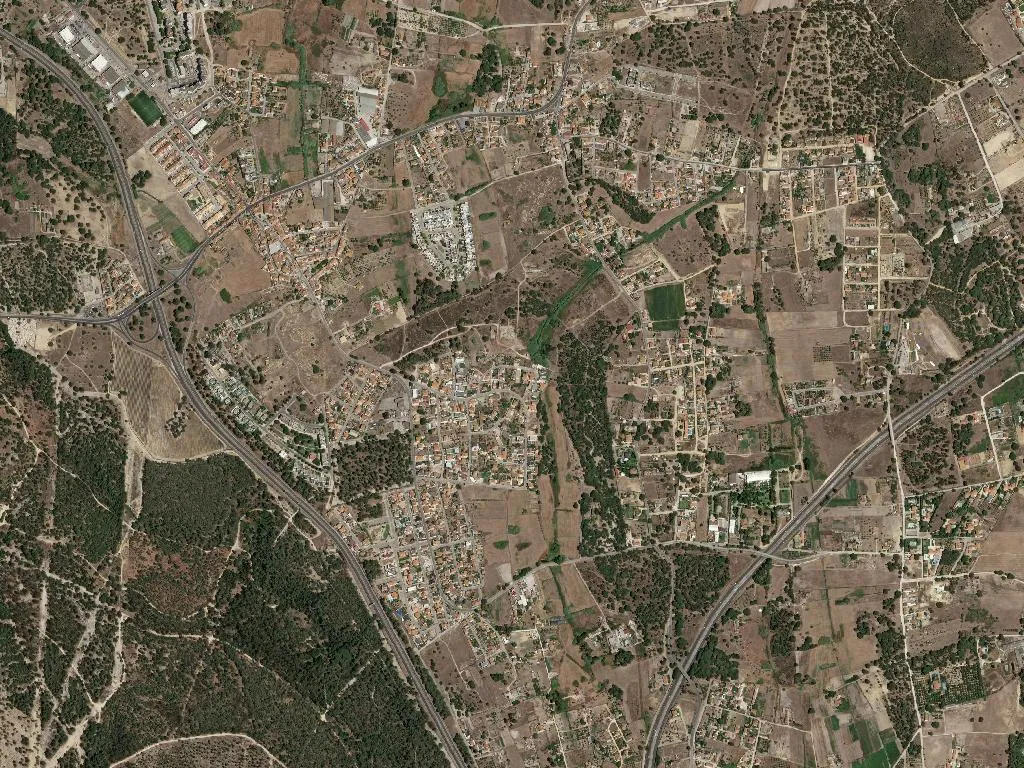
The wind arrives from the southwest already salted. You taste it before you see water—brine on the lips, a faint sting in the eyes. Only when the laundry on the third-floor balcony lifts like a semaphore do you remember the Tagus is four kilometres away. Santo António da Charneca sits 46 m above the estuary on a low plateau of former marshland, 784 hectares of housing estates, allotment-sized gardens and pine-edged roads that Lisbon commuters race through but rarely stop to name.
Forty metres above the tide
The land tilts so gently toward the river that the morning light hits flat and hard, bleaching façades the colour of bone by 09:30. In July the sky burns a metallic white; in January, after Atlantic fronts have rinsed the air, every TV aerial and carob branch is etched with the crispness of a die-cut print. Without hills to cast shade or funnel breezes, the parish feels open, almost telescopic—an amphitheatre facing the invisible water.
Roughly 11,600 people share that horizon. Density is moderate (1,479 per km²), the blocks never more than six storeys, the gaps between them planted with loquats whose knotted trunks survive the salt gusts. Children still kick footballs against garage doors; retired shipyard workers still walk small dogs at the same hour, no watch required. It is commuter-belt Portugal, but the belt has not been cinched too tight.
The arithmetic of staying
Census 2021 counted 1,788 under-15s and 2,556 over-65s. The playground of EB1 Santo António bursts at 10:15; the benches of Jardim 1.º de Maio fill at 10:30. Between those two chimes of the bell, three generations share the pavement: pushchairs outside the Minipreço, carrier bags swinging from handlebars, a grandfather teaching a granddaughter to whistle with an acacia leaf.
Only eleven registered lodging units—rooms, flats, a single guest-house—mean tourism here is still conversational. You arrive because a cousin rents a spare room, or because you priced Lisbon hotels for a week and felt seasick. The parish council website lists heritage walks and bird-watching leaflets, yet the real pitch is simpler: stay south of the capital, pay north-Alentejo prices, drink Setúbal wine in the evening and still be in Cais do Sodré for brunch.
What the estuary puts on the table
Santo António da Charneca lies inside the Península de Setúbal PDO, the demarcation that gives the world Moscatel de Setúbal—honey, orange peel and a whisper of resin. You will not find quintas here, only family pergolas shading barbecues, but the wine lists of Café Avenida and Mercearia Silva carry unlabelled bottles that locals refill for six euros. Order a glass and it arrives chilled in a short tumbler, no ceremony.
The estuary supplies the rest of the vocabulary. On Saturdays Restaurante O Charneco simmers caldeirada de enguias—eel stew thick with coriander and pepper—while the baker opposite sells pão de massa dura, the dense crumb that refuses to dissolve in fish broth. There is no signature dish, no chef with a podcast, just the grammar of the south bank: cuttlefish grilled outside on a patio of broken tiles, chouriço assuaged with red from nearby Palmela, coffee that costs seventy cents until you ask for decaf.
Peripheral gravity
Being peripheral is an art Lisbon’s south bank has rehearsed since the first railway ferries shuttled workers to the shipyards in 1907. Santo António da Charneca never tried to be the next Cacilhas, never courted riverside condos. Instead it perfected the internal loop: bakery at 07:30, bus stop at 07:45, café at 08:00 where the waiter starts pouring your meia de leite before you reach the counter. The Carris number 4 still terminates here; from the Barreiro ferry dock it is twenty-five minutes door-to-door, a timetable so reliable it becomes invisible.
Walk those loops at dusk and the architecture reveals itself: streets numbered not named, stairwells tiled in 1950s azul-and-white, a single modernist church whose bell sounds a minor third flat. Between the blocks run footpaths wide enough for two neighbours and a dog, shortcuts that save exactly forty-five seconds and confer lifelong citizenship. Outsiders think they are lost; residents know they are almost home.
The after-sound
Around 18:40 the concrete exhales. Traffic on the IC20 thins, televisions inside switch from news to novela, and a hush settles that is not silence but subtraction. Underneath it persists the estuary’s long exhale—a faint hiss of salted air rattling a clothes-peg somewhere on a high wire. You notice it only when it stops, the moment the wind drops and the peg hangs still. Then, like a skipped heartbeat, it returns.
That miniature chime is the acoustic fingerprint of Santo António da Charneca. Learn to listen for it once and the memory follows you like the taste of salt on your tongue long after you have crossed the river again.