Full article about Grândola: Where Music Hid in Cork-Oak Shade
Cork scent, schist heat and the chapel hush behind the April anthem
Hide article Read full article
Heat shimmers up from the schist like a tuning fork held to sunlight. The air is thick with pine sap and the faint caramel of cork bark warming in the midday glare. Beneath your sandals the slate creaks, a dry metallic note that travels straight up the spine. Somewhere overhead an acorn drops, the crack swallowed by the cork-oak canopy before it ever reaches the ground. This is the first lesson Grândola teaches: sound behaves differently where there are more trees than people.
Four syllables made the village immortal at 00:25 on 25 April 1974, when José Afonso’s “Grândola, Vila Morena” slipped past the censors as the second cue for the Carnation Revolution. Yet the anthem is only the prologue. Spread across 416 km² of Alentejo upland live 10,302 souls whose calendars are still shaped by the cork harvest, not by metro timetables. Londoners have a tube stop every 250 metres; here you can walk twenty minutes and meet nothing wilder than a black pig scratching its back against a holm oak.
Slate and lime, two belfries, two kinds of quiet
The parish church sits exactly where it should: dead-centre, facing the pastel-pink café where half the town gathers after Sunday mass. Inside, candle wax and stored linen give off the cool smell of August cupboards. Light enters sideways, the way it does in Vermeer, picking out hairline cracks in the nave wall that no architect will ever repoint unless Lisbon remembers to post the cheque.
Seven kilometres west, the chapel of Santa Margarida da Serra is smaller but proportioned like a stone tuning fork. Its door sticks, its silence magnifies the sound of your own pulse. Both buildings are “Monuments of Public Interest”, a designation that translates as “too important to demolish, too expensive to mend”. Meanwhile the steps erode to the exact tempo of the faithful – and of the merely footsore seeking shade.
Scattered across the hills are half-swallowed hermitages that look like sets from a forgotten Manoel de Oliveira film: whitewash, iron cross, bell the size of a clenched fist. No one visits, yet everyone navigates by them: “Turn left at the Senhor da Pedra, then keep the wind turbine on your right.”
Between mountain and heath, two geologies in one glance
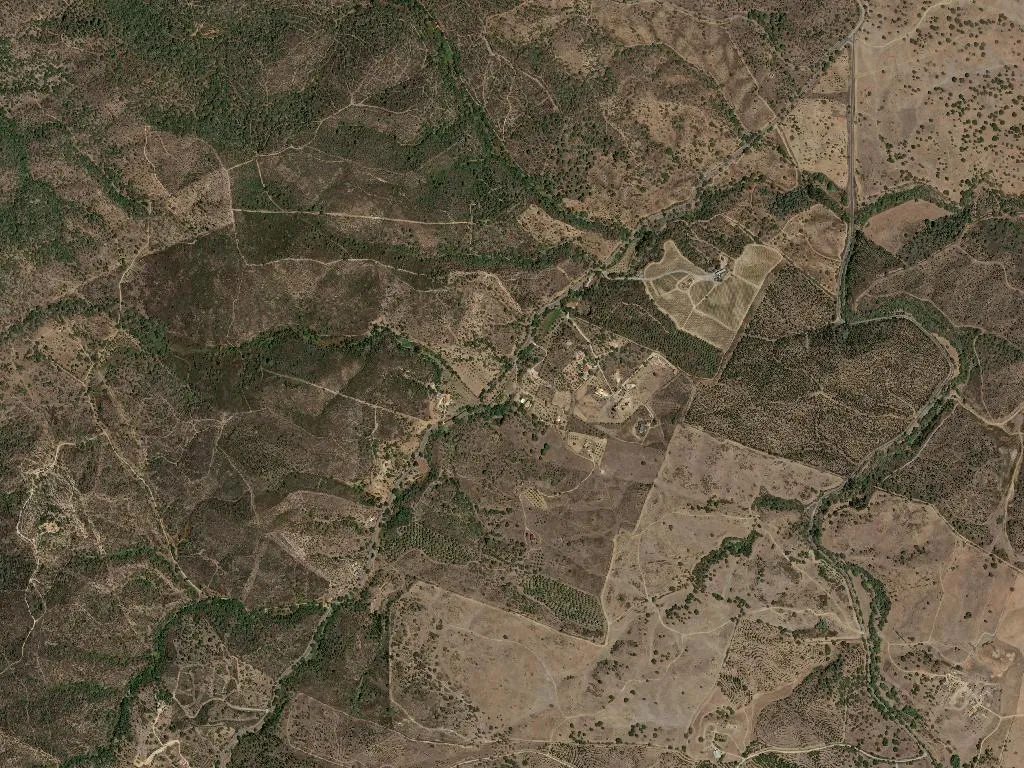
The Serra de Grândola is a ridge of Ordovician slate that makes your teeth sing if you taste dust on a windy day. Cork oaks twist out of it like elderly partisans, trunks stripped every nine years to the raw umber of fresh cork. Walk downhill and the soil lightens to the poor sand of the charneca, where umbrella pines drop needles that smell of peppermint rock. This is the territory of Sunday strolls: trainers filling with sand, children vanishing among strawberry trees whose fruit ripens like scarlet ping-pong balls.
The Davino river is modesty itself – a winter thread, a summer memory – yet it keeps the reed beds green enough to lure flamingos on their commute between the Sado estuary and the rice fields of Comporta. Bring binoculars, but leave the click-and-shoot at home; waders here spook faster than any Lisbon waiter confronted by a hen party.
What the soil insists on putting on the plate
Grândola does not do “fusion”. It does consequence. Lamb from these stony pastures carries the IGP stamp “Baixo Alentejo”, the flavour of thyme and drought. Kids still nursing appear as Cabrito do Alentejo IGP, the meat pale from a milk diet that ended only days ago. Black pigs roam the montado, snuffling for acorns that turn their fat into something halfway between butter and marzipan; the resulting Carne de Porco Alentejano DOP needs nothing more than coarse salt and a hot grill. The half-soft, half-bitter Serpa DOP cheese arrives at table with bread you tear, not slice, scattering crumbs like schist shards across the linen.
In the 257 places to stay – from homestays scented with wood-smoke to converted barns where the pool is an old irrigation tank – breakfast means jam from the neighbour’s apricots and coffee that arrives when it’s ready, not when you tap an app. Call it slow food and you’ll be corrected: “It’s just food, cooked by people who eat it too.”
Walk slowly, listen to the trees
Way-marking is refreshingly minimal: a dab of red paint on a cork trunk, a cairn of slate. Leave the town square, pass the agricultural co-op, and within ten minutes you are in a hush so complete you can hear sweat evaporate. Population density drops below eight per km²; the only company may be a wild boar that bolts faster than you can raise a camera. Take water, take a hat, and forget the signal bars – half the map on your phone is already parchment-coloured.
By late afternoon the benches around Praça da República fill with the unhurried. Old men discuss rainfall the way City brokers discuss futures; grandchildren practise wheelies while their mothers scroll wordlessly through Instagram. The average age is high, the birth-rate low, yet the conversation is alive, trading memories of Paris construction sites and Venezuelan gold mines the way other villages swap recipes.
Dusk falls fast. The serrra becomes a black paper-cut against a sky still lemon at the horizon, and the air cools as suddenly as if someone had opened a fridge door. Somewhere an owl rehearses the opening bars of Afonso’s song, but slower, in a minor key. Only then does Grândola stop being a lyric and become a place you can inhabit without subtitles – a village that, for once, refuses to end when the music does.