Full article about Concrete, Creole & Estuary Breeze in Baixa da Banheira
Baixa da Banheira & Vale da Amoreira mix Tagus salt, Afro-Portuguese murals and pre-cast estates into Moita’s most atmospheric commuter town.
Hide article Read full article
Concrete and Estuary Air
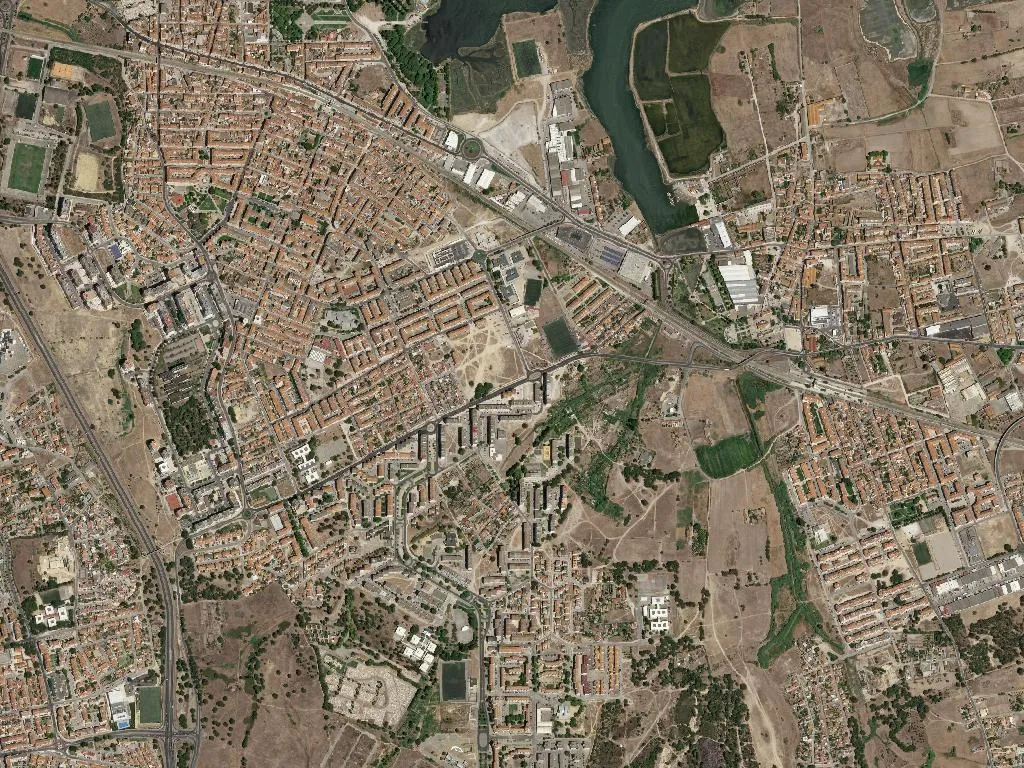
The Fertagus train exhales and the atmosphere shifts. Before the doors slide apart, you already taste it—warm, tidal breath from the Tagus laced with the metallic tang of overheated brake discs. A salt-southerly draught sweeps the platform at Baixa da Banheira station: the estuary is only seven metres above sea-level, almost level with the soles of your shoes. Thirty thousand people live on this pancake of alluvium, barely six square kilometres of densely packed geometry.
When the Rails Replaced the Rivers
Two modest rivers once crossed this flood-plain—Ribeira da Banheira and Ribeira da Amoreira—ringing their small farms with reeds and dark alluvial soil. Then the railway arrived in the 1930s, ferrying foundrymen from Castelo Branco, ploughmen from Alentejo, fishermen from the Algarve. Each carriage unloaded a different accent, a different paprika, a different saint above the cooker, but the objective was identical: four walls within walking distance of a wage. Baixa da Banheira stacked itself street by street until it swallowed thirty-five per cent of the entire municipality of Moita. Vale da Amoreira kept its orchards longer. In 1970 the first pre-cast housing estate—Bairro Fundo de Fomento de Habitação—rose on the former vegetable plots; after the 1974 revolution, thousands of returnees from Portugal’s former colonies were billeted here. Today the neighbourhood hosts one of the largest Cape Verdean communities in greater Lisbon; on summer evenings you hear morna drifting from a third-floor balcony while the concrete still radiates the day’s heat.
Spray-Paint Chronicles
Vale da Amoreira’s party walls serve as an open-air diary. Geometric patterns echo West-African textiles; half-finished faces peer between scaffolding; tags switch mid-sentence from Portuguese to Cape Verdean Creole, sometimes to French. Municipal programmes give aerosol artists legal space and time; the result is a palimpsest that resists the estuary’s salt air. At dawn, low light strikes the east-facing façades and the murals appear almost liquid—indigos gain depth, vermilions smoulder.
A Market that Behaves like a Piazza
Inside the re-furbished Mercado Municipal da Baixa da Banheira, stainless-steel counters replace the old timber stalls, yet the function is stubbornly social. Shoppers debate the price of golden peaches in July, exchange rumours about next year’s school placements, queue for espresso at the counter where the aroma meets drifting September grape must. Bottles of Moscatel de Setúbal line one aisle; another chiller holds Carnalentejana DOP beef, trucked in daily from the Alentejo plains.
The Clubhouse Republic
If the parish has a defining architecture, it is organisational, not aesthetic. Worker-run cultural clubs founded in the 1940s did far more than host weekend dances: they built nursery schools, paid secondary-school fees, ran literacy classes for women who had followed their husbands to the factory gates. Even now, with over-65s outnumbering under-15s by roughly seven to four thousand, the neighbourhood association still lobbies for allotments, diabetes screening, after-school karate. Every painted bench, every community hall, every azulejo-scattered wall has been argued over, voted on, reclaimed.
Salt on the Skin
Leave the station at dusk and the estuary reasserts itself. Condensation beads on apartment glass; the occasional fig or tamarisk pushes through cracked tarmac, leaves glossy with brine. The road south to Setúbal crosses salt marshes where stilts and avocets pick through mirror-flat ponds; behind you, the skyline is a low algebra of rooftops and television aerials. Board the evening train and the carriage fills with phone-lit faces, polyglot gossip, the faint sweetness of pastéis de nata bought from the market mezzanine. As the train accelerates towards Lisbon, the last thing you register is sound: a Cape Verdean guitar line fading above the clatter, while the Tagus—unseen but omnipresent—lays another microscopic layer of salt on Vale da Amoreira’s technicolour walls.