Full article about Gaio-Rosário & Sarilhos Pequenos: Tagus dusk, flamingo ink
Oyster wharfs turned cod vats, Neolithic nets, river-blessing boats
Hide article Read full article
River Light
The Tagus is still warm from the afternoon sun when its colour shifts – slate-blue dissolving into molten gold just before dusk. Beyond the wooden pontoon, low tide peels back the estuary to reveal russet banks of silt where flamingos sharpen the horizon like pink stylus strokes. Salt, silt and the faint iodine of wrack hang in the air; the only sound is the small slap of micro-waves dying on the imported sand. Nineteenth-century boards creak underfoot, the same complaint they have made since the days when ox-carts arrived with cork and copper, and left with holds full of oysters.
Fluvial Memory
Gaio was never a village that happened to be on the river; it was a creature of the river. Six millennia of middens lie beneath the primary-school playground – archaeologists pulled out Neolithic net-sinkers in 1994 – but the modern story starts with Martim Afonso’s sixteenth-century estate and accelerates when the estuary became Lisbon’s larder. By 1900 flat-bottomed skiffs shuttled crates of Tejo oysters to the capital and across the Spanish border by the million; wooden trawlers were built on the same slipways that now service fibreglass runabouts. In workshops along the Gaio quay, women coiled kilometre after kilometre of tarred rope – the "sarilhos" that gave neighbouring Sarilhos Pequenos its name.
When oyster stocks collapsed in the 1960s the parish council tempted Europe’s largest salt-cod processor to the old drying yards. The factory still desalts thirty thousand tonnes a year, its stainless-steel vats humming behind the original ochre façade; the workforce park their scooters beneath stone lintels carved with anchors.
Blessing the Water
On the first Sunday of August the river becomes a nave. Fishing boats, kayaks and the ferry from Barreiro dress themselves with marigolds and ribbon for the procession of Nossa Senhora da Boa Viagem – Our Lady of the Safe Journey. The parish priest moves from deck to deck, sprinkling the bows while engines idle and passengers lean over the rails to catch a drop on a handkerchief. October belongs to Our Lady of the Rosary, whose feast dissolves into sardine smoke and improvised fado in the square beside the tide gauge. Mid-summer brings the Círio dos Pescadores: the bishop’s launch circles the fleet three times, scattering carnations and reciting the 104th Psalm in a baritone that carries across the water. Inside the fishermen’s social club the same night, singers still trade extemporaneous quatrains over glasses of cloudy white.
Eating the Estuary
The cooking tastes of silt and tide. Caldeirada de enguias layers river eels with tomato, potato and pimentão, finished with cheiro-da-terra, an aromatic herb that grows only on the brackish edge. Ensopado de peixe-espada com amêijoa is comfort food at 3 a.m. after the nets are hauled: chunks of swordfish simmered open with clams, no more than a lick of white wine and plenty of coriander. Stewed oysters recall the golden age of ostreiculture, their liquor thickened with caramelised onion. Winter demands açorda de marisco – a bread soup bobbing with prawns and a softly poached egg – or sopa da panela de borrego, a clay-pot lamb broth served with yellow corn bread. Dessert stays local: bolinhos do Gaio, cinnamon-dusted rice cakes, and the queijadas de Sarilhos, flaky pastries filled with requeijão. The wines are from the Setúbal Peninsula – light muscatel for shellfish, periquita reds for anything that once had fins.
Living on the Edge
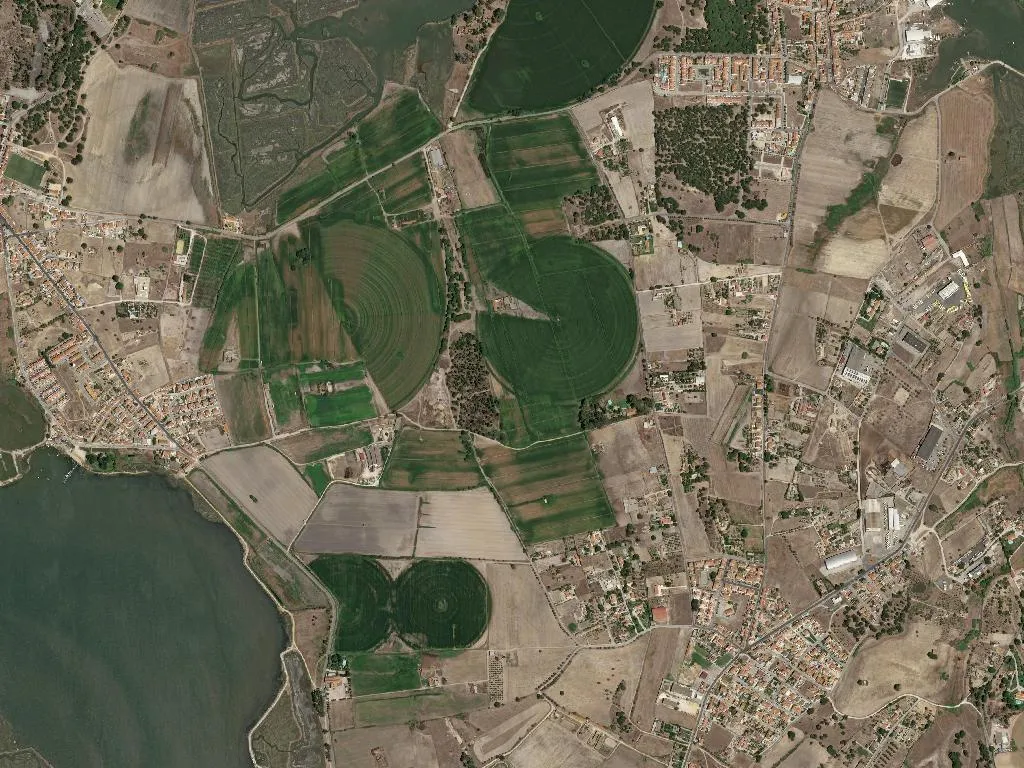
The Linear Park follows every curve of the estuary, a five-kilometre ribbon of boardwalk and cycle track punctuated by bird hides. At dusk spoonbills lift off the salinas, wings edged in copper; further out, glossy ibis probe the mud like curved tweezers. The artificial river beach – 7,000 m² of Tagus sand dredged in the 1990s – fills with families who prefer currents they can see. Kayaks slip between glasswort and sea lavender, startling terrapins that balance on half-submerged logs. The cycle route continues east to Alhos Vedros, past salt pans painted peach by micro-algae and the ruin of a tide mill whose wheel stopped turning in 1974.
When the sky finally drains of colour the far bank becomes a string of sodium pearls reflected in black water. The only motion is the estuary breathing – a slow lift and fall that has measured the parish clock for centuries, reminding whoever is on the pontoon that this place was never backdrop: it was workplace, market, highway, home.