Full article about Flamingos & Salt-Tanged Streets of Montijo–Afonsoeiro
Estuary breezes, baroque chapels and pink flamingos in the wetlands of Montijo and Afonsoeiro.
Hide article Read full article
Montijo: Where Marsh Meets Tide
Water slaps against warped timber. From the river quay, Tagus estuary brine laps at pillars blackened by salt and silt. The breeze smells of mudflats and seaweed. Twenty-five minutes across the water, Lisbon glitters; on this bank you stand ankle-deep in a slower, damper, earthier world.
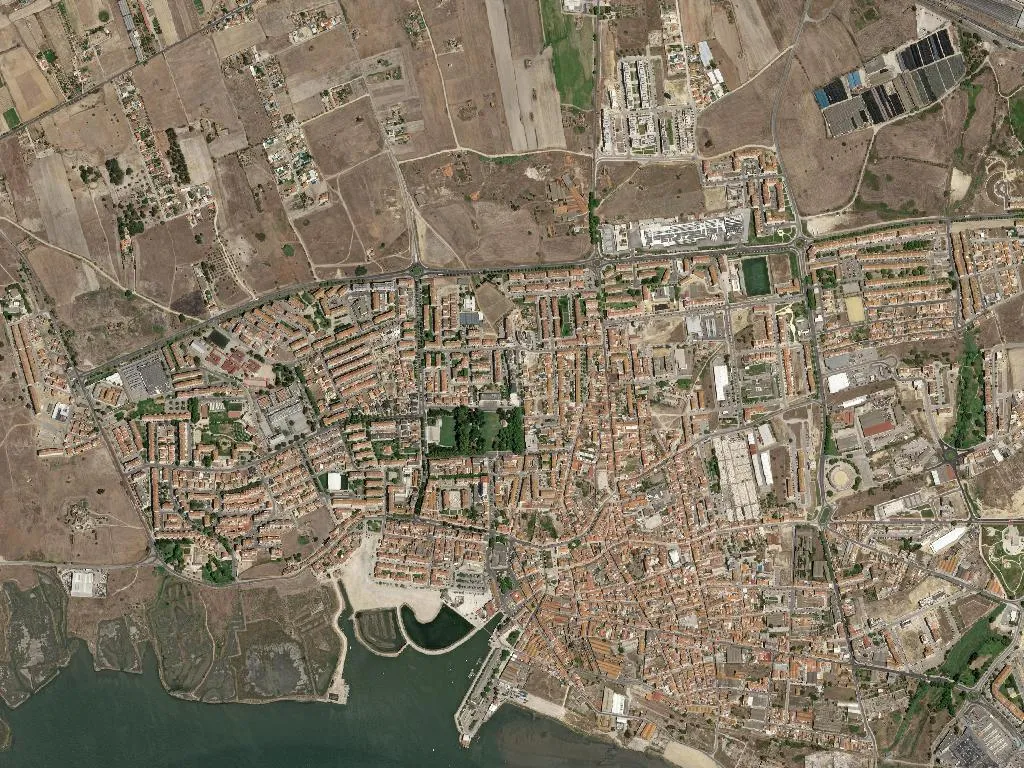
Average elevation: 12.6 m. Almost everything is flood-plain. The Latin monticulus – little hill – gave the town its name, yet “hill” flatters the ripple on which it sits. Founded in 1295 under the Order of Santiago, today’s Montijo squeezes 41,404 residents into barely 30 km².
The houses that rode out the quake
Lisbon’s 1755 earthquake shook the place hard, but Pombal’s rebuild left straight streets and thick-walled, lime-washed façades. The pillory – Pelourinho, listed since 1910 – stands in a square where stone still radiates late-afternoon heat. Inside the parish church of Nossa Senhora da Graça, a Mannerist altarpiece survived both tremors and time. Blue-and-white 18th-century tiles in the Misericórdia narrate Bible stories in cobalt; next door, the pocket-sized 16th-century Chapel of São Sebastião cradles an outsized baroque throne – its very disproportion is what fixes it in the memory.
Cross into Afonsoeiro, once a royal hunting ground gifted by Dom Afonso III to Afonso Anes in 1258, and the Church of Nossa Senhora da Conceição rises among stone-pine plantations that still drip resin on summer mornings.
Flamingos, salt, rice
Europe’s largest estuarine nature reserve begins here. Internationally rated wetlands fan out between saltpans and reedbeds. The Estuary Trail runs 11 km from quay to mud-bank; on any given winter morning, greater flamingos sieve shrimp in ankle-deep water while purple herons stand motionless among bulrushes. In 2021 the only successful flamingo nesting in Portugal was recorded on these islets.
A riverside boardwalk and cycleway thread the Urban Park of the Tagus. At dusk the sun drops behind Lisbon, turning high-rise glass copper – a show best viewed from this, the less celebrated shore.
Eels, escabeche and chilled muscatel
Montijo’s cooking tastes of river and hinterland. Clam soup is thickened with yesterday’s bread and handfuls of coriander; eel stew smells of white wine and parsley. A 19th-century canning industry survives in bar snacks of pickled tuna and sardine escabeche sold inside the 1920 municipal market. Olive-oil cakes arrive warm, their crusts shattering between the teeth; sweet pastries are stuffed with pumpkin jam or the local queque sponge. To drink, frosty glasses of Setúbal muscatel or Tagus lager. Look out, too, for Carne de Bravo do Ribatejo beef and Riscadinha apples from nearby Palmela, especially during November’s São Martinho fair.
Flying boats, guitars and waterborne processions
In 1920 the first commercial seaplane in Portugal left this quay for Cais do Sodré; the commuter ferry still keeps Montijo on an umbilical cord to the capital. On the first Sunday of May, a flotilla of fishing boats carries the image of Nossa Senhora da Graça across the river – a thin line of devotion stitched between banks. June’s Festas de São Pedro colour the streets with paper bunting and all-night folk dancing. Fado guitarist António Chainho, born above a hardware shop on Rua da Misericórdia, took Montijo’s fretwork to concert halls from Paris to Tokyo.
Across the industrial estate, the Arte no Montijo murals daub warehouses with spray-can colour, giving a 21st-century counterpoint to Pombal’s sober grid. In the estuary visitor centre, tripods of telescopes pick out what the naked eye misses – the blush-pink underwing of a flamingo, the dagger-dive of a grey heron.
Late afternoon, tide out, a strip of glistening mud appears; fiddler crabs scuttle sideways. The air cools, salt dries on your lips, and the last ferry casts off with the wet slap of a rope. Those who stay behind hear the engine fade – then only the river, breathing in and out like some great estuarine lung.