Full article about Pinhal Novo: Railway-Born Plain Between Pines & Salt
Hear the 1857 Linha do Sul rattle through wheat fields scented with resin and Atlantic brine
Hide article Read full article
Pinhal Novo: Where the Plain Tastes of Salt
The train is heard before it is seen. A metallic shiver travels along the rails, judders through the platform concrete, then dissolves in the warm air rising off the flatlands. At Pinhal Novo station the sound has repeated itself for 166 years – since 1857, when the Linha do Sul sliced through the pine forest and gave a heartbeat to a village that did not yet exist. Step onto the platform today and the sequence is always the same: first the dry heat radiating from the cement, then a breeze freighted with resin – or the memory of it – and finally the hush of almost 27,000 people living on the hinge between suburb and countryside.
A Name That Comes Out of the Ground
There is no castle, no medieval wall. Pinhal Novo’s origin is lexical: two words that mean precisely what they say. “Pinhal” for the blanket of stone pines that once covered this gentle plateau, barely 41 m above sea level; “Novo” because the nineteenth-century settlers who arrived with the railway were instructed to clear glades, sow wheat and plant vines where only straight trunks had stood. The town is therefore daughter to both earth and iron: the line turned the scatter of small-holdings into a staging post between Lisbon and the Alentejo, and the daily traffic in grain, cork and red wine wrote itself into local DNA. Official village status arrived only in 1991 – a bureaucratic catch-up to an identity that had been fermenting for decades.
Between Two Protected Worlds
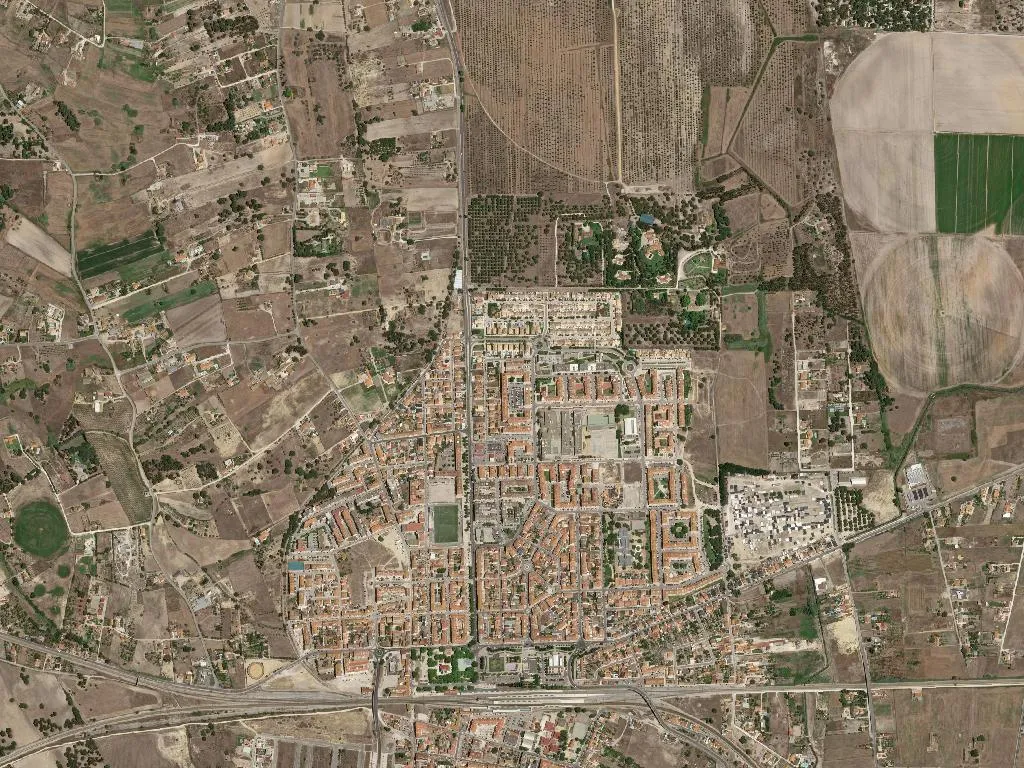
Geography here is a quiet privilege. To the south, the Arrábida ridge drops limestone cliffs into a sea the colour of slate ink; to the east, the Sado estuary unravels into creeks, salt marsh and copper-bright mudflats at dawn. Pinhal Novo sits between these two protected areas on a plain whose population density – just under 500 people per km² – still feels roomy. Walk five minutes beyond the last roundabout and the fields fan out, ruler-flat, to a horizon pricked with vineyard posts and olive trees that have survived every drought since the 1880s. When the wind swings south-westerly it carries the estuary’s iodine breath, a damp tang that settles on skin and reminds you the Atlantic is only 20 km away, even when you cannot see it.
Grapes, Cheese and an Apple with Stripes
The Península de Setúbal DOP reds – Castelão is the signature grape – taste of the sandy heat that bakes these soils. The vines are everywhere: low rows in summer leaf, skeletal stakes in winter. But the certified larder extends beyond wine. Azeitão DOP cheese, velvet-creamy and mildly pungent, is produced on Arrábida’s northern slopes ten minutes away. Palmela’s striped apple, Maçã Riscadinha – small, tart, almost cidery on the nose – is harvested from heritage orchards around the parish. Both products carry EU protected status; tracking them down requires the same patience you would give a perfectly ripened cheese.
The Rhythm of a Town Still Growing
With more than 4,000 children under fourteen and roughly the same number of residents over sixty-five, generations cross paths constantly – on the broad pavements of Rua 1º de Maio, in cafés whose tables spill onto the street, on Saturday mornings when the monthly producers’ market slows traffic to a stroll. Pinhal Novo does not market itself as a destination; its 25 guest rooms are aimed at business travellers or coastal refugees who want Arrábida’s beaches and Setúbal’s restaurants without sea-view prices. Logistics remain nineteenth-century simple: the station is still the civic heart, and Lisbon is 38 minutes away on the Fertagus commuter line – the Tagus sliding into view just before the 25 de Abril bridge, a surprise that never ages.
Salt on the Wind, Resin in the Mind
There is no beach, yet the ocean insists. On clear days the Sado breeze arrives salted with iodine and estuarine silt; the light over the plain has the diffuse, pewtery quality found only where land is low and water is near. Pinhal Novo occupies the interval – between limestone ridge and tidal river, between the departing and the arriving train, between the pine forest that named it and the vineyards that now pay its bills. The last thing you hear at dusk is the dry click of cooling rails after a day of sun – a sound so small it feels intimate, the audible signature of a place where railway and plain have been talking since day one.