Full article about São Domingos
Scent of dry earth, free-grazing Carnalentejana and salt breeze from 15 km away
Hide article Read full article
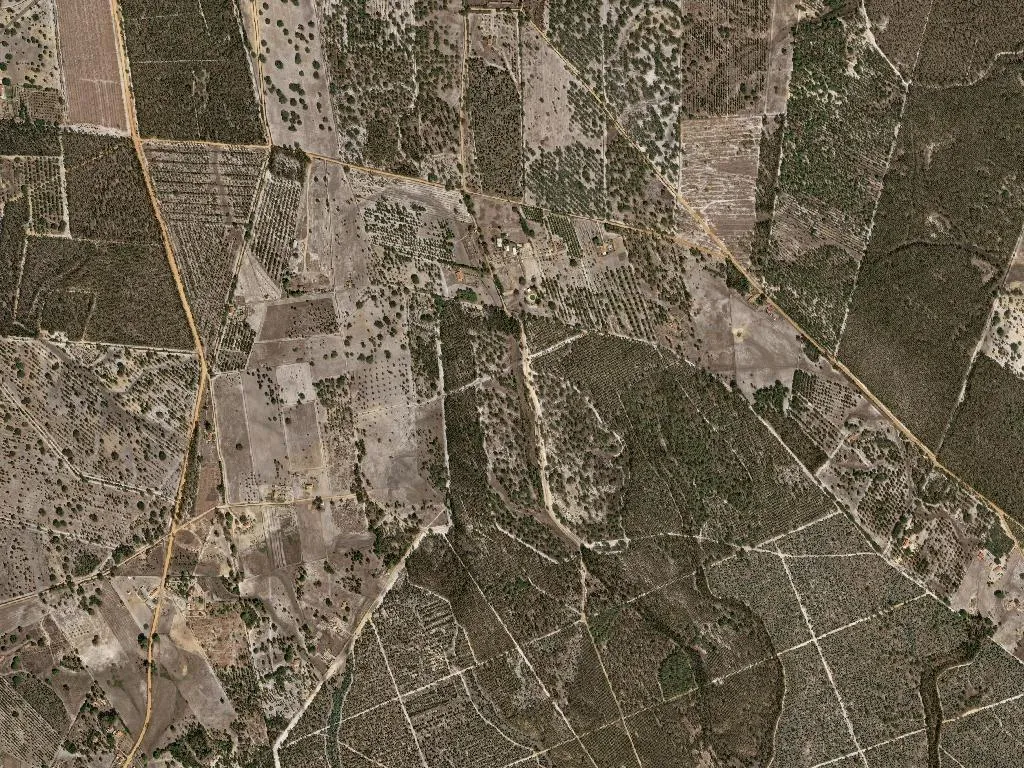
The plain stretches as far as the eye can see, interrupted only by lines of holm oaks and alder trees that cast long shadows at the end of the day. The air carries the scent of dry earth and grazing grass, and in the distance, far off, the white of a single-storey house stands out against the ochre soil. Here, on the coastal edge of the Alentejo, São Domingos breathes to the rhythm of five people per square kilometre — one of the lowest population densities in the entire municipality of Santiago do Cacém.
Land of grazing and montado
Across 12,926 hectares, the parish survives on the ancient pact between man and beast. The Santiago do Cacém Agricultural Cooperative, founded in 1964, still markets Carnalentejana DOP beef from cattle that graze freely beneath the cork and holm-oak canopy. Flocks of lambs — protected by the Borrego do Baixo Alentejo IGP label since 1996 — drift between parcels owned by three large estates: Herdade da Comporta, Herdade do Pinheiro and Monte da Lagoa. Alentejan pigs, reared extensively, fatten on acorns in the dehesas that roll north of the EN261.
At 110 m above sea level, Atlantic winds travel the 15 km from Melides beach to temper the summer heat and carry the salt tang that links this inland parish to the ocean. The same breeze feeds the Santo André and Sancha Lagoons Nature Reserve, classified in 1980 and one of Portugal’s most important coastal wetland systems. Though the heart of São Domingos is rural, the sea is never quite absent from its identity.
Food without flourish
In the grocery “O Pingo”, opened in 1978 and now run by the founder’s daughter, Serpa DOP cheese arrives every Friday from Vicente’s dairy in Serpa. Meat — beef, lamb or pork — comes from the municipal abattoir in Santiago do Cacém, where local farmers deliver on Tuesdays and Thursdays. The house sausage is a three-month smoked chouriço of black-pork meat. Olive oil is pressed at the Santo André cooperative, where 400 growers deliver galega and cobrançosa olives between October and December.
The only tasca open to outsiders — “A Paragem” on the EN261 — serves lamb stew on Wednesdays and seafood açorda at weekends, when Alfredo can source fresh catch from Sines. The house red is “Monte da Baía”, made by a small family property 20 km away in Santa Margarida da Serra.
Ageing and memory
Of the 585 residents counted in 2021, 221 are over 65 — almost four in ten. Only 52 are children, chasing footballs down streets where traffic averages twelve cars an hour. Seven holiday cottages — all converted between 2018 and 2022 — offer full immersion in this suspended everyday. There are no queues, no admission times, no need to book ahead. What exists is space: 22.1 square kilometres of it, and time to walk it.
The primary school closed in 2015 when the roll fell to eight. Now children catch the 07:45 bus to Santiago do Cacém, returning at 17:30. The day-care centre, opened in 2019 in the former parish hall, looks after 23 users, all born here. When the sun drops and the air cools, the smell of wood smoke rises from chimneys. Between the distant crow of Zé Manel’s rooster and the muffled bark of Dona Amélia’s dog, Bubi, São Domingos reveals itself: a place where the essential still suffices.