Full article about Corroios: Where Tagus Mud Meets Brutalist Balconies
Low-rise flats, shipyard ghosts and brackish wind shape daily life in Corroios, Seixal.
Hide article Read full article
Where the Estuary Breathes Through Concrete
The first thing that touches you is the wind—warm, brackish, carrying the smell of salt and silt. It rises not from the Atlantic but from the Tagus estuary, sliding over mudflats that appear only at low tide and brushing the façades of post-war apartment blocks. At dawn, when the Fertagus train rattles in from Lisbon, the air still holds the night’s moisture; by the time the sun clears the 26-metre contour line, the haze has settled like dust on the aluminium shutters of every fourth-floor balcony.
Density as Landscape
Fifty-eight thousand people occupy 17 square kilometres here, a figure that translates into audible fact: buses grinding through roundabouts, children’s voices echoing off 1970s concrete, the pneumatic sigh of bakery doors every morning at seven. Corroios is not a dormitory that empties before the commuter clock strikes; it is a self-feeding organism. Pensioners set its tempo—11,204 of them—pausing at the kiosk outside Igreja Matriz to argue over yesterday’s Sporting score while waiters ferry bicas in white porcelain. Teenagers reclaim the rhythm after school—7,089 under-14s dribble footballs across tarmac courts, their trainers squeaking the exact shade of municipal green chosen in 1998.
Look up and every other balcony displays a satellite dish like a small grey moon; look down and the pavements widen, narrow, then widen again according to the hurried master-plans of the Estado Novo, still readable in the angles of social housing blocks named after engineers rather than saints: Bairro da Silva, Bairro Novo, Bairro do Moinho.
One Listed Monument and a Memory of Steel
Official Portugal has granted listed status to a single building—the parish church, rebuilt in 1780 after the Lisbon earthquake. That scarcity is instructive. Corroios was erected not on Roman foundations but on shipyard contracts. Between 1940 and 1980 the Lisnave dry-docks, the Quimigal fertiliser plant and the National Siderurgy steelworks sucked in labour from Trás-os-Montes, the Alentejo and the Beiras. Red-brick chimneys once stood where the Forum Seixal shopping court now organises Saturday parking; welding sparks flew where teenagers now queue for bubble tea.
Go on a weekday and you can still clock the inheritance: a retired metalworker in a faded Lisnave boiler suit buying chouriço at the market, the muscular vowels of Alentejan Portuguese slicing through the softer Lisbon accent of his grandchildren.
The Peninsula Beyond the Blocks
Despite the concrete, Corroios belongs geographically to the Península de Setúbal wine zone. Sandy limestone soils and Atlantic- moderated winters begin two kilometres south of the last roundabout, nourishing Moscatel and Castelão vines whose grapes become the amber, orange-peel-scented liqueur automatically set down after lunch in neighbourhood grill rooms. You will not glimpse trellises between tower blocks, yet the terroir insinuates itself: the same iodine breeze that dries laundry on seventh-floor lines also ventilates oak casks in Azeitão cellars.
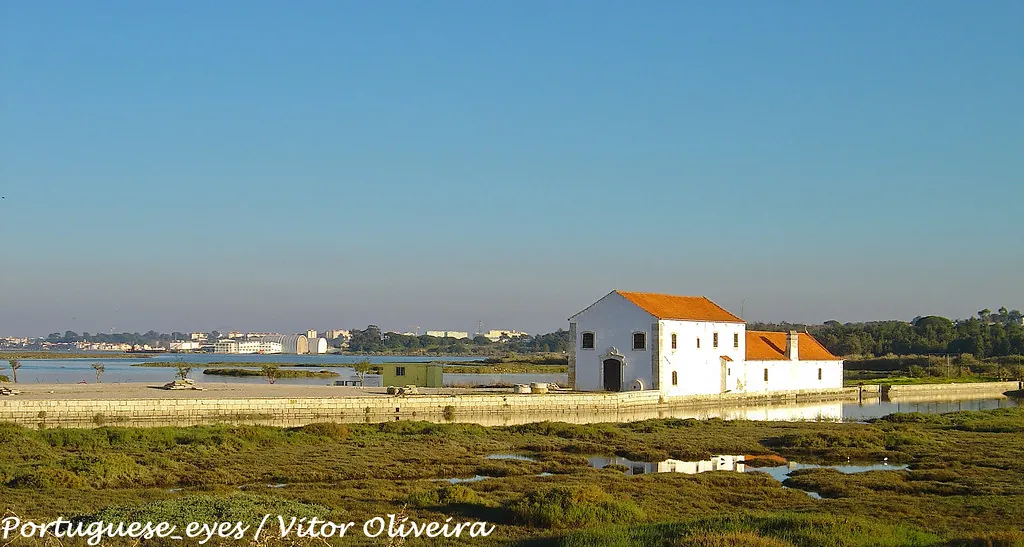
Logistics favour the curious. A 12-minute train ride delivers you to Pragal; from there the 25 de Abril bridge is 15 minutes by car, Lisbon’s Cais do Sodré even less. For those who choose to stay, 132 legal lodgings—ranging from entire flats to hostel bunks—offer rates one-third lower than the capital, making Corroios an efficient base for cycling the 20-km riverside path that links Amora, Seixal and the still-functioning tidal mill at Ponta dos Corvos.
Texture of the Everyday
There is no checklist sightseeing. Instead, texture: the 1952 municipal market refitted in 2004, where cherne (grouper) and lingueirão (razor clams) arrive by van from Setúbal before the fishmonger’s cigarette is half smoked. Formica tables at Café Avenida, open since 1978, where the galão arrives in a tall glass and the toasted sandwich is cut on the diagonal, always. Jardim da Mina at 18:30, when the plane trees cast metre-long shadows across sun-scorched grass and someone’s grandmother feeds pigeons from a plastic Sonia bag.
Evening noise layers itself: television chatter drifting from open kitchen windows, a scooter gunning uphill toward the N10, the 18:42 Fertagus whistle that tells every family the dinner hour is negotiable. The risk register is reassuringly boring—petty theft, the occasional football argument, nothing that requires a traveller’s sixth sense.
The Taste Left Behind
When the day’s errands are done, windows swing open to the estuary again. What settles on your lips is not the sharp salt of ocean spray but something heavier—salt married to riverbed, to grilled sardine escaping a fifth-floor balcony, to exhaust fumes from a bus route that should have been electrified years ago. It is the flavour of a place that refuses to perform for visitors, that simply continues—dense, stubborn, alive—while the tide keeps breathing in and out beyond the last car park.