Full article about Sesimbra Castle: Atlantic wind over 12th-century stone
Stand where Moors watched Lisbon, azulejos glow inside the chapel
Hide article Read full article
Sesimbra (Castelo): Where the Serra Drops into the Atlantic
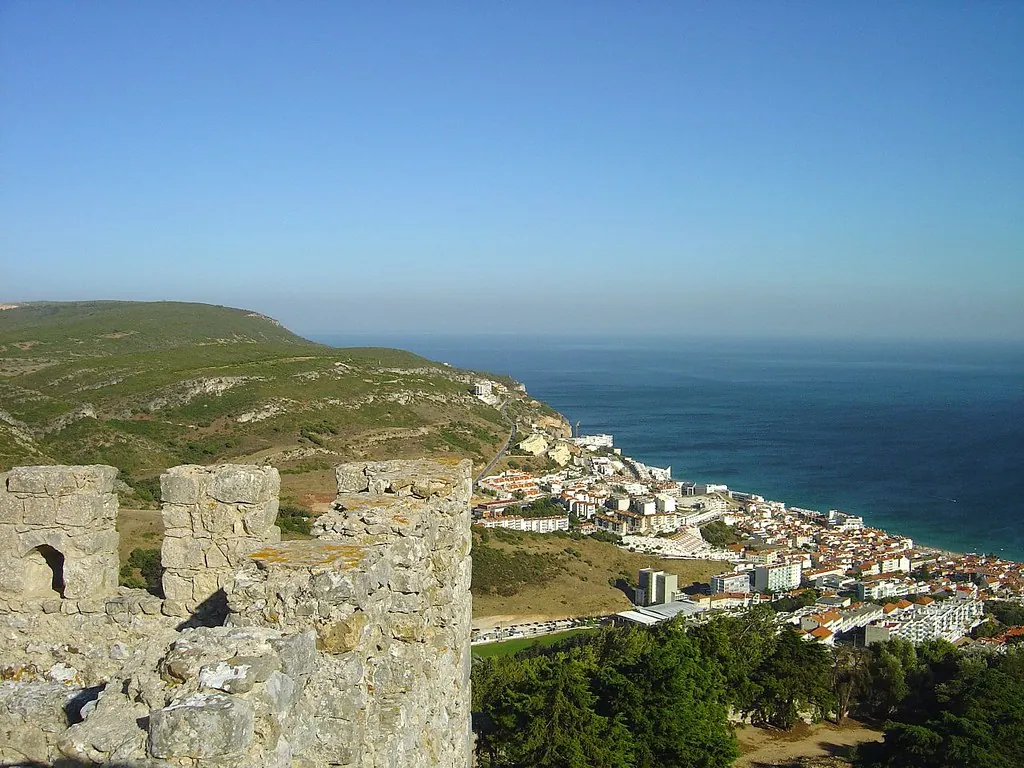
The wind arrives salted and herb-heavy – thyme, rosemary, rock-rose – and slams straight into the ninth-century battlements that cap the hill. Below, the Atlantic looks almost viscous, a slab of cobalt that refuses to shimmer. From the keep of Sesimbra Castle, the last Portuguese fortress with an unbroken sea view, your gaze free-falls: down through maquis-covered slopes, over the terracotta roofs of the fishing town, to the horizon where sky and water weld into a single glare. The image sticks, and it sticks hard.
Moorish stone, Christian lime
The parish of Sesimbra (Castelo) was carved out in 1388 and still covers 180 km² of cliff, cork forest, sand-dune and limestone ridge. Only 20,000 people live here, a density low enough for the land to breathe. Moorish engineers chose the 200-metre outcrop above the bay for a reason: from its walls you can sight Lisbon to the north and Cape Espichel to the west, the two compass points that mattered for trade and defence. Afonso Henriques stormed the castle in 1165 with crusading help; the keep and the Porta do Sol you climb today are twelfth-century, patched in the 1930s but still honest to the original footprint. Duck into the Igreja de Santa Maria and the interior is a shock of blue-and-white azulejos, 1720s tiles that narrate the Assumption in comic-strip panels. Entry is free; the custodian simply lifts the rope when you appear.
Walk the south wall and you understand why the place never fell again: the drop is sheer, and the Atlantic wind keeps you pinned like a specimen.
The fort that watched for pirates
Five minutes downhill, the Fortaleza de Santiago juts into the sand at sea level. Built 1642-48, its low star-shaped walls were designed for cannon, not arrows; inside is the town’s Maritime Museum, where a 1948 tuna-fishing dory, painted peppermint-green, sits beside harpoons and glass floats that smell permanently of brine. Outside, the Capela do Espírito Santo dos Mareantes – the Sailors’ Holy Spirit Chapel – still receives flowers before each trawler leaves port. The gesture is older than the nation.
The headland where the continent ends
Drive the coast road west and the lane ends at Cabo Espichel, a 110-metre knife-edge of limestone. The Santuário de Nossa Senhora do Cabo stands on the very lip, flanked by two eighteenth-century pilgrims’ hostels whose arcades are blistered white by salt. Stand on the parapet at dusk and the only sound is the Atlantic detonating against the cliff base; the sun drops straight into the ocean, turning the stone gold and the sea almost black. Pilgrims once came here to venerate a 1410 Marian apparition; today the buses leave at sunset and you can have the silence to yourself.
Toast flour and muscatel
Sesimbra’s cooking is split between surf and serra. Grilled red-mullet and percebes (goose barnacles) arrive straight from the wooden boats you see hauled up on the slipway, but the surprise is doçaria. Ask for farinha torrada in any café – a toasted-flour sweet scented with lemon peel and cinnamon, invented by local nuns and sold since the 1950s. Pair it with a glass of Moscatel de Setúbal aged in oak: amber, figgy, persistent. Inland, the soft-quilted Queijo de Azeitão DOP is coagulated with cardoon thistle, giving a vegetal bitterness that slices through the sugar.
Tracks through arbutus and salt spray
The parish lies wholly inside the Arrábida Natural Park; from Lisbon it is 40 minutes by car yet the ridge feels frontier-wild. Sign-posted trails leave from the castle gate and climb through arbutus, cork and dwarf oak to reveal pocket coves the colour of Bombay Sapphire. North of the town the Lagoa de Albufeira is a wind-tidal lagoon beloved by kitesurfers; south-west, the beaches of Meco have been clothing-optional since 1975, a social habit that survived every subsequent tourism boom. Between them lie the tiny calas – Ribeiro do Cavalo, Lagosteiros – reachable only by footpath or kayak, where the water is so clear you can count the ripples on the sand three metres down.
Back in town, look up: house doors have been painted with life-size historical scenes – sardine sellers, net menders, the 1535 earthquake – turning the old quarter into an open-air graphic novel. No fanfare, no tickets; just walk Rua da Fortaleza at 6 pm when the shadows give the trompe-l’œil depth.
The weight of wind at Espichel
There is a moment – everyone who stays for sunset recognises it – when the Atlantic wind drops for three, maybe four, heartbeats. The silence is not absence but substance: the echo of surf, the resin of heated heather cooling on the stone, the afterglow of limestone still holding the day’s heat. It is the colour of that gold, the exact tone the Atlantic throws back at Portugal when the light lies flat across the ocean, that you will find yourself trying to describe later and fail. You take it home in your luggage anyway.