Full article about Salt, Stone & Dinosaur Prints in Sesimbra
Dawn fish auction beneath Santiago castle, Jurassic tracks inland, Arrábida ridge ablaze
Hide article Read full article
Before the View, the Smell
The Atlantic announces itself early: salt crust, sun-baked wrack, a ribbon of diesel from the returning trawlers. Avenida 25 de Abril is still in shadow when the first boxes hit the quay—white polystyrene sweating ice, corvina staring skywards, cuttlefish drumming against the sides. Fishermen in indigo overalls coil orange rope while gulls wheel over the jade-green bowl of the bay. By the time the sun scrapes the peeling plaster of the old town, the hilltop castle is already gilded and the ridge of the Serra da Arrábida looks close enough to touch.
Walls over the Atlantic
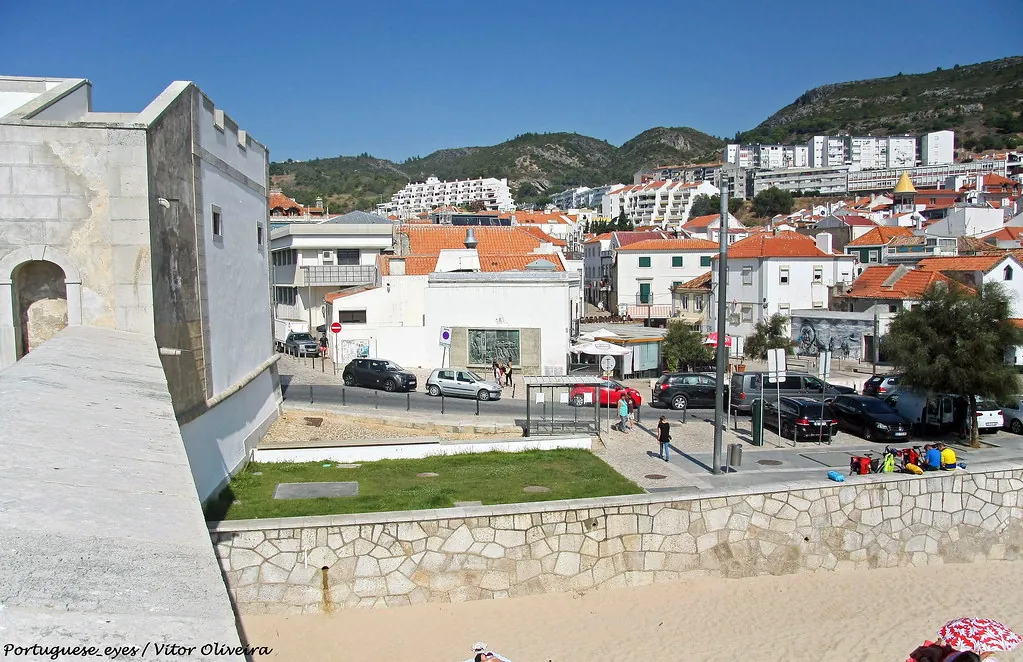
Muslim engineers chose the bluff first; Sancho I finished the job in 1199 and gave the fortress to the Knights of Santiago two generations later. What survives is a palimpsest—Islamic footings, Manueline bartizans, eighteenth-century gun emplacements—held together by stone pine that scents the wind. Walk the battlements and the view is a full circle: terracotta roofs stepping downhill to the Renaissance Fortaleza de Santiago, the small-boat anchorage, and, far west, Cabo Espichel’s sheer basalt prow. Locals claim that when an easterly levante blows you can hear Africa.
Down in the parish church, built atop its medieval predecessor, the gilded altarpiece is pure 1725 bravura—angels with gilded calves and a St James who looks as if he has just beached his boat. Next door, the fort that once guarded the documented port of 1252 is now a modest museum where children can finger rust-eaten Admiralty anchors. Over the centuries the town survived Castilian bombardments, the 1755 tsunami and Algerian corsairs; each time it rebuilt, because the sea always repopulated the nets.
Jurassic Footprints
Ten minutes inland, an abandoned limestone quarry holds 120 dinosaur tracks set down 155 million years ago. The prints—classified as a Natural Monument—crisscross pale grey slabs that once fed the limekilns whitening village walls. Running your palm over the three-toed indentations is like touching carbon paper from the Upper Jurassic. Village schoolchildren call the place “where the giant lizards walked”.
South again, the Cabo Espichel plateau ends in 150-metre cliffs. The domed Igreja de Nossa Senhora da Pedra Mua and the tiny Ermida da Memória anchor one of Portugal’s oldest pilgrimages: every October candle-carrying processions still climb the escarpment, singing chants that pre-date the Baroque façades by centuries. Between gusts the silence is so complete you hear your own pulse above the Atlantic detonating on the rocks below.
Lunch with the Atlantic
Inside the 1970s market hall, vendors bark prices for percebes goose barnacles that snap like al dente pasta, and for rosy prawns still tasting of yesterday’s phytoplankton. Follow the drift of paprika and grilled sardine to the tascas on Rua da Marinha. Here caldeirada—monkfish, meagre and tomato—simmers in copper pans, the surface glossy with Arrábida olive oil. Sesimbra’s tuna, line-caught just outside the bay, appears half a dozen ways: stewed with onions and white wine, tinned in local olive oil so delicate it solidifies in the fridge, or seared rare and served with sweet-potato crisps. Order choco frito—rings of fried cuttlefish that squeak against your teeth—then arroz de marisco, the rice stained sunset-orange with saffron and cuttlefish ink. From the hills behind comes kid goat roasted in a wood-fired oven and a peppery fresh goat’s-cheese that demands the cold citrus snap of a regional white. Finish with bolinhos de chouriço, the doughnut’s savoury cousin, and a chilled glass of Moscatel de Setúbal whose honeyed perfume is the liquid memory of these south-facing slopes.
Paths between Green and Blue
The Arrábida Natural Park wraps the parish in limestone ridges clothed with maquis—mastic, strawberry tree, lentisc—where Sardinian warblers keep time with the creak of cicadas. The Vereda dos Pescadores zig-zags 8 km through heather and wild rosemary to the cape, sea spray glinting like mica on the horizon. Praia da Califórnia and Praia do Ouro—golden scallops fringed with snorkel-clear water—fill with Lisbon families on August weekends, yet a ten-minute scramble west drops you to Ribeira do Cavalo cove. There, translucent shoals of sardines flicker over white sand and the only soundtrack is your own breathing.
Evening brings the low sun that flares on whitewash and turns furled sails the colour of papaya. Charcoal smoke drifts from backyard grills, someone tunes a twelve-string to fado menor, and the Atlantic keeps its appointment with the fortress wall—wave after wave, as metronomic as the days when Santiago’s knights first watched from these same stones.