Full article about Sado’s Salt-Breathing Estuary
Smell the fermenting mud, hear the nets drag, taste Roman salt on Sado’s shifting tide
Hide article Read full article
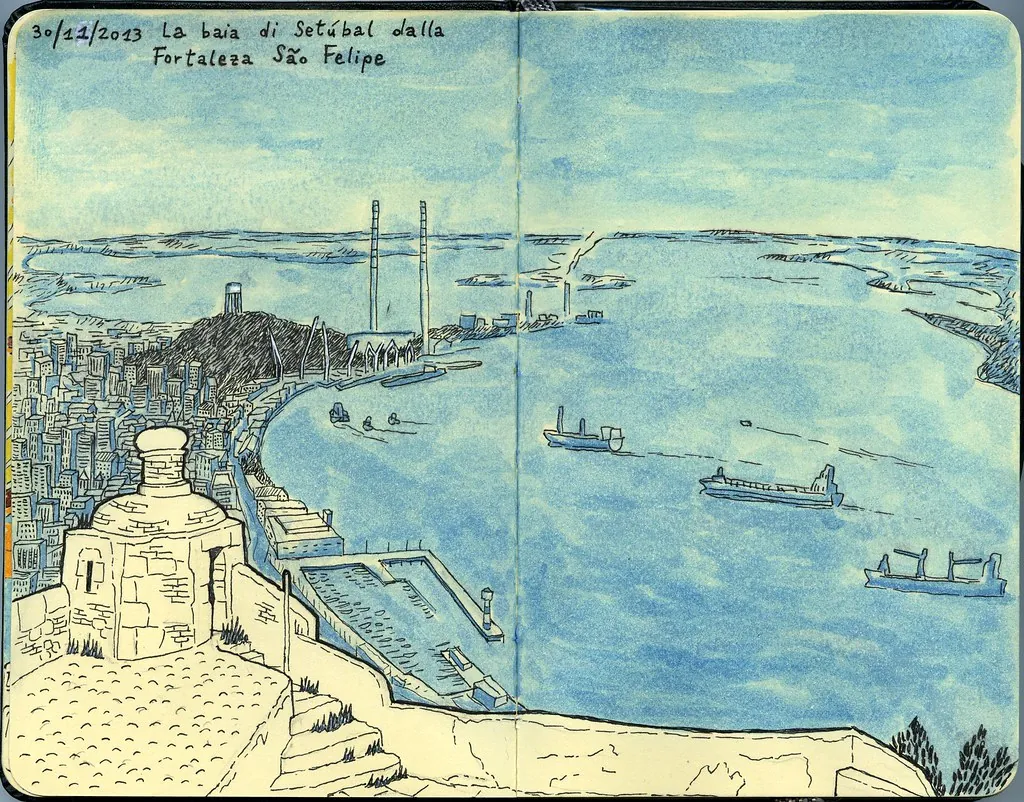
The first thing that arrives is not the image — it is the smell. A dense breath of mud and salt, of organic matter slowly fermenting under the sun, of brackish water advancing and retreating in the tidal channels like the paused breath of a vast body. The Sado estuary extends shallow to the horizon, and the morning light rebounds off its surface with an almost metallic intensity, silvery, forcing you to narrow your eyes. Just eleven metres above sea level, this amphibious plain — half land, half water — dissolves any notion of fixed boundaries. Here, limits are negotiated twice daily between tide and mud.
The River That Gave Name and Livelihood
Sado comes from the Latin, and the river baptised the parish that sprawls along its right bank. But before the name, there was work. On the Troia peninsula, across the water, the Romans of Cetóbriga already scaled and salted fish in stone tanks, turning the estuary into an open-air factory. Salting demanded salt, and salt demanded these marshes — vast, shallow, exposed to the southeasterly wind that accelerates evaporation. Walking today beside the surviving salt pans, the white crystals heaped on the wooden boards look like frost out of season, and the crunch of boots on saline gravel mingles with the sharp cry of Kentish plovers skittering along the water’s edge.
After the Romans came Visigoths and Arabs, each occupation leaving layers the landscape absorbed without fuss. The Reconquista brought the Order of Santiago and a reorganisation of territory. In 1553 a charter from Lisbon’s archbishop, D. Fernando, officially created the parish, but daily life had long since found its own rhythm: nets in the water at dawn, flat-bottomed boats navigating the channels, ox-carts hauling salt to Setúbal’s warehouses.
The Arte-Xávega and the Estuary’s Last Gestures
One fishing technique persists here as a gesture of resistance against hurry: the arte-xávega. Nets cast from the beach, hauled by arm and ox — or, today, by tractor — in a ritual millennia-old in essence. The Sado estuary is one of the last places in Portugal where this practice survives. Watching the net emerge, heavy with mud and small fry, is to witness choreography no technology has replaced. Water drains through the mesh, fish flash against the light, and the smell of iodine-laced brine suddenly intensifies, raw and sharp.
These waters are also home to a resident pod of bottlenose dolphins, perhaps the estuary’s most celebrated presence. Sightings come mostly at first light, when the surface is still glassy and grey dorsals cut the water silently, sketching brief arcs before vanishing. The Sado Estuary Natural Reserve protects this habitat — the wetlands, reed beds, rice fields stretching inland — and patient birdwatchers are rewarded: motionless herons like sculptures, flamingos tinting the salt pans pink at dusk, nervous sandpipers switching direction as if obeying an invisible cue.
Cuttlefish, Moscatel and the Apple No One Expects
Cooking on this estuarine shore is, first and last, estuary cooking. Choco frito — cuttlefish sliced into thick strips, dusted with flour and salt, plunged into olive oil until crisp outside and tender within — is practically a regional emblem. The dark ink stains the cook’s fingers like a signature. Grilled sea bass arrives whole, skin blistered by heat; clams and razor shells carry the mineral tang of the brackish water where they grew.
But the table does not stop at the sea. The Setúbal Peninsula is wine country, and Moscatel de Setúbal — dense amber, scented with honey and crystallised orange — partners desserts with a sweetness that never cloys because acidity steadies it. Azeitão DOP cheese, almost liquid inside, is served by slicing off the top and dipping bread into the creamy sheep’s milk paste. Less famous but equally protected, the Maçã Riscadinha de Palmela DOP wears red stripes on a yellow ground and snaps cleanly when bitten. For those who want inland Alentejo flavours that drift in by proximity, Carnalentejana DOP beef and Serpa DOP cheese complete a larder that straddles coast and plain.
The Ridge That Watches the Water
Lift your eyes southward and the Arrábida ridge cuts into the sky, dense with Mediterranean scrub — kermes oak, rosemary, arbutus — that in summer releases a resinous, hot perfume. Footpaths in the Arrábida Natural Park climb through white limestone and low maquis to viewpoints where the entire estuary reveals itself: the sand spit of Troia, the snaking channels, the green patches of rice, the mirrors of the salt pans. The descent brings cool shade and the dry sound of cicadas, ceasing abruptly when the path opens again onto the estuarine plain.
With 5,357 inhabitants and a density that lets you walk for long minutes without meeting anyone, Sado keeps a quietness that is not abandonment but rhythm. The three guesthouses in the parish offer discreet hospitality — the sort that receives few and receives them slowly. It is the place to come when you want to escape the commotion without quite leaving the world; ten minutes by car from Setúbal, and that includes the wait at the traffic lights on the way into town.
At day’s end, when the tide ebbs and the salt pans are exposed to the last sun, the mud gleams like polished pewter and the air carries a taste that settles on your lips — neither sweet nor bitter, just living salt, the same the Romans gathered, the same the crystals on the boards still hold, intact.