Full article about Salt-wind & limestone: São Sebastião breathes Setúbal
Flamingo marshes, maquis scent and 16th-century stone in one low-rise parish
Hide article Read full article
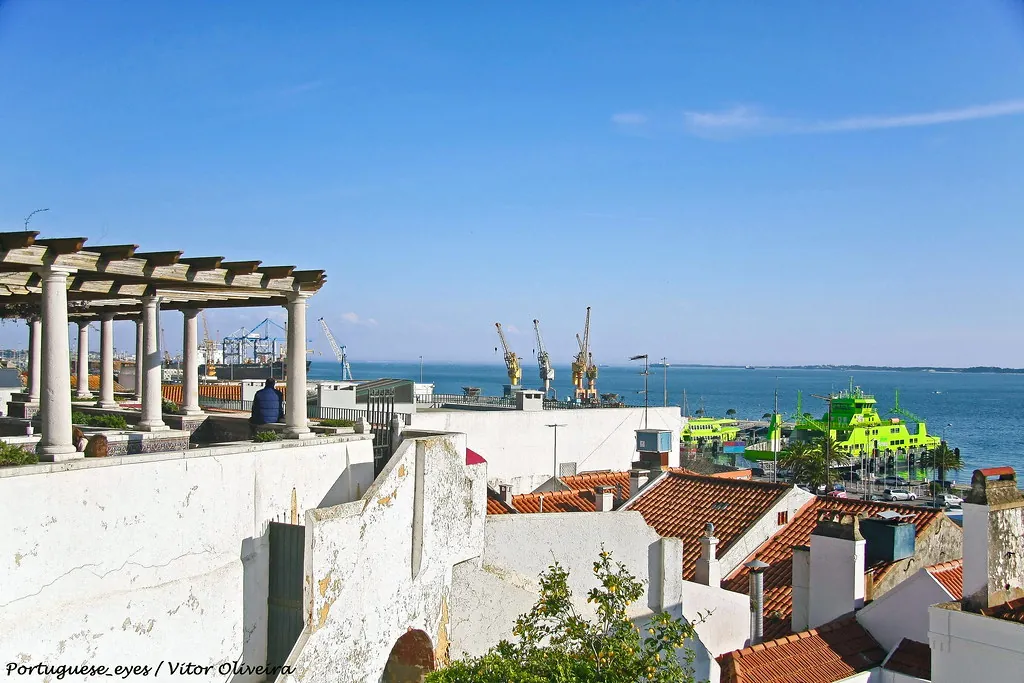
The wind gets there before you do. It slips through the open window of the Lisbon-bound train, carrying iodine and salt, tightening the skin, filming the lips. Only afterwards does the river appear: the Sado estuary unspooling like beaten copper, and beyond it the low-rise grid of Setúbal’s São Sebastião parish—52,000 people pressed between water and limestone escarpment at a mere 25 m above sea level. From the station footbridge you can already read the place in the air: brackish if the tide is high, resinous when the tramontana blows across the Arrábida ridge.
Between two lungs of green
São Sebastião is squeezed between two protected breaths of nature. North and east, the Sado Estuary Natural Reserve spreads 231 sq km of saltmarsh, mudflat and abandoned salt pans where flamingos winter and bottlenose dolphins patrol the navigation channel. South, the Arrábida Natural Park rises in a 35 km wall of Mediterranean maquis—kermes oak, strawberry tree, rosemary—so fragrant that on hot days the scent drifts downhill and mingles with diesel exhaust on Avenida Luísa Todi. You don’t need to leave the parish to know which way the wind is blowing: estuary smells of wet rope and fermenting algae; mountain smells of pine and pennyroyal.
Stone that remembers
Four classified monuments punctuate the parish, each a sedimentary layer of occupation. The sand-coloured Convento de Jesus, a National Monument since 1910, still carries the scalloped capital of the Roman fish-salting town of Cetóbriga beneath its Gothic ribs. Three minutes downhill, the Manueline portal of Igreja de São Sebastião (1532-56) opens onto a square where the cobbles rock gently underfoot—original calçada, polished by five centuries of parishioners. Across the water, the star-shaped Forte de São Filipe, now a pousada, aimed its cannon at pirates who never came; on the opposite headland the seventeenth-century Forte de Santiago do Outão serves as the navy’s hyperbaric hospital, its whitewashed wards smelling of eucalyptus and iodine.
Cheese, apples and grapes that taste of sand
Ask for the local menu and you are served geology. Moscatel de Setúbal, fortified and honeyed, grows on sandy soils first worked by the Romans; the 1907 demarcation makes it one of Portugal’s oldest DOCs. Reds from nearby Palmela carry the same limestone dust that flavours Azeitão DOP sheep’s-cheese—thistle-set, oozy, best eaten with a shard of the region’s other PDO star, the striped, tart Maçã Riscadinha de Palmela. The geography is small: Arrábida’s slopes eight kilometres south, apple orchards ten kilometres east, Alentejo plains fifteen kilometres inland. The taste is correspondingly concentrated.
Not village, not metropolis
Census 2021 counted 7,893 children and 10,467 pensioners inside São Sebastião’s 26 sq km, giving it the demographic slope of urban Portugal. Yet density is tempered by scale: 122 registered guest-houses (2023) are mostly first-floor flats on Avenida Luísa Todi or converted outbuildings in Fonte Nova, not glass towers. You can be in Lisbon in 48 min via the A2, on the Tróia ferry in 35 min, or browsing Livramento Market’s 5,000 azulejo tiles at 7 a.m. while fishermen unload cuttlefish still pulsing with estuary water. Convenience is not the point; friction is. One minute the rasp of a city bus, the next the high, thin whistle of a Mediterranean gull slicing the air above the roofline. One minute exhaust fumes, the next the sweet fermentation breath drifting from the cellars of José Maria da Fonseca, bottling since 1834.
The last sound
At 17:30 in winter, 20:30 in summer, the low sun flattens the Sado into a sheet of liquid copper. Traffic on the Avenida 5 de Outubro eases, conversations in the market drop to a murmur, and—if you stand still—you can hear the estuary: a soft plock as a school of sea bass or grey mullet breaks the surface. Not the ferry horn, not the clatter of glasses in Bar do Bonfim, just the brief animal reminder that the city was founded here two millennia ago because fish once jumped in the same warm water.