Full article about Sabadim
Arcos de Valdevez hide Sabadim, a granite hamlet of singing river, Roman-altar chapel & August fire-lit processions.
Hide article Read full article
The River Sings First
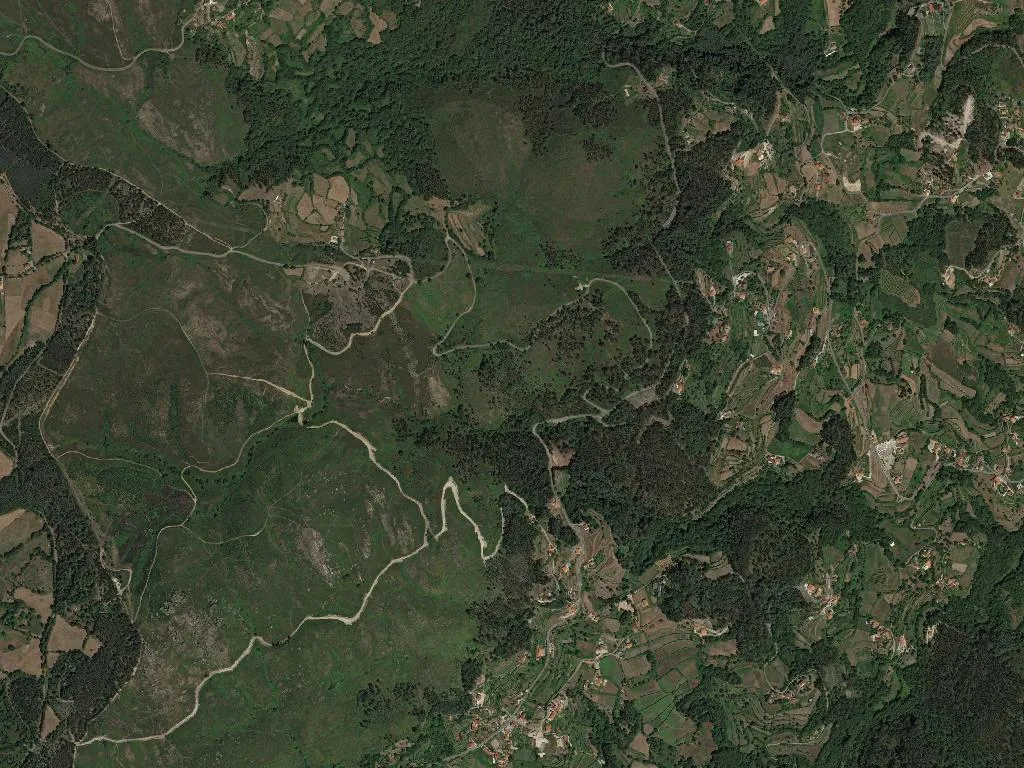
The first thing you hear in Sabadim is water. Not the hush of the Atlantic twelve kilometres away, but the bright, percussive chatter of the Ribeiro de Sabadim as it slips between moss-slick boulders and nudges the paddles of three surviving watermills. The sound follows you through the single-lane village, threading itself between granite houses, mixing with the distant clonk of cowbells from the small, auburn Cachena cattle that graze the surrounding slopes. At 376 m, caught between the granite ramparts of the Peneda massif and the Lima valley, Sabadim is a place governed by stone and running water.
Stone That Remembers
The parish church has stood in the geographical if not gravitational centre since the 1520s, its late-Manueline portal framing a baroque altarpiece that glows with gilt and azulejo blue. Outside, two 18th-century stone crosses mark the sacred boundary; step over them and you move from consecrated ground to common pasture. A five-minute shuffle down Rua da Igreja brings you to the humbler Chapel of Nossa Senhora da Porta, built, so the story goes, on top of a Roman altar to Jupiter. The altar stone is still there, mortared sideways into the south wall like a palimpsest of belief.
Cross the single-arched medieval bridge – its parapet worn smooth by pack-mule traffic that once linked Roman Bracara Augusta to Galicia – and you reach the Casa do Eirado, an 18th-century manor whose coat of arms is dissolving back into the granite. Behind it, seven stone espigueiros on stubby legs stand in a row. Unlike the open-air granaries you’ll see further north, these carry heavy slate roofs; the only ones of their kind in the Alto Minho.
Fire, Procession and Pilgrimage
On the second Sunday of August the village doubles in population. After a sung mass in the church, the statue of Nossa Senhora da Lapa is carried through cobbled lanes, stopping at improvised fire pits where eucalyptus branches flare and crackle. Empanadas and vinho verde circulate, a circle of gaiteiros strikes up, and the dancing continues until the granite itself seems to vibrate.
A week later it’s the turn of Nossa Senhora da Porta. Parish groups from across Arcos de Valdevez walk the ancient paths up to Sabadim for an outdoor mass and an impromptu agricultural fair: baskets of scarlet peppers, honeycomb still dripping, kids clutching helium balloons shaped like tractors.
September empties the village. Early on the first Sunday, locals set off on the twelve-kilometre pilgrimage to the Peneda sanctuary, carrying a hand-carved wooden cross that will remain on the altar for a calendar year. They sleep in the mountain dormitory, attend dawn mass, and descend the next day in companionable silence, boots powdered with granite dust.
Beef, Bread and the Morning’s Bake
Because the Cachena breed spends its life above 700 m, its meat carries a DOP label and a flavour that tastes of heather and wild thyme. You’ll find it seared as bife de lombo, slow-cooked in a clay pot with white beans and cornmeal porridge, or shredded into a chanfana stew darkened with red wine. Kids tend to gravitate to the kid – butterflied goat grilled over broom-stem embers – while adults mop up pork crackling with winter collards.
Bread matters. The wood-fired oven behind the parish hall fires at 04:30; arrive by nine and you’ll retrieve a rye-and-corn loaf the colour of burnt umber, the crust thick enough to tap. Pair it with fresh goat’s cheese cured in loquat leaves and a glass of Loureiro-based vinho verde from the communal press, bottled under a crown cap and tasting of lime skin and river stones.
Tracks Through Oak and Heather
Sabadim sits inside Peneda-Gerês National Park. The signed PR 15 footpath climbs from the bridge, corkscrewing through ancient sessile oak and pyrenean oak until the canopy breaks into high summer pastures where Cachena cows watch with amber unconcern. Three hours and twelve kilometres later you reach the pilgrimage church at Peneda, but the halfway reward is the Miradouro do Cimo da Porta – a granite balcony that lets you scan the Lima valley all the way to the Galician ridges; on a clear winter morning you can just pick out the Atlantic glint.
Back at river level, slip into the Poço dos Namorados, a chest-deep swimming hole once used by village women beating laundry on flat stones while boys practised guitar chords on the bank. Today it’s where teenagers escape both August heat and the aunt who keeps asking about wedding plans.
When the Mills Stop
Dusk is signalled not by streetlights – there are only four – but by the last metallic clunk of the mill paddles. Conversation moves indoors; wood smoke leaks from chimneys; the river keeps its own conversation going under the bridge. Stay long enough and António will emerge from the tiny café, wipe espresso grounds from his fingers and pour you a aguardente that tastes of windfall apples and last year’s grapes. Ask him about the 1950s, when the primary school held thirty pupils and nine working mills shook the valley with their rhythm. He’ll oblige, but only after raising his glass to the water that still remembers every story it was ever asked to carry.