Full article about Soajo’s granite granaries glow at dusk above Lima valley
Walk among 24 ancient espigueiros, sip loureiro vinho verde, gaze into Spain
Hide article Read full article
Granite, maize and afternoon shadow
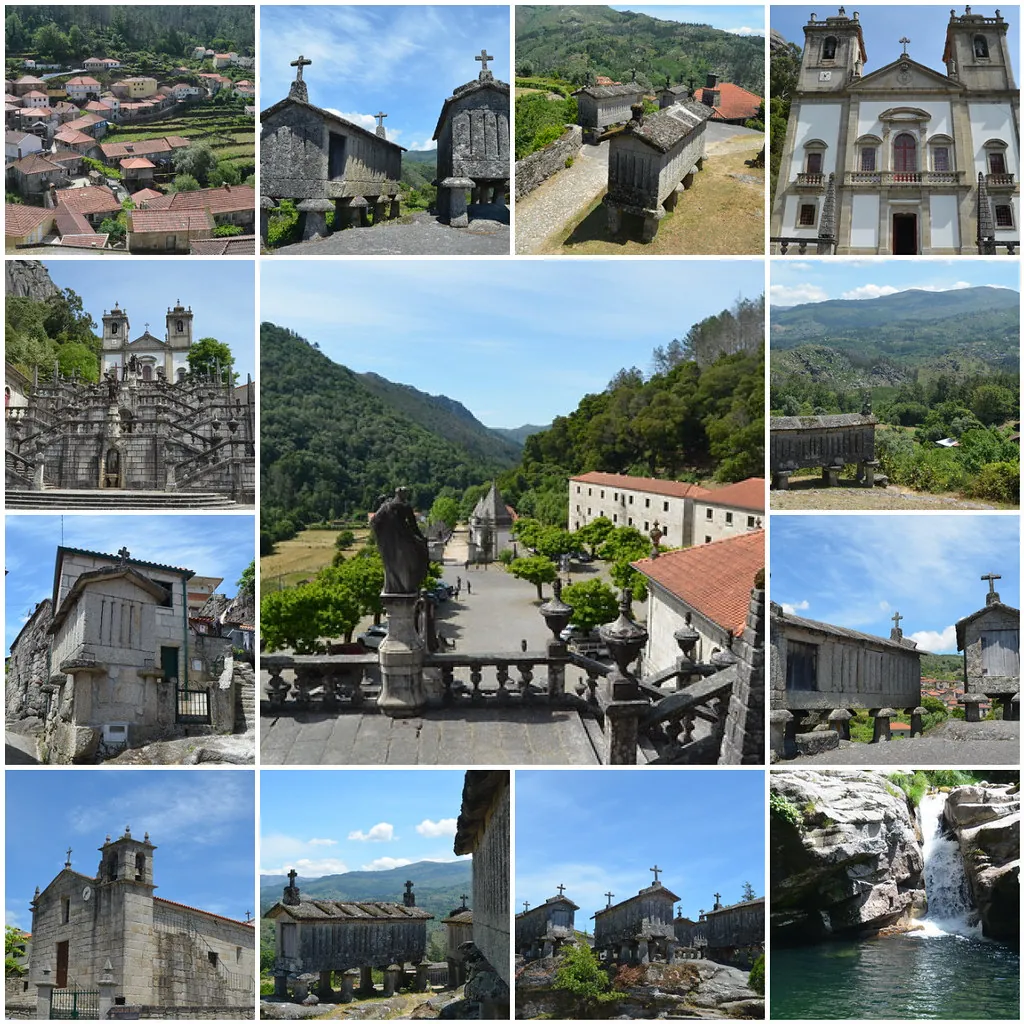
The granite darkens as the afternoon slips over the Eira do Penedo. Twenty-four espigueiros rise from a slab of stone, their rectangular forms lifted on stubby pillars to keep the damp and the rats at bay. Wind slips through the slats, rattling the last maize cobs like dry castanets. Beyond this communal threshing floor the Serra do Soajo cuts a jagged silhouette against the sky; the first chill of altitude drifts down the valley.
Soajo was once a town in its own right, stripped of municipal status in 1836 by Mouzinho da Silveira’s administrative reforms and bolted onto Arcos de Valdevez. The villagers still speak as though the council chamber were next door. In the Café Central, 87-year-old Joaquim de Sá refers to “o concelho” in the present tense, an independence that survives only in syntax.
Stone upon stone, grain upon grain
Across the parish 142 granaries survive, but the Eira do Penedo holds the greatest concentration. Each family once claimed one, marking ownership with a carved cross or initials: the Alves cross is 18th-century, the Oliveira lintel reads “A.O. 1876”. At sundown the granite ignites, the rows of little coffers glowing amber while their shadows lengthen across the rock like recumbent giants.
A five-minute walk south, the Ponte da Ladeira throws a single eight-metre arch over the Rio Taboal. Cart ruts are worn into the approach slabs; 200 m away the Pedra da Estrada preserves the grooves of iron wheels that once hauled salt from Galicia. Climb to the Miradouro de Cunhas and a glass platform hovers above the Lima valley; from Miradouro de Tibo, at 940 m, the view stretches from the Serra Amarela to Spain’s Xurés, the border peaks stacked like blue paper cut-outs.
What the table offers
During the last weekend of July the Feira de Artes e Ofícios fills lanes with smoke and music. Stalls serve vinho verde from the Lima sub-region—Quinta do Soajo’s loureiro, 120,000 bottles a year—paired with sarrabulho rice studded with scarlet rojões. At Tasquinha da Ti Rosa a kid goat spends four hours in the wood oven, its scent braided with oak smoke. The alheira from Miranda, salpicão and butelo hang above market tables like edible bunting.
The star protein is Carne Cachena da Peneda, DOP-protected since 1996, from 450 dwarf cows that graze the communal uplands. Every animal has a name—Mr António’s “Malhada”, Mrs Fernanda’s “Pintadinha”—and a lineage known to the parish. Dessert is Dona Amélia’s pão-de-ló, a deliberate damp sponge whose recipe has not changed since 1952; one slice demands a second glass of loureiro.
Trails between granite and water
Soajo lies inside Peneda-Gerês National Park, its boundaries climbing to 1,300 m. The Poço das Mantas loop, 1.2 km of dry-stone walls and veteran oaks, ends at a plunge pool that stays at 5 °C year-round. The longer haul to Lagoa dos Druidas sets off from Tibo, five kilometres of high-pasture walking among 280 semi-feral garrano ponies managed by the local breeders’ association. Bonelli’s eagles nest here—three pairs at the western limit of the species in Portugal—their occasional cry slicing the mountain silence.
Voices that stay
Every Tuesday the Casa do Povo hosts the Fiadeiras do Soajo, seven women aged 45 to 78 who keep the cantares ao desafio alive. They trade improvised verses, sewing new words onto ancient melodies. Dona Albertina, 78, learnt “A Serra do Soajo” from a grandmother born in 1870; the repertoire surfaces again during the Festa de Nossa Senhora da Lapa (first Sunday in August) and the Romaria à Nossa Senhora da Peneda on 28 September, when 800 pilgrims walk the 12 km old path from the village to the sanctuary.
The Northern Way of the Camino, added to the official network in 2016, cuts through Soajo between Ponte de Lima and Valença; hikers refill bottles at the 1897 fountain in the square, funded by an 84-family levy of 500 réis each.
Granite against the violet sky
The 2021 census counted 670 inhabitants—356 over 65, only 36 under 14. Yet the communal “compartes” system, codified in the 16th century, still governs 1,800 ha of shared grazing. Each sheep or cow pays €2.50 a month to the Baldios committee, which employs two herdsmen for the collective flock: 1,200 ewes and 180 cachena cattle. At dusk the tin bells return in descending chords, every clapper stamped with its owner’s number, the metallic percussion fading between granite walls until the mountain finishes the phrase.