Full article about Âncora: Atlantic mist, granite bones, returning bells
Visit Âncora in Caminha: thick-walled granite houses, salt-sprayed river mouth, July garlic-scented homecomings on the Coastal Camino
Hide article Read full article
Salt in the air, granite underfoot
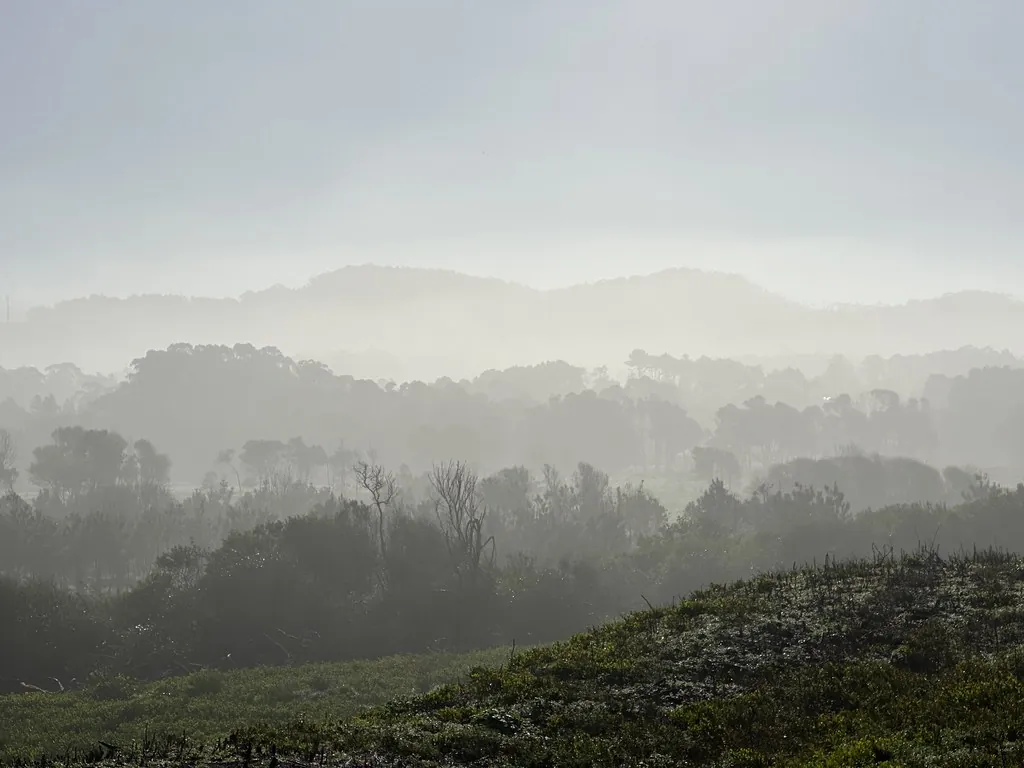
The Atlantic arrives before you do. It slips into the car through the air vents, metallic and cool, carrying the iodine tang of bull-kelp and something sharper — the scent of wet schist and eucalyptus resin drifting down from the Serra d’Arga. By the time you reach the river mouth at Vila Praia de Âncora, the ocean has already settled on your skin like a second layer.
Âncora is not a village that needs announcing. Its 1,186 souls occupy barely five square kilometres between the Rio Âncora and the open sea, an altitude of seventeen metres that feels lower when the spring tides push salt water up the narrow valley. The streets were laid out for ox-carts, not tour coaches; you park on compacted sand between boat trailers and the parish council keeps its minutes in a granite house the colour of weathered rope.
Stone that endures, bells that call you back
There are no blockbuster monuments here. What matters is the masonry: walls sixty centimetres thick, window frames carved from single blocks, rooflines that have learned to crouch under Atlantic storms. Granite mined from local quarries threads through the village like ligature, corner-stones rebated to carry the next century’s load. Even the newer villas obey the old rules — small east-facing windows, chimneys angled north-east, walls the colour of wet sand.
Faith still organises the calendar. On the first Sunday after Ascension the bells of Igreja de São Bento ring at dawn, and the population quietly doubles. Emigrants who left for Lyon or Neuchâtel in the 1970s reappear with grandchildren who speak French better than Portuguese. Paper garlands are strung between lamp-posts, sardines turn over makeshift grills, and someone’s uncle produces a trumpet last played at the 1998 Romaria. By Tuesday the village has shrunk again, but the garlic scent lingers in the curtains.
A path that passes through
The Coastal Camino — the littoral escape route of the Camino de Santiago — cuts straight through Âncora, way-marked with yellow arrows painted on electricity boxes. Pilgrims arrive with salt-stained boots and the stunned look of people who have just discovered the Atlantic can be colder than the Bay of Biscay. They refill bottles at the fountain by the fish-auction hall, ask how far to Caminha (eleven kilometres, mostly boardwalk), and upload photos of the 17th-century pillory that once displayed the village’s only set of iron manacles.
Thirty-six beds are available in six different houses: a ground-floor room with direct access to the sand, a family home where the host brings coffee at seven sharp, a flat above the bakery that smells of fermenting rye all night. By September the walkers thin out, leaving behind an Austrian coin and a Canadian flag patch forgotten on the washing line.
Green wine, grilled sea-bass
Vinho Verde sneaks down the valley as far as the tide allows. The vines here are trained high on pergolas so vegetables can grow underneath; the resulting Loureiro is sharp enough to slice through the oil of just-grilled sea-bass. In the fishermen’s tavernas — no menus, no card machines — the catch is listed by size: robalo 600g, dourada 400g. Order one and you receive the whole fish, scored and blistered, plated with nothing more than a lemon wedge and a dish of sea-salt that crystallised last summer on the rocks by Moledo.
The boats still leave at 05:00 when the bar is calm. You hear the diesel engines from bed, a low grumble that fades south-east towards the anchovy grounds. By nine the same boats are back, plastic crates sluiced clean, gulls arguing over the offcuts.
The mathematics of return
Demographics read like a slow leak: 279 residents over sixty-five, only 150 under twenty. Yet every July the campsite above the dune ridge fills with the same Portuguese families who have been renting the same canvas bungalows since 1998. They recognise each other by the way they angle wind-breaks, by the shade of their beach umbrellas bought in the same Viana do Castelo hardware shop. Their children, now engineering students in Porto, still race to claim the wooden picnic tables for lunchtime barbecues.
There is no Instagram pier, no renovated warehouse selling small-batch gin. What there is instead: a curve of sand wide enough to lose your neighbours, water clear enough to see your shadow on the bottom, a kiosk that sells only one brand of ice-cream but remembers how you like your coffee after the third visit. You come back because the place does not revise itself annually. The only new addition this year was a defibrillator bolted to the town-hall wall — the stone underneath remains untouched.
At dusk the low sun turns the granite honey-gold and the Atlantic switches to a softer register, a long hush that drowns out mobile phones. The waves advance, retreat, advance again, counting time the way medieval monks once counted beads. Somewhere in that rhythm is the reason 1,186 people still live on this narrow shelf between river and ocean, and why the rest of us, passing through, find ourselves scanning estate-agent windows on the way out.