Full article about Dem
Hear the twice-daily bell, hike to the 3-country viewpoint above Dem (Caminha) and trace ruined mills along moss-slick irrigation channels
Hide article Read full article
The bell that stitches four hamlets together
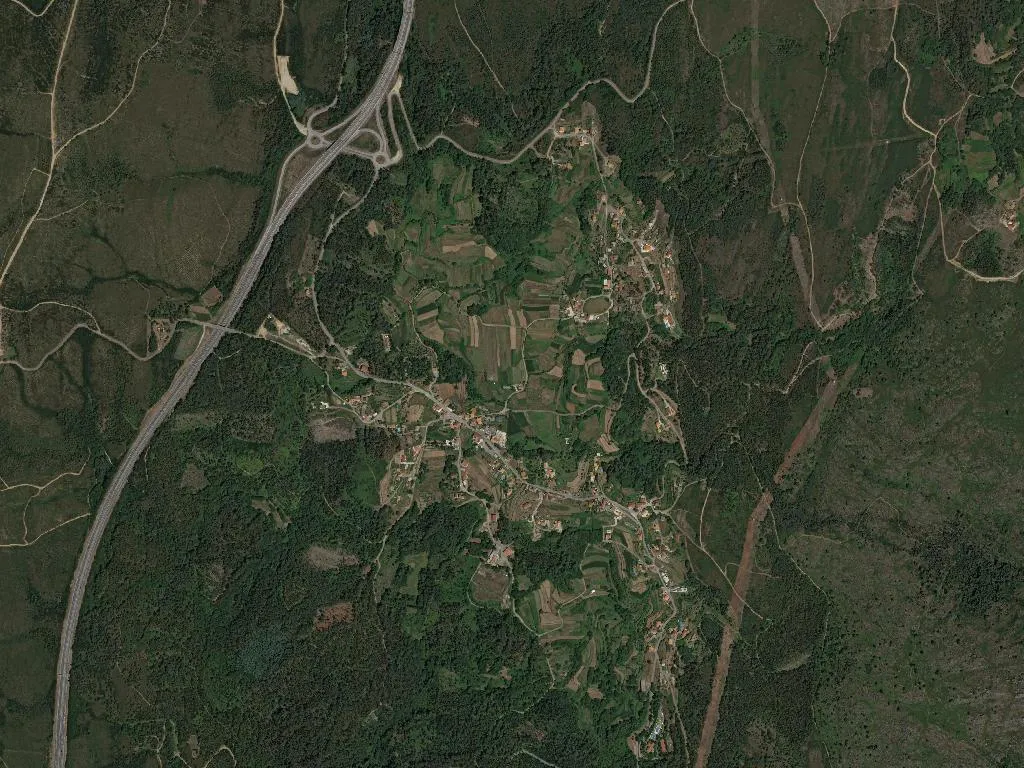
The bell of São Gonçalo rings twice a day—midday and seven sharp. For a few seconds the scattered settlement of Dem feels like a single village. The rest of the time Pedras Frias, Boucinha, Chão do Porto and Aldeia keep to their own ridges, linked only by a wriggling lane that climbs and drops through chest-high schist walls.
The church itself is 1970s brutalist: raw concrete, a steel cross skewered into the skyline. Inside, three altars and one oil painting salvaged from a 17th-century wayside shrine in Gondar. Mass is Sunday 11.30; on weekdays the doors stay locked.
Up to the Lady of the Ridge
Six kilometres of grit road lead from the church to the Senhora da Serra chapel. The footpath begins beside the old primary school in Chão do Porto, slips through the iron gates of Quinta do Coura and climbs under umbrella pines. Allow 45 minutes on foot, 25 if you thumb a lift in a farmer’s jeep. At the top, twin tile-clad belfries and a door that squealed in 1978 and still does. The reward is a three-country sweep: the Minho sliding into Galicia, the Coura valley corkscrewing below, and, on the far horizon, the glassy lagoons of Castrogalan. On 5 August the chapel’s romaria draws 200 people—double Dem’s resident population. Bring water; there is no café, no fountain, no phone signal.
Where the mills once turned
Dem’s watermills folded one by one as mains electricity reached the hills. The last, Sr António Carvalho’s, ceased grinding in 1983; its broken wheel still hangs above the Coura like a snapped cog. The irrigation channels still tick, feeding smallholdings of kale and tomatoes. Follow them from Boucinha to Pedras Frias and you’ll clock two hours of tunnels, aqueducts and moss-slick slabs—boots essential after rain.
Wednesday night in Aldeia
The Rancho Folclórico rehearses in Aldeia’s village hall every Wednesday. Entry is free, applause expected. The costumes date from 1950: woollen jackets heavy with chain-stitch, skirts that weigh three kilos and fasten only if your waist behaves like a mid-century mannequin. In September the group performs at the São João d’Arga fair—two nights on a stage erected in front of the bakery. Beer €1.20, veal skewer €4.
Wayfarers and way-markers
The Coastal Camino slices through Dem on its zig-zag between Vila Praia de Âncora and A Guarda. Pilgrims pick up the yellow arrow at Chão do Porto’s tiny roundabout. There is no albergue; those who linger knock on doors or retreat five kilometres to the coast. Café O Serrano opens at 7.30 a.m., fires up the espresso machine and sells rice-cake pastries for 60 c. It also offers the only wi-fi for miles.
Where to lay your head
Dem is not an overnight accident; you come on purpose. Two options: Casa do Rio, a slate-roofed house with three doubles (two-night minimum) suspended above the Coura, or a single en-suite room at Quinta do Coura (car essential). The nearest railway station is in Caminha, 18 kilometres away. AV Minho bus 203 pauses at Chão do Porto at 8.10 a.m. and 6.40 p.m.—except Sunday, when the hills belong once again to the bell.