Full article about Seixas: Stone & Salt-Kissed Vinho Verde
Pilgrim footfalls echo across granite vineyards above the Atlantic in Seixas, Caminha.
Hide article Read full article
The Stones That Named a Village
Granite cobbles of the Caminho da Costa clack beneath pilgrim boots soon after dawn. In Seixas the very ground announces its pedigree: “saxa”, the Latin-rooted word for jagged rock that bequeathed the parish its name. The same stone shoulders the low walls corralling Loureiro vines, props up cottage foundations and provides the time-worn steps of the 16th-century Capela de São Bento. At only 44 m above sea level the plateau yields to light without hesitation; when the sun threads almond branches it throws lacework shadows onto whitewashed façades still damp with night dew.
Wayfarers’ Register
Seixas lies on the coastal variant of the Portuguese Camino, and that fact sets the village clock. By late afternoon the stone benches outside the single café are claimed by walkers easing off socks, inspecting blisters, rehearsing the remaining eight kilometres to Vila Praia de Âncora. The route slips past the parish church of São Martinho, its 1750s façade masking an interior riot of gilt carving, then corkscrews through pergola vineyards whose wires hum when plucked by the Atlantic breeze. Medieval way-markers survive in the shape of 1734 granite crucifixes and the Fonte dos Cântaros, a moss-lined trough where water emerges so cold it makes fillings ache.
Above the Teja stream the so-called Castelo Velho offers little more than a ragged line of boulders and a perceptible drop in ground level; 1985 excavations confirmed a late-Bronze-Age hillfort, yet imagination is required to raise its walls. In July the stream shrinks to a silver ribbon between reeds and willows, forming pockets of humidity where ferns outmanoeuvre the drought.
Green Wine & Almond Blossom
Vinho Verde country stretches in every direction: terraces stitched with Loureiro and Alvarinho on low pergolas that let Atlantic breezes stave off mildew. Come mid-September the lanes clog with tractors towing creaking cane baskets; grapes are snipped into 15 kg boxes to keep the skins intact for a bright, lightly spritzed wine that tastes of lime zest and salt. At Quinta do Rego you can sample straight from stainless steel, the chill fogging the glass while the acidity snaps like a green bean.
The kitchen larder is equally site-specific. Smoked morcela hangs in granite smoke-houses; cornbread rises overnight in Carreço’s communal wood-fired oven; almond dough is coaxed into conventual sweets for feast days. Almond reappears in dried-fig bonbons, each slit fruit stuffed, pressed and stored in tins lined with bay leaves. Local olive oil — Azeite de Trás-os-Montes DOP — emulsifies vegetable caldo, while scarlet colourau (smoked paprika) stains the wind-dried chouriços that swing from porch beams like burgundy socks.
Fires & Fireworks
Festivity punctuates the calendar. On 21 March São Bento draws the faithful to a nine-day novena culminating in a night-time procession and a ten-minute firework fusillade that ricochets off the Minho escarpment. The first Sunday of August belongs to the Romaria de São João D’Arga: pilgrims climb 700 m to the granite ridge eastwards where, legend insists, crusaders planted the relics of a saint they had carried from the Holy Land. Santa Rita de Cássia has her day on 22 May, filling the churchyard with women bearing roses and fishermen clutching gilt wax crowns. On each occasion the local philharmonic strikes up, brass echoing across the same stone walls that once echoed to Latin prayers.
Horizon of Heather
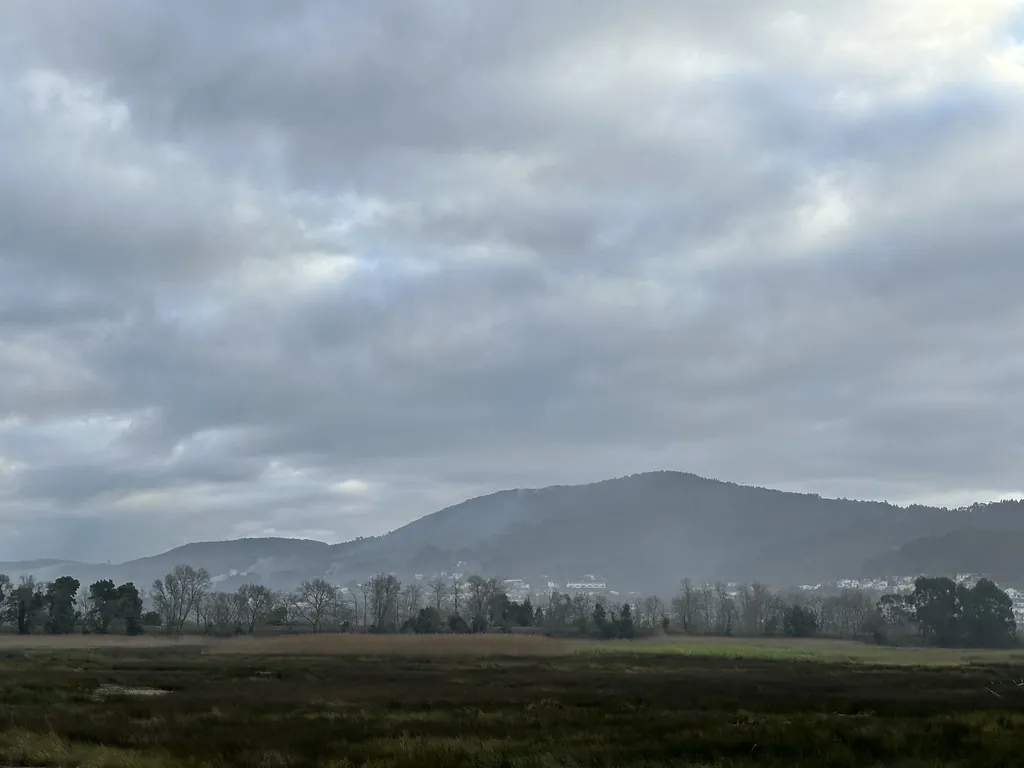
To the east the Serra d’Arga ridge rises like a breaker frozen in granite. In April its gorse and heather flare yellow and mauve, and the summit cairns appear deceptively close across the valley. Only 1,413 souls share Seixas’s 833 hectares — a density low enough for nightingales to be heard from bedroom windows and for the evening smell of wood smoke to drift unhindered. When the church bell — cast in 1887 — tolls for vespers, the sound rolls over almond terraces, grazes the stubby ruins of Castelo Velho and dissolves into the Teja’s murmur, leaving the village to a silence measured not in decibels but in centuries of repeated, unhurried gestures.