Full article about União das freguesias de Chaviães e Paços
Walk the secret Camino, guard a 13th-century lamb, taste Cachena beef in Melgaço
Hide article Read full article
Two villages, one frontier
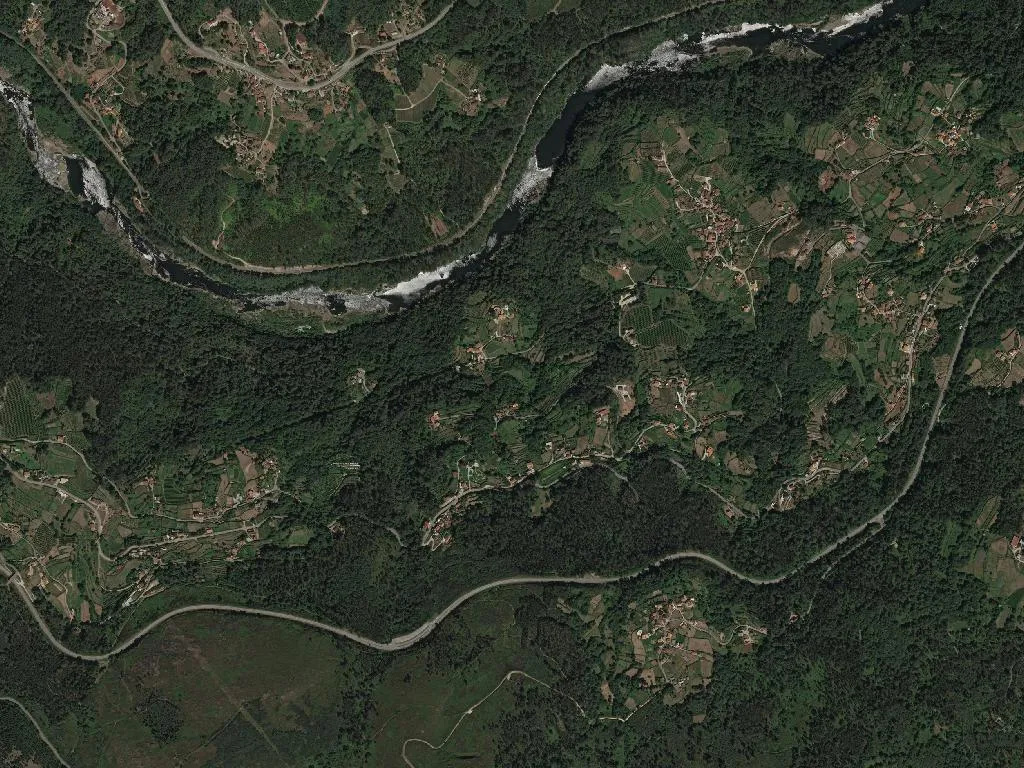
Hiking boots drum across the uneven cobbles of Chaviães just after first light. Few English walkers realise they are treading the coastal variant of the Camino de Santiago as it slices through the village centre, skirting a 13th-century Romanesque doorway still guarded by a crudely carved lamb. Backpacks thud against granite, water bottles are refilled at the stone font, then the path drops to the Minho valley where wood-smoke drifts above slate roofs and the river slides wide and slow, hemmed by low walls of dark schist. These are the pesqueiras—medieval fish-traps assembled without a scrap of mortar four centuries ago—still snaring shad and lamprey each winter.
The civil parish of Chaviães e Paços was formalised in 2013, yet its twin settlements pre-date most European nation states. A royal charter of 1183 records Chaviães; Iron-Age castros on Coto da Moura and Monte do Castelo hint at still older occupation. Paços, first mentioned in 1210, takes its name from the administrative “palaces” of minor nobility who administered the border. Positioned hard against Galicia, the hamlets were repeatedly overrun during the War of Restoration; Casa Grande, a sober manor house on the riverbank, still wears iron-ringed windows designed for musket fire.
Inside Peneda-Gerês National Park, the parish covers barely eight square kilometres and houses 559 residents—259 of them over 65. Yet the arithmetic is shifting: three self-catering cottages have opened in restored stone outbuildings, grocer “O Minho” ships Carne Cachena and blood sausage to Lisbon, and the last Saturday in March draws urban day-trippers to the Dia do Fumeiro, a communal crash-course in sausage-stuffing followed by lunch at a single 40-metre table.
Water and stone trails
Sign-posted as the PR7, the Rota das Pesqueiras follows the Minho at sundown when oblique light ignites the schist weirs and night herons clatter home to roost. From Viladraque’s tiny miradouro the view peels south along the river corridor to the serrated ridge of Peneda, its slopes quilted with alvarinho oak and cork. Halfway down, Melgaço’s only river beach—Louridal—offers a pontoon for kayaks and water clean enough for otters. Some visitors paddle the 3 km down-river, drifting to the sandbar with a midway swim.
In Paços a 300-year-old cork oak is known as the “oath tree”; oral history claims minstrels swore loyalty here before ferrying into Galicia. Since 1962 every newcomer still signs the Livro de Irmandade and drips a splash of alvarinho white into the ledger—symbolic acceptance into a parish that numbers fewer inhabitants than most London restaurants seat for Sunday lunch.
Smoke, wine and summer feasts
The kitchen larder is strictly demarcated: Cachena beef from the mountain pastures, salpicão air-dried in mountain draughts, cornmeal broa to catch the juices. Wood-oven salt cod arrives blistered with onion and potato; almond-and-egg São Bento cake and cloud-light suspiros de Paços finish the meal. On 22 July the church of Santa Maria Madalena shoulders a procession, brass band and midnight ball; Santa Ana follows four days later. Eight December brings the Romaria de Nossa Senhora da Conceição, where apples, chestnuts and a bemused heifer receive a priest’s blessing, continuing a pre-Christian fertility rite dressed in Catholic vestments.
Dusk folds over the granite. The final walker disappears towards Santiago, the church bell strikes nine, and the only sound is the Minho nudging its ancient stone traps—an insistence that borders, like rivers, are never fixed for long.