Full article about Wood-smoke mornings in Parada do Monte & Cubalhão
Stone granaries, Cachena cows and sweet-chestnut broa above the Santiago trail
Hide article Read full article
The scent of sweet-chestnut logs and baking broa
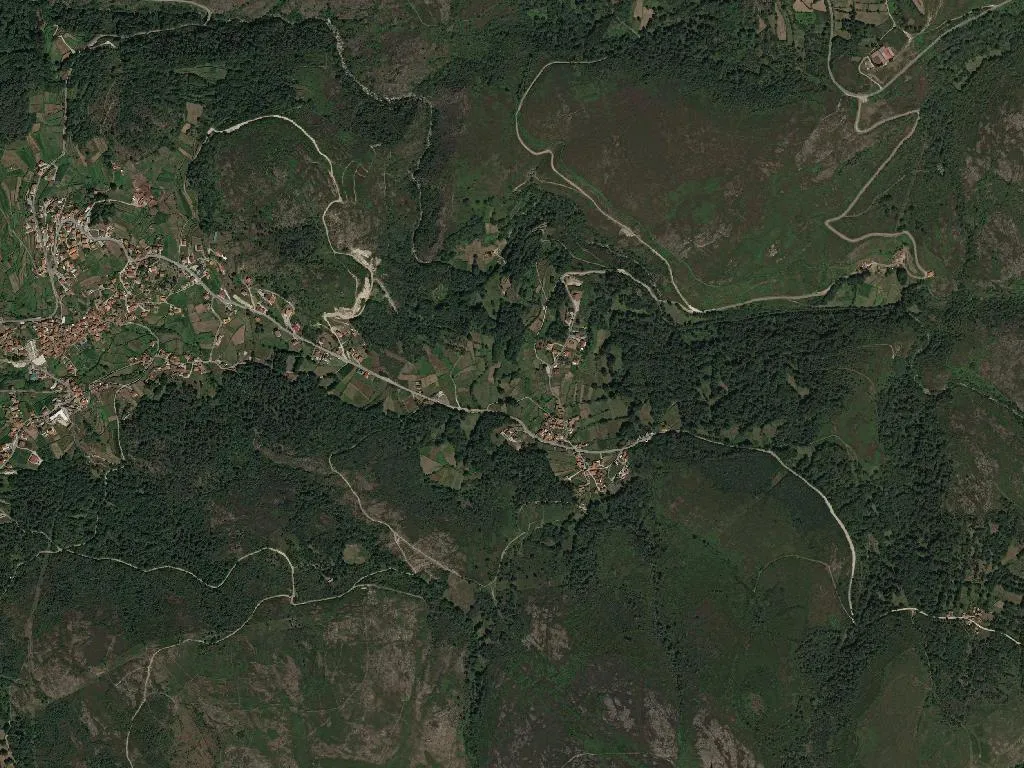
Seven in the morning, 649 m up, and wood-smoke is already threading through the air of Parada do Monte. Mist still clings to thirty-seven stone granaries standing shoulder-to-shoulder on a patch of packed earth, their schist walls fitted without a speck of mortar. A cowbell tinkles somewhere on the plateau as Cachena cattle drift downhill, the only punctuation in a silence that tastes of cold resin and strawberry-tree sap.
A mountain halt with a mission
The name is a medieval instruction manual: “Stop here before the summit.” Traders and coastal pilgrims heading to Santiago did exactly that, resting at the 13th-century São Bento chapel before the last haul over the Serra da Peneda. A yellow arrow still points from the Romanesque apse down toward the Peneda river, marking the Portuguese Coastal Way. Two kilometres east, in Cubalhão – the word derives from Latin for “small cask” or refuge – a Manueline stone cross lifts its eroded Latin inscriptions to weather that has blown in from five centuries of Atlantic fronts.
When Napoleonic troops swept through, villagers buried the church silver in riverbank pits; it survived, the French didn’t. Every 21 March the silver-encrusted statue of St Benedict is paraded round the same granite forecourt while sweetened Easter loaf is divided among neighbours and women race to finish a length of rough wool on four-pedal looms. The last master-weaver, Maria da Luz Pereira, died in 2008 at 87; her 1953 loom is now a listed monument of intangible heritage, kept in situ on Rua da Igreja.
Two protected breeds, one pot
Parada-Cubalhão is the only parish in Portugal where two indigenous cattle graft side-by-side under DOP status: the stocky, auburn Barrosã and the much smaller, black Cachena whose cows barely clear a metre at the shoulder. Up on the 900 m flats they share wind-scoured pastures, then descend to appear later as different cuts in the same dish. Turnip stew is thickened with smoked Barrosã shin; Cachena belly, minced with mint and stuffed into hog tripe, sends steam crawling across kitchen windows like wet gauze. The companion wine is local Alvarinho planted at 650 m on dark schist at Quinta da Peneda – an altitude that sharpens citrus edges and demands approval: “If the swirl collapses before three turns, the bottle doesn’t leave the valley,” says agronomist José Morais, who set out the first vines in 1993.
Up to the waterfall and the dark sky
Way-marked trail PR6 – “Caminho do Monte” – climbs 550 m over twelve kilometres to the Peneda cascade, tunneling through oak woods padded green with moss. From the Cruzeiro lookout the Minho valley unfurls westward toward the Soajo range; after nightfall the absence of light earns the national park’s “Dark Sky” badge, revealing a white-rumped vulture circling under Orion while a ring-ouzel sings from a birch. When fog pours into Cubalhão, older residents still say “o Monte está a fumar” – St Benedict has lit a beacon for wanderers. On Christmas Eve the wooden clappers of the Chocalhada echo through empty lanes, and granite walls hold the dawn chill long after the sun has cleared the ridge.