Full article about Pinheiros: Where Granite Glows and the River Murmurs
Pinheiros, Monção hides 13th-century stone, family-made vinho verde and river-cooled hush 4 km from Spain.
Hide article Read full article
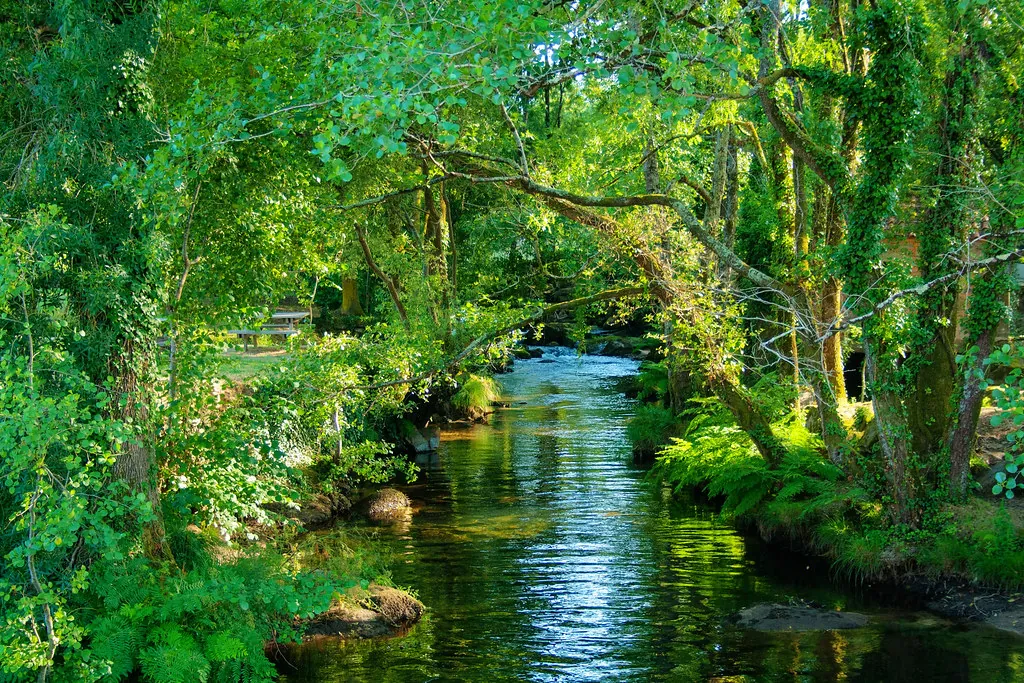
The granite calvary catches the mid-morning sun and throws it back in shards of quartz. Along the lane, iron gates the colour of bottle glass and faded Wedgwood click softly in the breeze. Somewhere a dog gives two half-hearted barks; closer, the Mouro river keeps up its low commentary, hidden by reeds. Pinheiros, population 319, moves to a pulse so deliberate that every face is already known by every other.
A 13th-century church, not a postcard
Igreja de São João Batista stands where the road widens just enough for four parked cars, not “among rolling fields”. Built between 1250 and 1280, the Romanesque doorway survives intact; the Baroque bell tower arrived only after the 1755 earthquake reminded villagers that granite also cracks. Sunday mass is at 11.30 sharp, said by a priest who drives over from Monção. The building is the parish’s sole National Monument—there are no others waiting to be discovered.
Vineyards you have to look for
Vines cloak 213 ha, yet they rarely dominate the view. Instead they appear as pocket-handkerchief plots tucked behind knee-high walls, parcels split again and again by inheritance law. At 55 m above sea-level the land is not hillside but a granite platform stepped by the Minho into narrow terraces. Most of the resulting vinho verde never leaves: roughly 60 % is drunk by the families who made it; the rest is sold to the Monção co-operative and disappears into bulk blends.
Beef that commutes
Barrosã and Cachena cattle do not graze here; they spend their days 40 km away in the Barroso and Peneda ranges. Locals buy the meat from Quinta de São Miguel on the EN202 (km 12) or from Monção’s municipal abattoir shop, O Monchique, at €14–16 a kilo. For festivals, neighbours form informal syndicates: half a steer is bought collectively, butchered in someone’s barn and divided by weight and kinship.
The school that lost its pupils
Thirty children, one hundred pensioners. The primary school closed its doors in 2009; now the yellow bus leaves at 7.45 a.m. from the stop outside Café O Cruzeiro and returns at 5.30 p.m. When winter rains swell the Mouro, the municipal road 1030 floods and the detour along the EN202 adds 15 km to the journey.
Holiday rentals are officially listed at four, but only two take guests with any regularity. Casa do Lagar (Rua da Igreja 32) offers three bedrooms and a granite kitchen for €80 a night; Quinta do Rio sits 2 km outside the village down an unpaved farm track—low-slung city cars need not apply. Book through Monção town-hall website or ring +351 251 650 080.
Days when the village swells
Two feasts redraw the map: 15 August, Nossa Senhora da Rosa, and 15 September, Nossa Senhora das Dores. Emigrants from Paris, Geneva and Luxembourg begin arriving three days early; by 6 a.m. on the morning of every festival every patch of shade already contains a parked Renault Scenic. Grilled sardines sell for €8 a plate; a plastic tumbler of local vinho verde is €1. The municipal sound-system must fall silent at 2 a.m.—a rule the councillor himself enforces with the master switch. By dawn the next day the wheelie-bins overflow; the refuse lorry needs two full runs to restore order, while the Mouro carries the odd drifting bottle downstream and deposits it on the first gravel bar 500 m away.