Full article about Copper stills, stone walls, alvarinho vines: Sago, Lordelo,
In Monção’s granite amphitheatre, three villages craft Portugal’s sharpest white wine
Hide article Read full article
Copper, stone and alvarinho: inside Minho’s smallest wine parish
Armindo Cerqueira lifts the lid and a coil of sweet, heavy steam rolls out of the copper pot. One by one, pear-shaped drops of aguardente slip from the swan-neck pipe into a clay jar. The still is the same one his grandfather bought in 1952: 180 litres of grape pomace per batch, an oak-wood fire, forty-five days’ work from first load to last spirit. Outside, the terraces of Sago drop towards the stream in irregular stone steps. Every dry-stone wall has a name and a birthday: Valado da Ribeira, built in 1874 by Joaquim Tavares; Penedo do Lobo, almost two metres high, standing since the 1872 phylloxera blight. Above them, 42 hectares of Alvarinho ripen on granite wires, enough to make this tiny place one of Portugal’s most specialised white-wine micro-zones.
Three villages, one granite amphitheatre
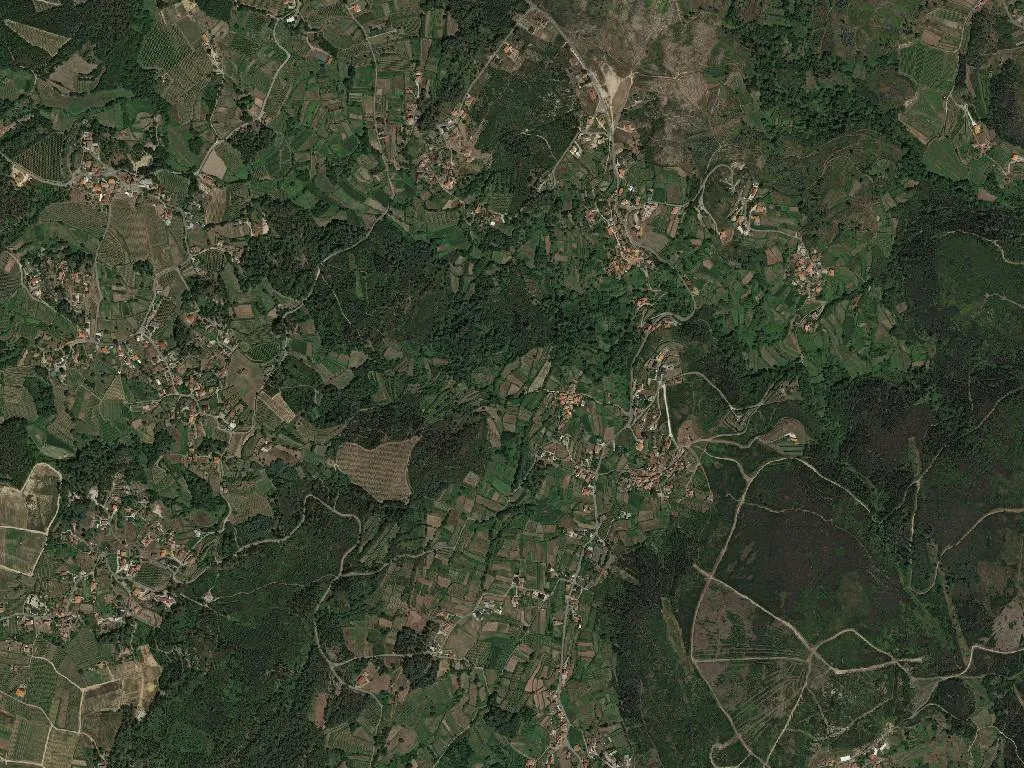
The civil parish of Sago, Lordelo and Parada was stitched together by administrative decree in 2013, but the geography had already done the job. Tilted south-west towards the Lima valley, the 833-hectare triangle is a single suntrap planted almost entirely to vine. The 2022 agricultural census lists 42.3 ha of Alvarinho, 18.7 ha of Loureiro and a stubborn 3.2 ha of table grapes for home consumption. At 203 m above sea level, the plots sit just high enough to catch Atlantic breezes that slow ripening and keep the natural acidity that Minho whites trade on.
Sago, the oldest settlement, appears in a royal charter of 1245 granted by Afonso III. Linguists link the name to sagum, the Roman military cloak—an etymology first floated in 1905 by the Portuguese philologist Leite de Vasconcelos. The parish church, rebuilt in the late 1600s, carries a gilded baroque retable carved by Braga woodworkers and a 1723 silver cloak offered to Our Lady of the Assumption by the local captain-major of Monção. Lordelo’s 1716 Chapel of Our Lady of Sorrows keeps an 18-panel azulejo cycle of the Virgin’s life; the cobalt blues still read clearly against the whitewash. In Parada, the chapel of Santo António was re-erected in 1867 after its tower collapsed, and inside stands Our Lady of the Rose, brought from Rio de Janeiro in 1890 by a returning emigrant. Her gold-embroidered silk dress cost 12,000 réis and travelled alongside a handful of jacaranda seeds—one of the trees still shades the chancel.
Harvest clocks and rye time
Grape-picking starts on the third weekend of September and follows a strict timetable. The Sago co-op receives fruit from 8 a.m. to 8 p.m., paying €1.85 per kilo for Alvarinho and €0.95 for Loureiro (2023 figures). Across the parish boundary in Parada, Manuel Pinto has trodden grapes barefoot since 1978: 200 kg per batch, two slow circuits of the stone lagar, ten minutes of what looks like a restrained waltz. Bread is governed by the same seasonal rhythm. Lordelo’s rye loaves use flour ground in Álvaro Gomes’s water-mill, turning since 1946; the dough ferments for 14 hours, then bakes in the communal wood oven at 4 a.m. on the first Tuesday of each month. The monthly fair—23 certified stalls, held on the first Sunday in Praça Dr Francisco de Sá since 1923—sells morcela blood sausage from black pigs, Cachena beef chouriço, 60-day-cured goat’s cheese and honey that has passed a strict formic-acid test. At O Cachena restaurant, Saturday demand peaks at 120 plates of rojões: 400 g of pork shoulder, two decilitres of white wine, a tablespoon of Goan paprika, onions grown three terraces away.
A 4.2-km ledger of stone and slate
The PR3 MON walking route, approved by the Portuguese Camping Federation in 2017, begins at an 1897 granite cross inscribed “VOTOS DE ANA MARIA 1897” and climbs to the São Lourenço lookout at 312 m. From the bench you can read the Lima valley like a map: the Roman bridge at Vila Meã, the Gerês ridge on clear days, the aluminium glint of the Minho motorway far below. A dry-stone packhorse bridge—3.8 m long, 1.2 m wide, mortarless, fourteenth-century according to a 1963 district archive file—crosses the Sago stream just before the 2.3 km mark. Beyond it, the Carvalhais calvary lost its arms in 1936 when the municipal road was widened; the axe marks are still visible in the granite base.
Festivals filed by date
15 August – Festa de Nossa Senhora da Rosa, Parada
Procession starts at 4 p.m.; women scatter petals of Rosa gallica grown in their back gardens since 1890. Brotherhood accounts for 1892 record “six arráteis of petals, cost 480 réis”.
Second Sunday of September – Nossa Senhora das Dores, Lordelo
Mass sung by the choir of S. Pedro de Rubiães, seven flower-covered biers, an evening concertina set by Zé da Eira in the old primary school (€5 ticket, onion soup included).
Easter Sunday – Encontro dos Santos
St Marcos leaves Sago, St Pedro leaves Parada; they meet at 11 a.m. on the N202 junction. The parish brotherhood, founded in 1854, still pays the priest’s stipend in cash: €20.
5–6 January – Cantar dos Reis
Eight men (“reisos”) tour the three villages with drum and reed flute. Households give €5, a bottle of wine, a corn rye loaf. The lyrics, transcribed in 1918, begin: “Ó minha menina linda / deixe-nos lá entrar…”
Spring at 14 °C
At Val da Lage, 600 m beyond the last house in Sago, a granite spout delivers water at a constant 14 °C, pH 6.2, 180 mg/l silica. In summer the spring fills 800 five-litre carboys a day. Before lifting the load, visitors sign the notebook left by Teresa Dias, who has minded the flow since 1997. “Água leve,” someone has written, “serve para o café e para o pão”—light water, good for coffee and for bread.