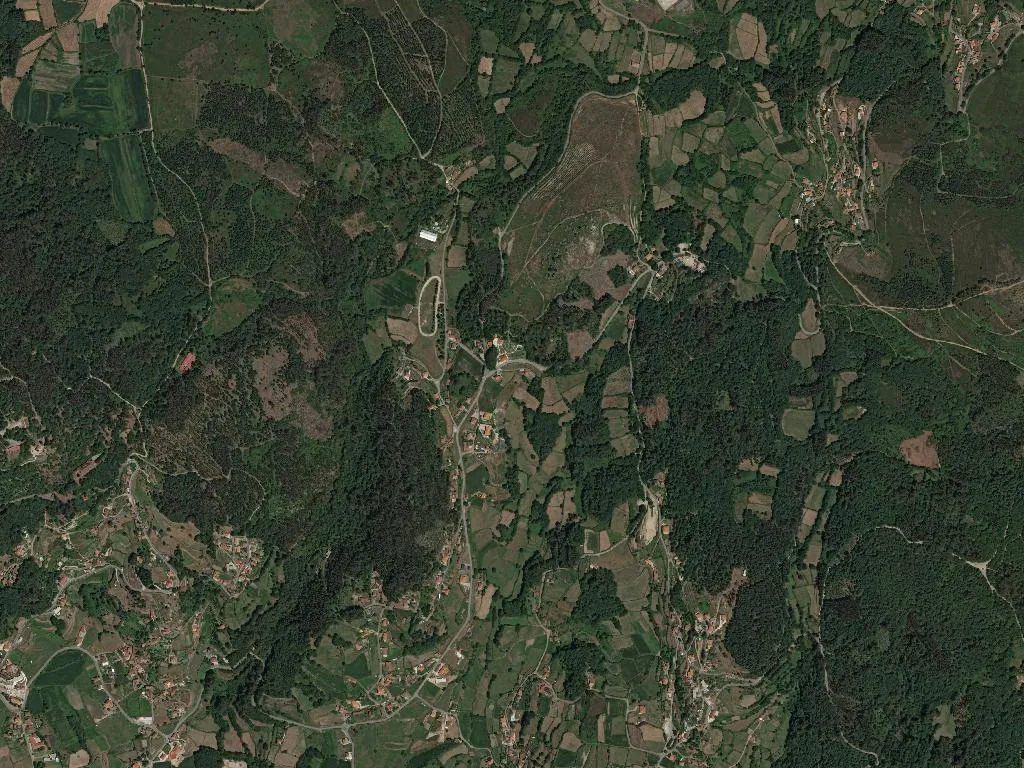
Full article about Padornelo: bells, vines & Atlantic-damp granite
Padornelo in Paredes de Coura is a mist-crowned Minho hamlet where chapel granite, Barrosã beef and eucalyptus-scented vines keep time by the harvest bell.
Hide article Read full article
The church bells do not keep time; they ring when someone dies or when the priest remembers to summon the faithful. At 428 m above sea level the air is more than fresh—it is Atlantic-damp, laced with eucalyptus resin and, on still evenings, the sweet smoke of pine cones hissing on hearths. Padornelo yields itself reluctantly: you must first climb the potholed lane, idle past the crossroads where an old woman sells runner beans from a plank-and-brake-pad stall, then feel the silky granite of the steps that rise to the thirteenth-century chapel of São Bento.
Six hundred and sixty-six hectares of hillside fold in on themselves, each slope christened like a member of the family—Couto, Carvalhal, Outeiro da Costa. Vinho Verde vines are not here for scenery; they are lashed with fencing wire and off-cuts of tractor cable, and the hands that train them are mapped with cuts, the knees swollen from kneeling. The harvest begins at seven sharp in September, the village oratory clock striking eight as mist lifts, and the scent of crushed grapes mingles with the sweat of backs that have been bent since first light.
The choreography of habit
Of the 412 souls on the parish roll, many now live behind nailed doors whose grandchildren only appear for August. Yet at dawn Sr António still shoulders his hoe and descends to his parcel of vines; at dusk D. Alice scatters maize and calls her hens home by name. One hundred and seventeen residents are over sixty-five, and they alone know the precise week to prune, how to cold-smoke a Barrosã flank so it never turns bitter, which wild sorrel will calm a stomach after too much caldo verde.
Barrosã beef never reaches a menu as a DOP badge; it is the steer Zé Manel reared on the high paddock, slaughtered in December and eked out through the year. The snowy fat became crackling, bones flavoured Monday soup, softer bones went to the dog. Sunday still demands a boiled dinner, though no one has four hours to watch the pot—pressure cookers hiss, and the table is laid.
Calendar of devotion
The Festa de Nossa Senhora do Livramento is fixed for 8 September, but cars begin nose-to-tailing in on Saturday night. Café Central sells bifanas for €2, the iron railings still bear the dent where last year’s teenage star of the bullring snapped his wrist, and the forcados of Vila Franca arrive by chartered coach. Returnees from France unpack Lindt chocolate, grandmothers swipe through phone galleries of toddlers in Lyon. It may pour or swelter, yet the marquee rises on the same churchyard where corn once dried in the sun.
Among the five places to sleep, three are granite houses willed by grandparents. Sr Joaquim kept his wood-fired bread oven; he bakes every Saturday—for himself, though a wedge is always left on the rack should a guest wander through. The Smugglers’ Trail skirts the garden wall, but today’s hikers meet no tobacco runners—only regimented eucalyptus where sweet chestnut once stood, boundary stones commemorating owners long buried.
At gloaming, when the sun slips behind the distant Marão and the kitchen of D. Lourdes glows gold, she still cranes out to see if the cat has returned. Silence is not the word; you hear the neighbour’s dog, the Antunes tractor changing gear up the lane, a high-altitude airliner threading the sky. Padornelo is not quiet—it is a place that amplifies whatever you have come missing.