Full article about Nogueira: bronze bells, walnut groves & Barrosã cattle
Feel Nogueira’s slow pulse: São Romão bell rings above River Vade, Camino arrows, August loaves & Barrosã cattle.
Hide article Read full article
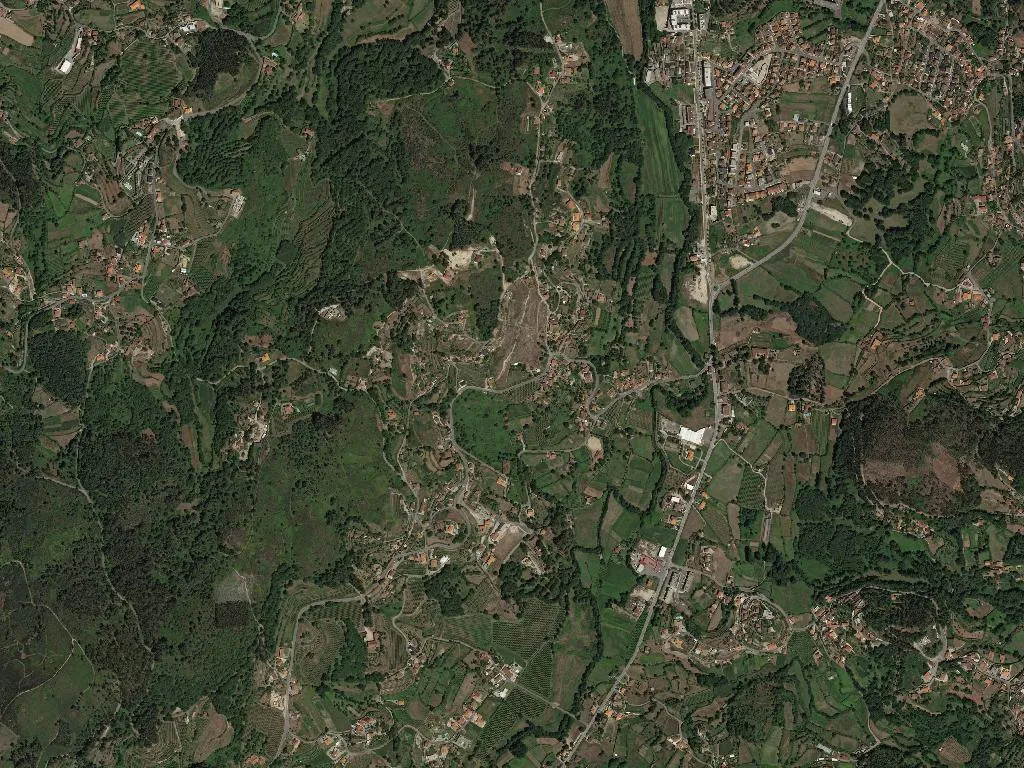
The scent of burning wood drifts through the damp air rising off the River Vade. At six o’clock the bell of São Romão strikes — a low bronze note that climbs the valley and dissolves among the chestnut groves. Nogueira sits only 94 metres above sea level yet feels altitude of a different sort: time is measured by what the land yields — grapes in September, the pig-kill in January, village fairs when the days stretch longest. Cattle of the Barrosã breed still graze the communal uplands, moving between scrub and stable as if the route were mapped in their blood.
Written in granite and parchment
The place first appears between 1085 and 1089 in Archbishop D. Pedro’s census as Sancto Romano de Nogaria. The Latin nucaria needs no translation: walnuts have always grown here as thickly as the stone walls. In 1190 the church was ceded to Crasto Monastery and for centuries its priests signed themselves “abbot”, a dignity granted to few rural parishes. Rebuilt in 1845, the parish church remains the only listed building for miles; its granite façade, softened by Atlantic wind and mountain rain, reads like a palimpsest where some family names still stand out while others have weathered to shadows.
Way-marked walls and the valley of forgotten mills
Nogueira is an overnight halt on the Portuguese Coastal Route of the Camino de Santiago. For four kilometres within the parish, yellow arrows and scallop shells are stencilled on schist walls with commendable urgency. The Trilho do Vade traces the river six kilometres downstream to a small sand-and-pebble beach, passing water-mills the bramble has reclaimed and winter pools where shy little grebes dive without a ripple. Westward the path climbs into Peneda-Gerês National Park; on the thermals above the common land griffon vultures wheel, assessing whether the thermals are worth the effort.
August: procession, brass band and blessed loaves
The first Sunday of August fills the chapel of Nossa Senhora da Paz with candlelight. Men shoulder the painted palanquin, women sing hymns in the same cadence they use for stitching at the doorway. In the churchyard a makeshift dance floor: vinho verde poured into thick glass tumblers, chouriço spitting on open coals, a concertina that never misses a beat. On 24 August, the feast of São Bartolomeu, the priest blesses bread and water at the church gate. At Christmas the liras—a wandering band of trumpets, snare drums and home-made mortars—shake the village awake; light sleepers learn to live with it.
Barrosã sirloin and Vade alvarinho
In the kitchen a cast-iron pot keeps the posta barrosã tender — steak from a heifer that grazed inside the national park, lightly pounded. It arrives with local white beans and new olive oil whose green bite still carries the sting of November milling. In the smokehouse, oak logs flavour the charcuterie; a well-stitched salpicão will keep until the almond trees bloom. Dessert is either airy sponge cake made with extra yolks or walnut biscuits dictated by grandmother memory. The alvarinho grown along the Vade is poured cool; its razor acidity scours the palate before a final measure of old aguardiente “burns off” the chill that drifts down the sierra at dusk.
When evening light strikes the terraced vines the hillside turns copper and gold. Beyond, the irrigation channel follows the slope like a rosary whose beads no one has forgotten to count.