Full article about Arca: Where Ponte de Lima’s Oldest Bell Still Tolls
Granite lanes, Baroque chapels and loureiro vines echo with 12th-century stories.
Hide article Read full article
The bell of Igreja Matriz strikes once — a low, deliberate note that rolls down the terraced valley of the Lima and dissolves in the dawn haze. Granite houses absorb the vibration, their walls the colour of weathered pewter, then release it slowly, like something half-remembered. It is Monday, and three kilometres away, in Ponte de Lima itself, stallholders are already scraping metal trestles across the river-side cobbles for the fortnightly market. Here in Arca, population 3,925, the day starts with a different metronome: wooden shutters flung open, a glance at the sky, a second glance at the vines. Large enough to sustain two rival cafés and a three-way parish-council feud, small enough that every dog recognises the engine note of every passing car, Arca measures time by ecclesiastical bronze rather than smartphone alerts.
Stone that predates the paperwork
The parish name appears in 12th-century foral charters, yet the schist-and-granite footings of many houses suggest Visigothic or Roman thumbs. Locals still argue whether “Arca” refers to a granary or to the stone coffins once placed along the medieval drove-road for travellers who failed to reach the bridge at Ponte de Lima. The present Igreja Matriz, consecrated in 1752 to Nossa Senhora da Boa Morte, is unmistakably Baroque: a warm, wheat-coloured façade carved from the same quartz-rich granite that keeps visitors guessing — “But it looks brand-new?” Inside, gilded woodwork climbs the walls in fractal bursts; outside, two smaller chapels, Senhor da Saúde and Senhor do Socorro, punctuate the lanes like devotional full stops, each commanding its own feast day and, conveniently, its own seasonal justification for an extra glass of loureiro.
Three feasts, three weather fronts
May ushers in the Festa do Senhor do Socorro when hawthorn is still in flower and the Lima runs high. By the last Sunday of August the Festa da Senhora da Boa Morte draws thousands of pilgrims who process behind a canopy of embroidered velvet, sweat and melted candle-wax perfuming the air. September belongs to the Festa do Senhor da Saúde, timed to the first Atlantic swell that scuds oak leaves across the roads. Every procession follows the same choreography: slow shuffle through lanes barely two arm-spans wide, a sung Mass, then fireworks launched from a council-owned field so close to the houses that windowpanes clatter in sympathetic applause. Mid-Lent adds the Entrudo burial, Arca’s answer to carnival: men in borrowed veils, women with drawn-on moustaches, the parish pretending not to recognise the godfather lurching behind the mock-hearse.
Platefuls with a postcode
Minho cooking was never designed for polite adjectives. Arroz de sarrabulho arrives the colour of mahogany, its sauce thickened with pork blood, cumin and a splash of red Vinho Verde; beside it, papas de sarrabulho — the same stew reduced until a spoon stands upright, the fuel that once sent field workers straight back uphill before the plates were cleared. Rojões à Minhota crackle in earthenware, demanding an immediate rinse of sharp, spritzy white Loureiro. The steak comes with a passport: Carne Barrosã DOP, from the long-horned, chestnut-coloured cattle that graze the Serra do Soajo. Custardy toucinho-do-céu and coconut-scented bolinhos de amor follow, so dense with egg yolk they make sense only after salt and iron have had their say, and only if the bica is short, fierce and anything but decaf.
A river that refuses to hurry
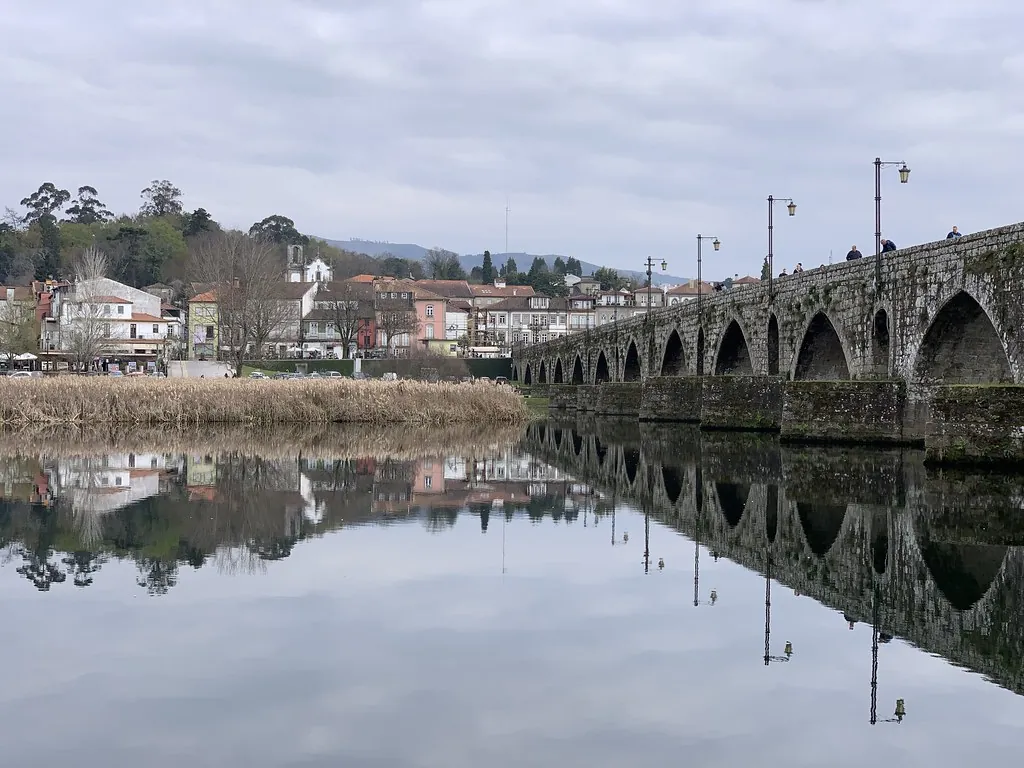
Arca’s palette is entirely green — not the gentle pasture green of southern England but an Atlantic, almost phosphorescent hue that flares or dulls according to the cloud ceiling. Terraces of maize and potatoes drop toward the Lima, whose surface slides so slowly it lures summer bathers into a mid-river current that has outpaced more than one confident swimmer. Two miles upstream, the Lagoas de Bertiandos e São Pedro de Arcos nature reserve protects a mosaic of fen carr and trembling bog, where Iberian emerald dragonflies stitch between alder trunks and marsh fritillaries rest on royal fern. Herons stand motionless until Senhor António’s Labrador announces every walker with operatic conviction. Sections of the Portuguese Coastal Camino thread through here; the recommended pace is whatever allows you to hear your own boot leather creak.
Granite’s late-afternoon gravity
At dusk the sun skims the ridge, stretching every wall into a long sundial. The air tastes of wet slate and woodsmoke, a combination that settles in the throat like the word “stay”. Seventy-eight beds are scattered among converted haylofts, manor houses that call themselves “turismo de habitação”, and spare rooms where the tariff includes a mother-in-law’s entire repertoire of 1953 gossip. What actually pins you to the valley, though, is subtler: the Lima’s unhurried hush, audible only when you stop moving — the acoustic equivalent of a friend who says nothing, yet never leaves your side.