Full article about Arcozelo: Where Lima River Loops & Vinho Verde Shines
Corn cobs turn on schist terraces, brass bands climb cobbled lanes, pilgrims cross Roman bridges.
Hide article Read full article
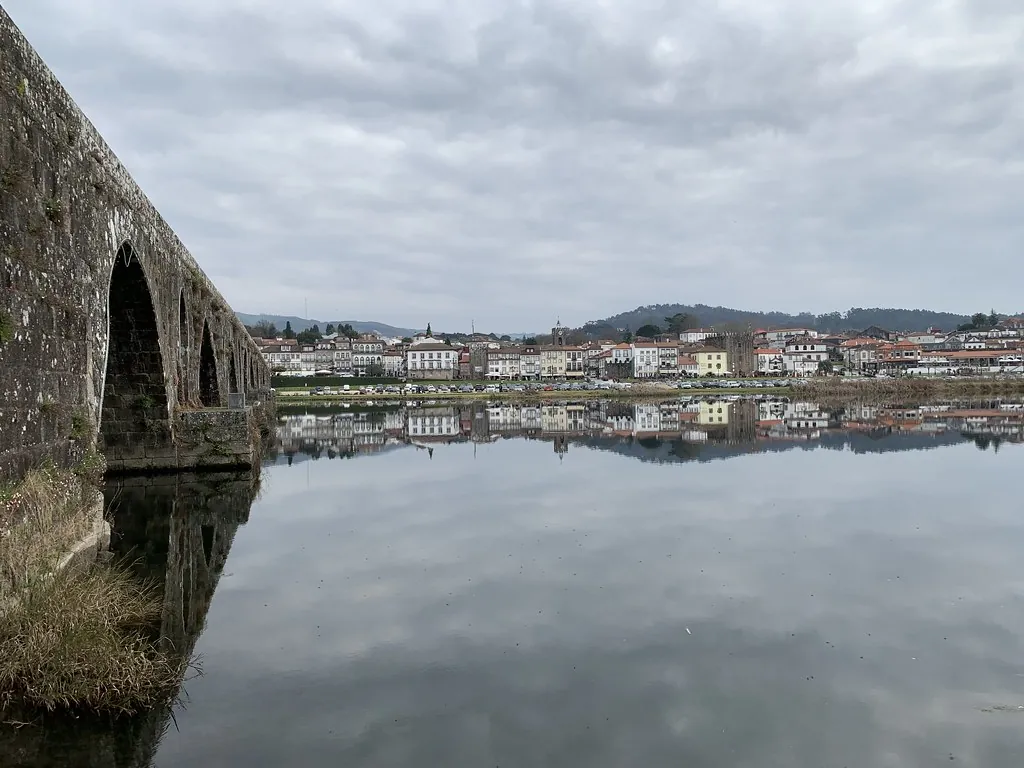
The Lima River completes a languid oxbow just upstream from Ponte de Lima, and on the outer, sun-lit bank lies Arcozelo. At only 85 m above sea level, the land exhales into wide hay meadows and low, schist-walled terraces of Vinho Verde. Dawn arrives sideways in summer, burnishing the maize rows and catching the trellis wires so that each vineyard seems laced with silver. Behind, the Serra de Arga lifts a granite spine against the sky, but here the valley floor is open, acoustic, generous.
3,562 people share twelve square kilometres, a ratio that still allows silence to settle between houses. The settlements — Calvelo, Facha, Gemieira — are separated by single-track lanes where granite posts mark old threshing floors. Corn cobs are spread exactly where they always were, turned by hand every hour so the sun evens the moisture. An ageing index (829 residents over 65, only 414 under 18) has not hollowed out the fields; you will meet a tractor before you meet a tourist, and wood-smoke rises at dusk when the bread ovens are lit.
Two Ways, One Crossroads of Faith
Arcozelo is stitched by two separate Santiago routes. The Central Portuguese and the Nascente both cross the parish, funnelling walkers from Ponte de Lima across low Roman bridges and past seventeenth-century stone crosses. Three annual romarias still reorder village time: Nossa Senhora da Boa Morte (late August), Senhor da Saúde (second Sunday in July) and Senhor do Socorro (May). Processions shoulder painted statues up cobbled gradients, the brass band keeping step, pilgrims arriving from the neighbouring concelhos to fulfil vows recorded in ribbon tails that flutter behind farmhouse doors.
A National Monument and a listed heritage building anchor the place without fanfare. The chapel of São Pedro de Arcos, its churchyard pocked by centuries of rain, once contained the Senhor do Socorro procession where, aged eight, I lost a leather sandal in the crowd and had to walk the last kilometre barefoot.
Between Lagoons and Loureiro
Two kilometres east, the lagoons of Bertiandos and São Pedro de Arcos form a Ramsar-classified wetland — a mosaic of reed-bed, alder carr and mirror-calm water where purple herons and glossy ibis stage late-summer feeding frenzies. Cyclists can reach the reserve in ten minutes on farm lanes that tunnel between hedges of fennel and wild plum. The same tracks thread the Vinho Verde sub-region of Lima, where Loureiro grapes ripen slowly under Atlantic influence. The resulting wine carries the razor-edge acidity that slices through the fat of Barrosã beef, a DOP breed driven down from the Serra do Soajo each week to the Lima market. In my uncle’s barn, the wooden corking press still smells of the first pressing each September — a scent of green apples and crushed stems impossible to bottle.
Logistics for the Curious
Arcozelo is not an adrenaline destination; it is an unhurrying addendum to Ponte de Lima, five minutes by car or twenty by bicycle along the river. Fifteen self-catering houses — stone cottages, modernist villas, a converted hayloft — rent by the week; none exceed two storeys, and most open onto vegetable gardens where guests are invited to pick tomatoes. Paths remain empty for hours, gradients are gentle, and the café in Gemieira serves a galão made with milk that left the cow that morning — the foam thick enough to coat a moustache.
Time here is agricultural, not digital. Autumn is the smell of crushed grapes bleeding through wicker cestos; spring is the hush after rain when soil steams; August is the crackle of drying maize leaves against your shins. At golden hour, when a distant tractor down-shifts and swallows stitch the air above the irrigation channel, Arcozelo simply asks you to notice — nothing more, nothing less.