Full article about Bertiandos: Where Lagoons Breathe Before Dawn
Wetland mirrors, pine-scented board-walks and three whispered pilgrim miracles near Ponte de Lima.
Hide article Read full article
Where the water draws the map
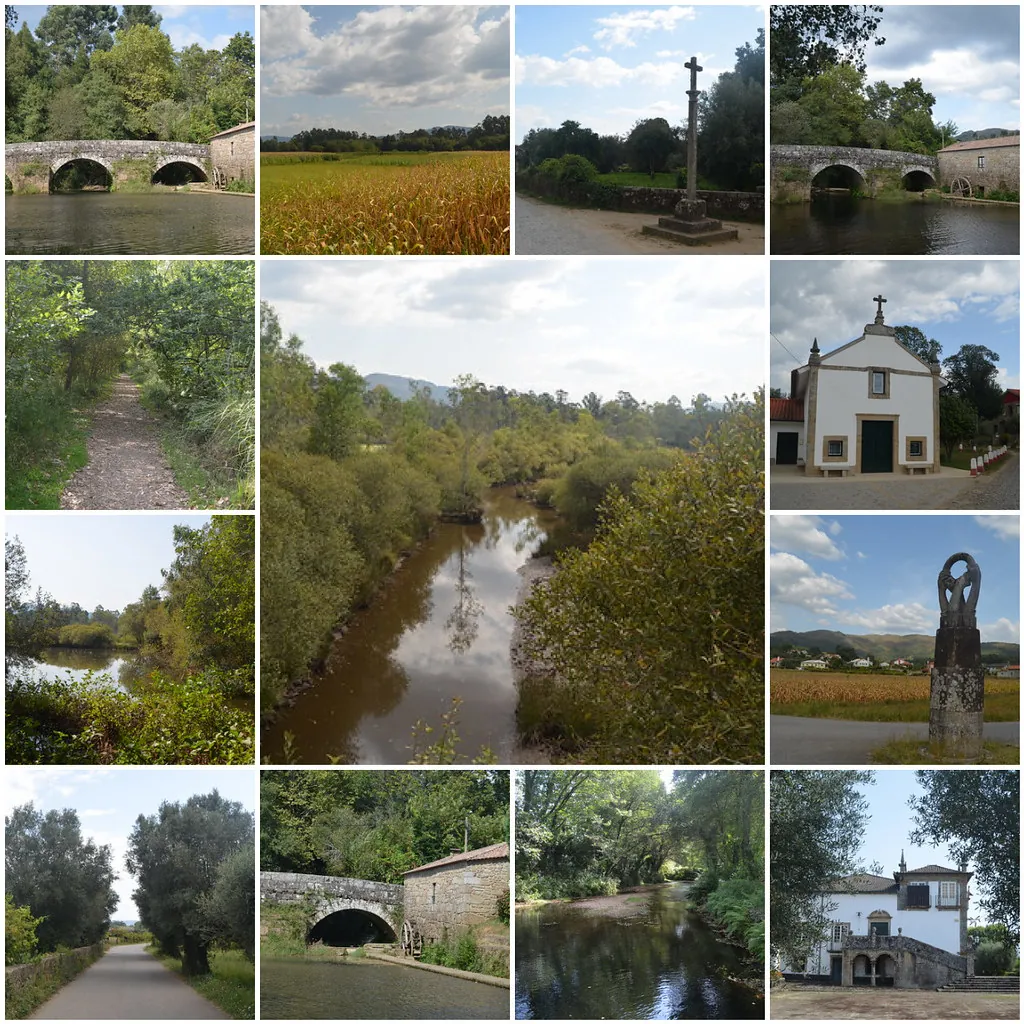
At 4.7 m above sea-level, Bertiandos is sketched by water long before cartographers arrive. Dawn doesn’t break over the lagoons—it kindles inside them, as though the surface itself struck the match. White poplars don’t mirror the sky; they pin it down by the roots. Silence has ballast here: even the heron’s dive lands like a held breath. Three hundred and sixty neighbours move to an invisible tide that registers not in the ankles but somewhere deeper, like the ache after a long day’s reap.
Where land forgets its own name
The 2 km board-walk that loops through the protected wetlands creaks when the barometer falls; sun-warmed pine boards feel momentarily alive. Beneath, the water smells of iron and bruised leaf. Dragonflies don’t dart—they hang like pause marks in a sentence you can’t quite finish. Clouds slide overhead and the lagoon darkens, warping your reflection into a stranger’s face.
Festivals arrive as warnings, not invitations. On the first Sunday of September the image of Nossa Senhora da Boa Morte is carried through lanes scented with hot wax and paper flowers. In July the procession of Senhor da Saúde pulls outsiders who leave brand-new shoes on the church step as thank-offerings. Senhor do Socorro is still shoulder-borne by four men who know, to the gram, how heavy a miracle is.
The crossing no one halts at
The Portuguese Coastal Camino skirts the edge of the village but rarely stops. Most pilgrims stare at GPS arrows; the few who linger are the ones who’ve mis-read the way-markers—the German with one leg shorter than the other, the Korean woman crying on a recycling bin. In the five houses with guest rooms, sheets smell of home-made soap and the faint sourness of laundry dried by the fire. Breakfast is yesterday’s loaf with foil-wrapped butter, but the coffee is tar-thick and correct.
There is no pub. There is the Capelinha—Dona Amélia’s front room. Knock and she’ll pour a measure of medronho fire-water from a green plastic demijohn. The television is permanently tuned to the news channel, volume permanently off.
Dusk that refuses to end
Sunset doesn’t gild the lagoons—it switches them on from below, as if someone wired LEDs into the silt. The smell of silt collides with wood-smoke drifting from supper hearths. Streets are empty, yet voices leak through granite walls—arguments over milk running out, grandchildren who never ring.
A black cat crosses the N202 with a rat still writhing in its jaws. A Spanish-plated hatchback pulls up beside the water, kills its lights, sits twenty minutes in darkness. When it leaves, a plastic cup remains on the verge. By morning it will be half-submerged, drifting toward the Atlantic no one here can see.