Full article about Calheiros: where granite drinks mist above the Lima valley
Stone hamlet breathes damp Vinho Verde air, keeps three quiet feasts and two Camino trails
Hide article Read full article
The sound arrives first
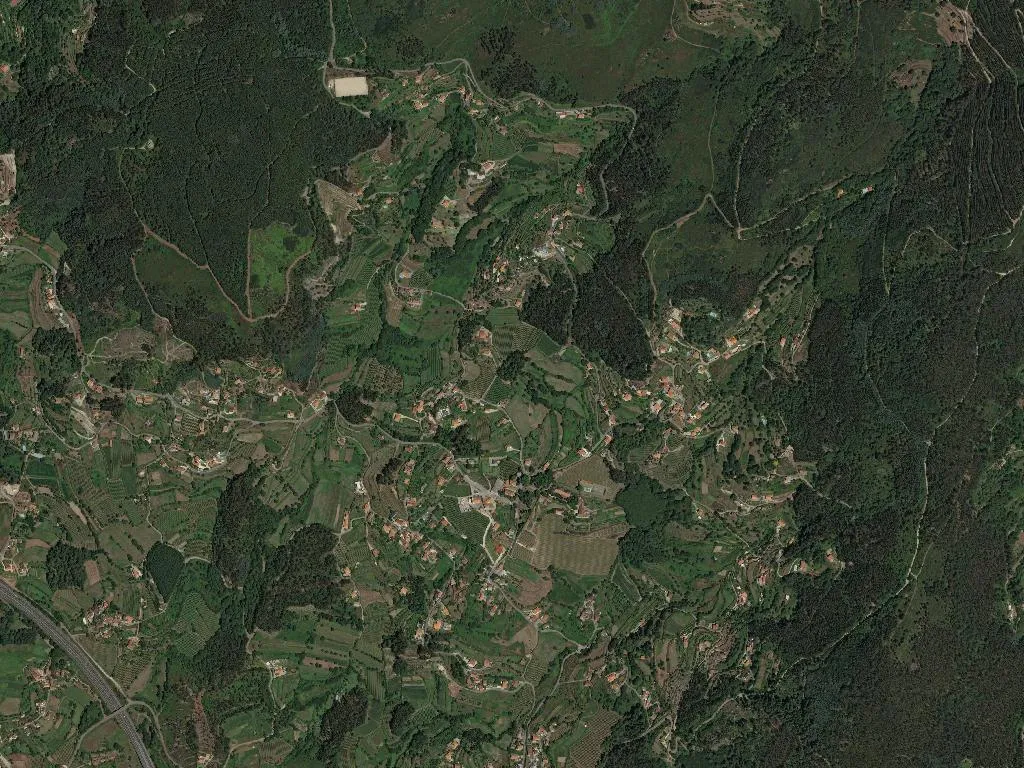
The sound arrives before the river comes into view: a low, constant hush of water moving under its own weight, even when no stream is visible. At 197 m above the Lima valley, Calheiros keeps that dampness in the air you feel when you open the washer mid-cycle. Granite walls store the chill of night until well after lunch; lay a palm against them and it’s like touching a bottle of water that’s been sitting in shade. Dirt tracks coil between low vineyards terraced in a hurry, as though someone stamped the steps in with their heel and walked on. Less than ten kilometres from Ponte de Lima, 930 people are scattered across 850 ha where the green of Vinho Verde dissolves into grey stone and brown earth.
Three feasts, three tempos
The church calendar still sets the metronome of the year. In May the faithful process for Nossa Senhora da Boa Morte; July belongs to the Lord of Health; September to the Lord of Help. None of these cairinhos balloons into the showy romarias of the Minho coast—no brass bands, no neon-stripe ferris wheels. Instead, neighbours check who’s coming, the way you scan a WhatsApp group before a christening. Demography mirrors rural Portugal: 130 children under 14, 196 residents over 65. No drama, just the arithmetic of a place where coffee left on the saucer goes cold before you remember to drink it.
Between the path and the lagoon
Two long-distance footpaths bisect the parish. The Central and the Nascente variants of the Camino Portugués climb north out of the Lima, rucksacks bobbing, trekking poles ticking against uneven granite. A handful pause at one of the eight registered guesthouses—usually the ones limping on blistered heels or the ones who’ve realised lunch was an hour ago. Most keep walking, leaving only boot prints and a pale wake of dust that the wind soon smooths away.
Four kilometres east, the protected wetlands of Bertiandos and São Pedro de Arcos provide the aquatic counterpoint. Although the boardwalks and observation hides sit officially in neighbouring parishes, the reed beds and seasonal lagoons leak into Calheiros like a neighbour’s cat that decides your kitchen is now its territory. On misty dawns the boundary between the cultivated and the wild turns opaque, as if you’re looking through bathroom glass.
Beef and vine
Barrosã beef—carrying the same DOP shield as the cattle that winter in Trás-os-Montes—appears on local tables, but the dominant crop is the vine. Rows of Loureiro and Arinto climb southwest-facing slopes, catching the afternoon Atlantic light that sparks the light, faintly spritzy whites of the Lima sub-region. Beneath the older houses, granite cellars stay a constant 13 °C year-round, a fridge that never needs defrosting.
The only listed monument—an Imóvel de Interesse Público whose precise name has slipped through bureaucratic cracks—stands somewhere along the lanes. It might be a chapel, a wayside cross, a manor house. Ask for directions and you’ll be told, “Oh, that old thing by Sr Armindo’s gate.”
A comfortable density
At 109 inhabitants per km² Calheiros is neither deserted nor packed. Houses are close enough for the church bell to reach every garden, far enough apart for each family to keep its own vegetable plot, smokehouse and tempo. Children still kick footballs on earthen squares; old men occupy stone benches beside chapels, watching hikers pass like a living channel-hop without the television. Late afternoon sun backlights the vines, and the place shows its quiet equation: water moves unseen under the soil the way direct debits slip through a current account; paths climb without urgency, the way you wander out for bread; cold granite under your palm stores the memory of everyone who planted, harvested, left—or simply stopped for an espresso and never found a reason to leave.