Full article about Correlhã: Where the River Neiva Won’t Stop Whispering
Granite mills, Roman bridge and cork-less hills echo silver-mined stories in Ponte de Lima’s riversi
Hide article Read full article
The soundtrack arrives before the scenery: the Neiva river drumming its fingers across granite, a looped lullaby that locals swear they no longer hear. In Correlhã the water talks non-stop—to the millstones that still turn, to the willows that lean in like eavesdroppers, to anyone standing on the single-arched Roman bridge at dusk. Some villagers claim they can’t sleep away from the noise; others need it to close their eyes.
Cork that never paid the rent
Textbooks trace the name to Latin corticea, land of cork. Truth is, the oak forests never fed anyone here. A 16th-century silver mine did brief, louder business—tunnels still riddle the hillside behind the football pitch—until the seam ran out and the adits were bricked up. Sundays you’ll see a retired teacher knee-deep in the river with a prospector’s pan, convinced glitter remains. “Like looking for coins in someone else’s coat,” laughs the barman at Café Neves, sliding across an espresso the colour of the absent ore.
Three chapels and a popularity contest
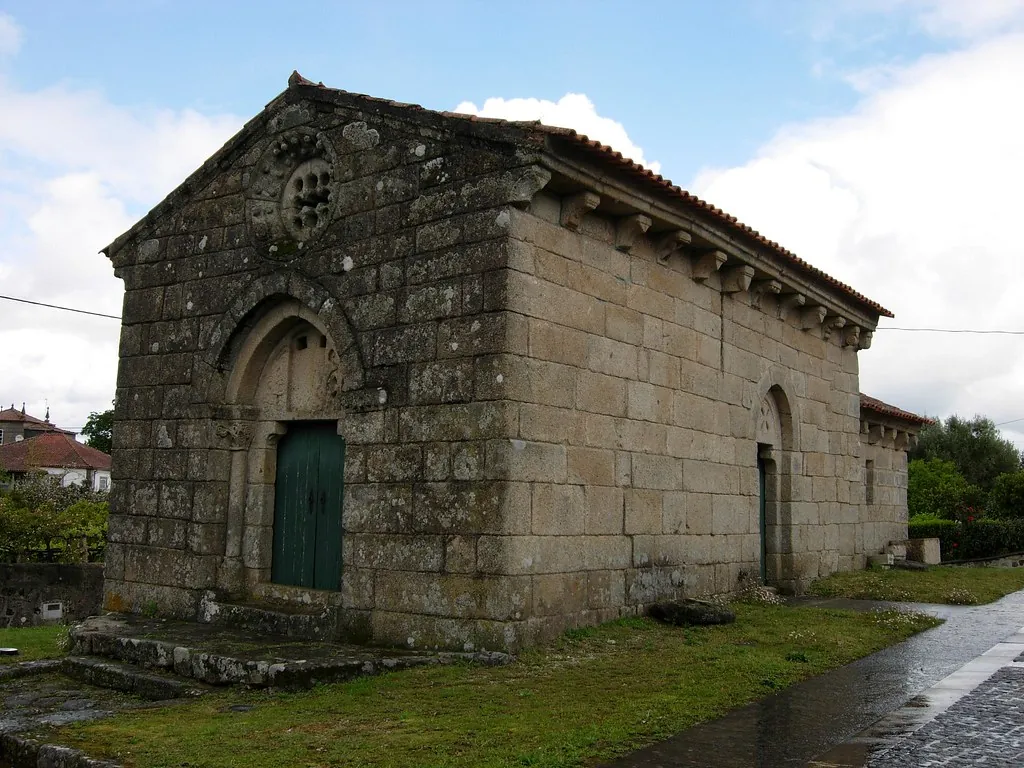
Nossa Senhora da Boa Morte, da Saúde, do Socorro—Our Lady of the Good Death, of Health, of Rescue—sound like a divine focus group. Each has her own day in the calendar, her own procession, her own cake stall. During the autumn bazaar the parish auctioneer—weekday job in the town-hall planning office—flogs hams and ewes’-milk cheeses with the urgency of a Christie's specialist. The mother church, granite and time-warp, keeps Iberian time: its bell tolls 29 seconds late, every hour, as if reluctant to hurry the day.
What lands on the table
Carne Barrosã, the region’s auburn-coated cattle, was prized long before Brussels handed it DOP status. Order rojões—cubed shoulder flash-fried with smoked paprika—and the pottery comes scarred sunset-orange. The wine poured alongside is loureiro, sharp enough to reset your palate after every bite. For feast days there’s arroz de sarrabulho, a dark, viscous rice stew thickened with pork blood and cumin; in winter, caldo verde appears, emerald shreds of garden kale bobbing with chilli-streaked chouriça. Dessert is toucinho-do-céu, literally “bacon from heaven”, a sugary slab of egg yolk and almond that dissolves before guilt arrives.
Where feet and faith converge
Two variants of the Camino de Santiago slice through the parish: the Central and the rarer Nascente. Pilgrims emerge from eucalyptus shade asking how far to the Spanish border, down a glass of tap water, march on. Locals prefer the loop up Monte São Simão—550 m of calf-burning schist track rewarded with a 270-degree sweep of the Neiva coiling like a slow thought towards the Lima. Beyond the ridge the Bertiandos lagoons lie hushed, a Ramsar wetland where bitterns boom louder than church bells.
Population 2,787, elevation 21 m, district Viana do Castelo—statistics miss the point. When the Atlantic northerly blows it carries the smell of wet earth and woodsmoke, the scent of primary school mornings. Rain or shine, someone is always watching the river pass, counting time in watery syllables.