Full article about Feitosa: Lima Valley’s Granite-Hugged Hamlet
Where Loureiro vines quilt the slopes above the silver Lima and pilgrims sip stone-cool water.
Hide article Read full article
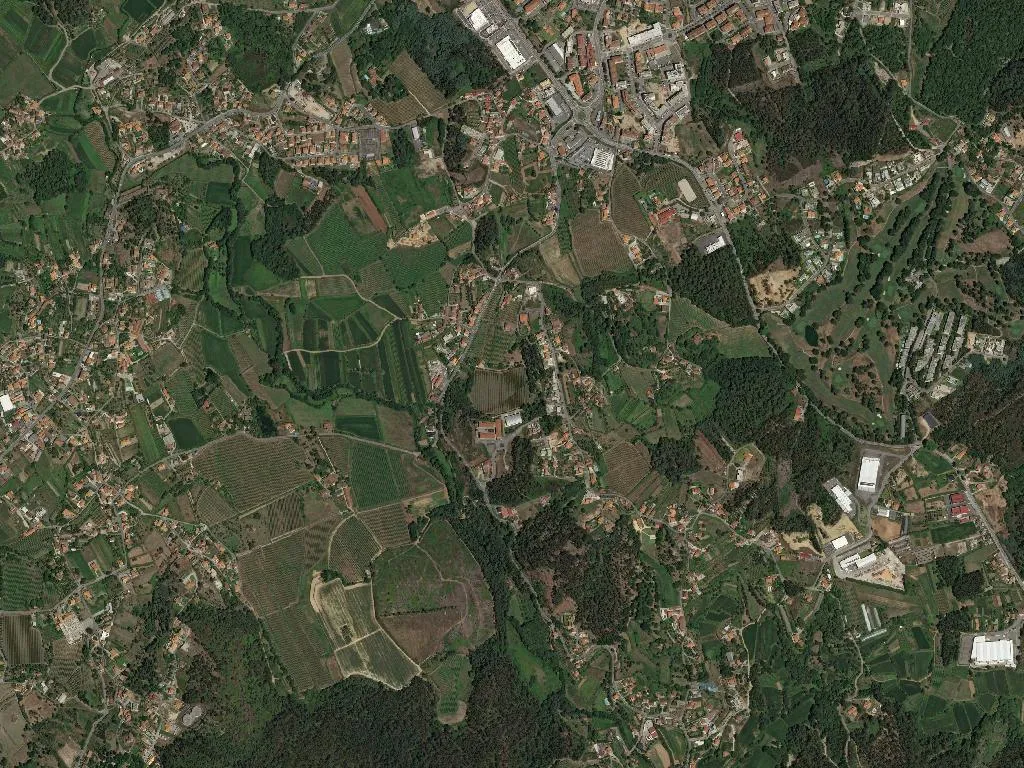
The granite of the church wall is still warm, as though it has just finished digesting yesterday’s sun. Feitosa rises only 45 m above the Lima estuary, yet the brow of the hill is enough to unwrap the river into a broad silver ribbon and to parcel the valley floor into tidy rectangles of Loureiro vines. Twenty-seven square kilometres hold 1,865 souls, two baroque chapels, three summer festas and a black cat known as “Bull” for reasons no one can explain.
Pilgrims at the fountain
Two variants of the Camino – the Central and the Coastal – slice straight through the village. Hikers arrive in blister-plastered sandals or neon trail shoes, but every one of them pauses at the granite fountain in the square: the last public spout for miles whose water tastes of stone rather than chlorine. There is no albergue, so those who linger sleep in spare rooms advertised on WhatsApp as “airbnb rural” by cousins who moved to Lisbon. Ask for a supermarket and you will be sent five kilometres down the N203 to Ponte de Lima’s Minipreço, advised to take a rucksack and a bottle – the road feels longer when you walk it sober.
What the calendar celebrates
15 August belongs to Nossa Senhora da Boa Morte – an alarming name for a procession of extraordinary beauty. The statue leaves the chapel, descends the main street, then loops back along the upper lane where ninety-year-old Rosa hands out water-and-salt biscuits to children. Later in the year come the feasts of Senhor da Saúde and Senhor do Socorro – the priest’s insurance policy, as he puts it, “because you never know”. By late afternoon the air is braided with incense and sardine smoke; plastic cups of sharp vinho verde change hands faster than the pall-bearers can keep pace.
Wetlands and wire-trained vines
For mirror-calm water without cow-trampled mud, drive ten minutes to the Bertiandos Lagoons Nature Reserve – boardwalks, kingfishers, and mosquitoes of championship pedigree. In Feitosa itself water is strictly for irrigation; everything else is given over to vines trained along galvanised wires. The concrete levadas mark parcel boundaries like pencil lines – each square has an owner, each owner a weather theory, a grape-price grievance and an opinion about the neighbour. The wine is bottled anonymously, yet in the café they can name the grower from the shade of the bagaço in your glass.
Who stays, who circles back
There is a nursery, a primary school, and a yellow bus that rattles older children to the secondary school in Ponte de Lima. At eighteen most decamp to Braga or Porto; a decade later many reappear, horrified by coastal rents, and convert the parental attic into a self-contained flat. Visitors arrive in October, when the vine leaves turn turmeric and the air smells of new olive oil. They leave behind cash and take away a label-less bottle – no VAT payable, swears the seller, “because it’s a gift”.
The day ends when the sun slips behind the wooded ridge of Lanhas and the first wood-smoke stitches itself into the sky. Someone waters the turnip patch, another bolts the hen-house, and Zé’s dog begins the night shift of barking. Feitosa has no curated soundtrack – just the slow creak of a bicycle, the river’s distant murmur and, at six tomorrow morning, a single tractor coughing itself awake. It is a sparse score, yet enough for those born here – and for the stray pilgrim who, by design or mistake, misses the turning back to the road.