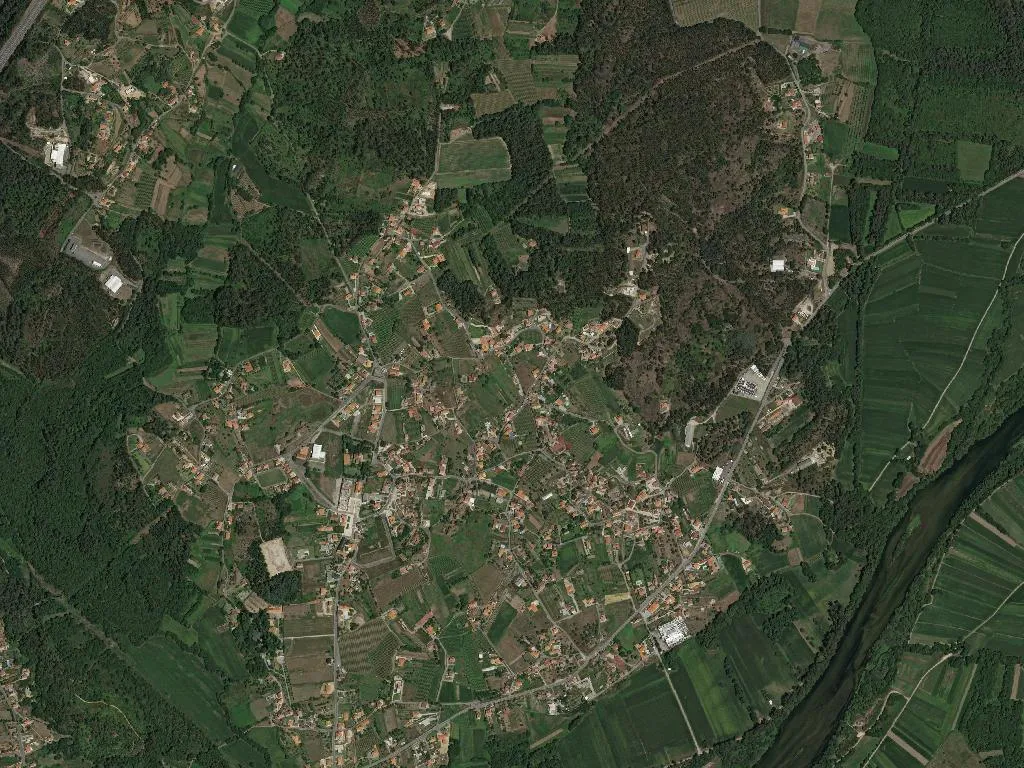
Full article about Fontão: Where the Camino Whispers Through Vineyards
Two Santiago routes braid this Lima-valley parish of silent churches, schist terraces and oak-shaded
Hide article Read full article
The sound of a wooden door
The church door of Senhora da Boa Morte groans on its hinges. Inside, lime-washed walls drink the silence as though they have been storing it since the 18th century. Outside, the vineyards slide downhill in disciplined ranks towards the Lima’s tributaries—every leaf a bright counter-note to the schist walls that box the plots. Even when the river itself is out of sight its weather lingers: a soft, Atlantic diffusion that silver-plates the green. Fontão never announces itself. It leaks into view—through elderly couples shuffling to the bread van, through the heel-printed dust of the pilgrims’ track that will, if you follow it long enough, deliver you to Santiago.
Two routes, one parish
Only a handful of places in Portugal are crossed by two separate arms of the Camino de Santiago. Fontão is one. The Central Portuguese and the Nascente weave through the parish like slow rivers of rucksacks, converging at the tiny crossroads by the chemist. Backpacks rest against granite curbstones; boots are eased off under oak shade. The land itself is shaped by this footfall—smallholdings sown to the edge of the path, wayside calvaries that serve as 3-D signposts, the constant hush of irrigation channels. At just 41 m above sea level the gradient is forgiving; muscles unclench, conversation stretches out.
Stone, faith and the calendar
Religious architecture keeps time here. Beyond the mother church stand two granite chapels—Senhor da Saúde and Senhor do Socorro—each the size of a modest sitting room. Their feast days map the summer: Senhor do Socorro in July, Senhor da Saúde in August, Senhora da Boa Morte on the first Sunday of September. Locals who have spent the year in Porto or Paris reappear, aproned and sun-hatted. Processions inch through the lanes, shoulder-borne biers rocking like slow metronomes. Afterwards the threshing-floor behind the primary school becomes an outdoor dance: long refectory tables, green wine in heavy glass, sardines spitting on makeshift grills while a brass band works its way through every polka in the repertoire.
What is eaten, what is drunk
Carne Barrosã DOP—meat from the shaggy, russet cattle that graze the Serra do Gerês—arrives as slow-roast shoulder or as rojões, the fat marbled so finely it melts into the rice. The same smokehouses that cure the region’s chouriço perfume the air with sweet chestnut wood. In the glass, the local Loureiro-based Vinho Verde is sharp enough to make the next mouthful of pork possible. Desserts obey the convent ledger: airy sponge (pão-de-ló), brittle cavacas shells, yolk-yellow custards that taste of saffron and confession.
Water, green and silence
Three kilometres east, the protected wetlands of Bertiandos and São Pedro de Arcos open like a secret lagoon. Fed by the Lima, the ponds draw purple herons, kingfishers and the occasional glossy ibis that has overshot the Tagus estuary. Boardwalks duck under willow tunnels and across mirror-still water where the only sound is the plop of a carp. Walk back towards Fontão and the terrain reverts to a patchwork of allotments, maize plots and oak coppice—horizontal, layered, nothing vertical to break the gaze except the distant blue thumb of the Arga hills.
What lingers
By late afternoon the low sun ignites the vines and the schist walls glow like embers. Somewhere a tractor ticks itself cool; somewhere else a cock is being needlessly honest. The wine in your glass tastes faintly of river stone. You realise Fontão has taken the measure of you—not with what it showed, but with what it withheld: the weight of granite, the patience of a vine that will not be hurried, the silence that settles between footsteps on a dirt road.